
Matrixyl® Neolide™ is Croda Beauty’s 2026 reformulation of its best-known anti-ageing peptide: the same palmitoyl pentapeptide-4 that built the Matrixyl® franchise in the 1990s, now carried inside a submicron lipid capsule that releases it into skin over roughly 15 days. The launch matters less for the molecule than for the delivery decision behind it — Croda has chosen to re-engineer how an established active reaches its site of action rather than introduce a new one. For brands and contract manufacturers, that is a different kind of ingredient story, and it changes what a claim like “peptide serum” can reasonably promise.
Key takeaways
- What it is: an encapsulated form of Matrixyl® (Palmitoyl Pentapeptide-4) held in a submicron-sized lipid capsule, supplied as a liquid dispersion.
- Principal: Croda Beauty (Croda Beauty Actives), announced 11 April 2026 and shown at in-cosmetics Global 2026 in Paris.
- Headline data (supplier-reported): peptide release sustained for up to 15 days, a 25% firmness improvement at two weeks, twice the effect of standard Matrixyl® on fine lines, and a 31% collagen III increase when paired with microneedling.
- Sustainability profile: 99.79% natural origin under ISO 16128, vegan suitable, TFA-free, RSPO compliant, and a 43% lower carbon footprint than the original Matrixyl®.
- The catch for formulators: Croda does not publish a use level, pH window or full study designs on its public page — those have to come from the technical data sheet.
What exactly is Matrixyl Neolide?
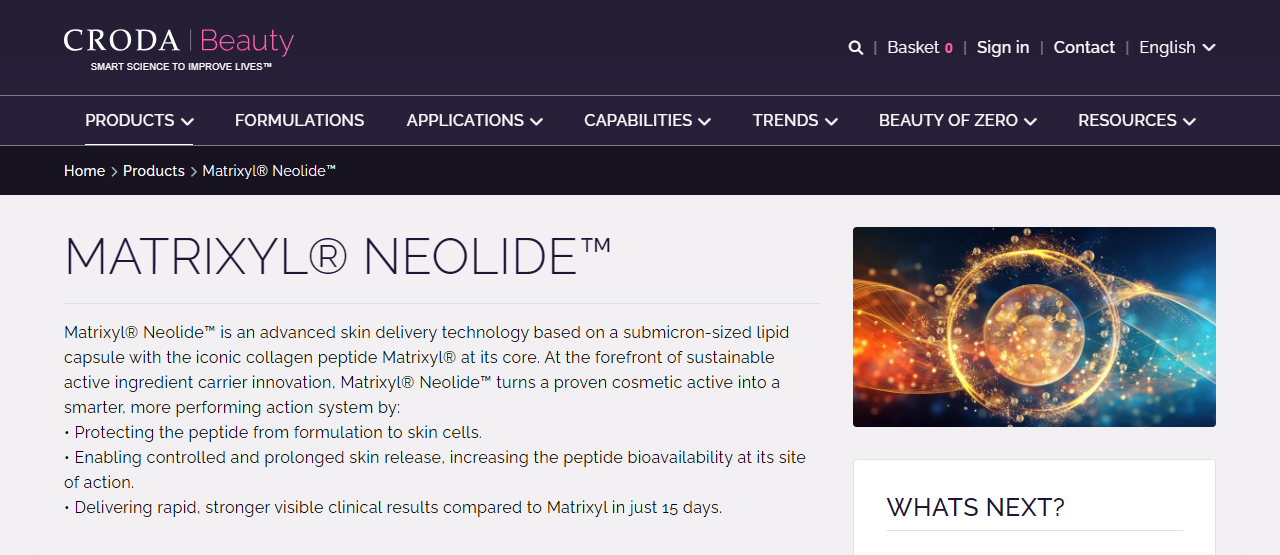
Matrixyl® Neolide™ is a delivery-engineered version of an existing active, not a new peptide. Croda describes it on its product page as “an advanced skin delivery technology based on a submicron-sized lipid capsule with the iconic collagen peptide Matrixyl® at its core.” The peptide itself is Palmitoyl Pentapeptide-4 — the matrikine-signalling fragment that has anchored Croda’s Matrixyl® range since the late 1990s and remains one of the most widely specified anti-ageing peptides in commercial skincare.
The full INCI listing is Water (Aqua) (and) Caprylic/Capric Triglyceride (and) Propanediol (and) Cetyl Palmitate (and) Lauryl Glucoside (and) Hydrogenated Phosphatidylcholine (and) Caprylyl Glycol (and) Palmitoyl Pentapeptide-4. Read that list as a specification rather than a label: hydrogenated phosphatidylcholine and cetyl palmitate are the capsule wall, caprylic/capric triglyceride is the lipid core, lauryl glucoside is the stabiliser, and caprylyl glycol is the preservation booster. It is, in other words, a pre-built liposomal system delivered as a liquid at 25°C, and the peptide is a minor component of what you are actually dosing.
Croda’s stated rationale is threefold: protect the peptide from the moment it enters the formulation until it reaches skin cells, release it in a controlled and prolonged way to raise bioavailability at the site of action, and lower the environmental footprint of achieving a given result. That framing places Neolide™ in the same conversation as other 2026 launches built on carrier innovation rather than novel chemistry — a pattern also visible in the AI-designed collagen III active BASF brought to market with Bota Biosciences, where the differentiator was how the protein was designed rather than what it was called.
What does the clinical data actually show?
Croda has published four headline figures, all supplier-reported and all worth reading with their conditions attached.
| Reported result | Comparator | What it does not tell you |
|---|---|---|
| +15 days of prolonged peptide release | Unencapsulated Matrixyl® | Whether release was measured ex vivo, in vitro or on human skin |
| +25% firmness improvement at two weeks (p<0.01 vs baseline) | Baseline, not placebo | Panel size, age range, instrument used |
| 2x greater effect on fine lines | Standard Matrixyl® | Whether both arms were dosed at equal peptide concentration |
| +31% collagen III (p<0.01 vs placebo + microneedling) | Microneedling alone | Needle depth, protocol, application timing |
The two-week firmness number is the one most likely to end up on a carton, and it is also the softest: a change against baseline is not a change against a placebo, and any well-formulated moisturiser moves firmness instruments over two weeks. The microneedling result is the more interesting one, because it is measured against placebo-plus-microneedling and therefore isolates the active. It also points at where Croda expects this ingredient to sell — the professional and post-procedure segment, where a 15-day release window lines up neatly with a treatment interval.
The “2 weeks remnant effect” Croda also cites is the claim brands should be most careful with. A residual effect after discontinuation is a genuinely useful property, but it is not a licence to imply that consumers can skip applications, and it is not the same as a 15-day dosing schedule.
What formulators need to know before specifying it
Encapsulated actives buy performance with handling constraints, and Neolide™ is no exception. The material is a liquid dispersion of lipid capsules, which means the capsule is the product — if processing destroys it, you have paid a premium for ordinary palmitoyl pentapeptide-4.
| Consideration | Practical implication |
|---|---|
| Form | Liquid at 25°C; a water-continuous dispersion, so it goes into the aqueous side of a formula. |
| Addition point | Standard practice for lipid-capsule systems is post-emulsification, at low temperature and low shear. Confirm the exact ceiling with Croda before scaling. |
| Use level | Not published on Croda’s public product page. Request the technical data sheet rather than assuming parity with Matrixyl® 3000. |
| pH window | Also unpublished. Phosphatidylcholine-based capsules are typically formulated in a mildly acidic to neutral range, but this must be confirmed, not inferred. |
| Stability testing | Capsule integrity is a separate question from bulk stability — a formula can pass appearance and pH while the capsules have already ruptured. |
| Applications | Croda lists face and neck skin care, eye contour care, and body care. |
That fifth row is the one that catches teams out. Encapsulation systems fail quietly: the batch looks and smells correct, passes its standard panel, and only underperforms once it reaches consumers. If you are commissioning this ingredient through a contract manufacturer, agree up front how capsule integrity will be evidenced across the shelf-life study — a point worth settling during the custom formulation phase rather than after the first production run, and worth writing into the stability testing protocol explicitly.
Why this launch matters for brands
Three things make Neolide™ commercially significant beyond its own sales.
It re-monetises a mature active. Palmitoyl pentapeptide-4 has been broadly available for years, and its price has fallen accordingly. By wrapping it in a patented carrier, Croda restores a premium and a defensible claim to a molecule that had drifted toward commodity status. Expect other principals to apply the same logic to their own legacy actives — the cheapest route to a 2027 launch is often a new delivery system around a known ingredient.
It rewards sustainability arithmetic. A 43% lower carbon footprint than the original Matrixyl® is a claim about efficiency, not about the peptide: if better delivery means less material for the same result, the footprint per finished unit falls. That reasoning is increasingly what EU and UK retail buyers want to see, and it gives brands something more defensible than an ingredient-origin percentage.
It pushes the professional channel. The microneedling data is not incidental. Actives that can be positioned in aesthetic clinics as well as retail shelves carry a materially better margin, and the 15-day release story is written for exactly that audience. Brands building toward a clinic-adjacent range should note that this positioning also raises the evidentiary bar — a claim made to a practitioner is scrutinised harder than one made to a shopper, much as it is when a brand takes on sensitive-skin claims in an OEM brief.
It is also the second Croda active in six months to be built around structural or delivery innovation rather than a new molecule, following Malvallin and its 3D-active skin-longevity positioning. That is a deliberate portfolio direction, not a coincidence.
What we could not verify
Every efficacy figure in this article is Croda-published and has not been independently replicated. Full study protocols — panel size, duration, demographics, instrumentation, vehicle controls — are not available on the public product or press pages, and no peer-reviewed publication on Neolide™ was locatable at the time of writing. Use level and pH range are likewise unpublished. We have not tested the ingredient, and this article is not a formulation recommendation; it is a market and technical read of what the principal has disclosed. Anyone specifying it should obtain the technical data sheet and supporting study summaries directly from Croda.
Useful links
- Croda Beauty — Matrixyl® Neolide™ product page (principal’s official page: INCI, claims, clinical figures)
- Croda — “Croda unveils Matrixyl® Neolide™, an iconic peptide with smarter delivery” (launch release, 11 April 2026)
- Personal Care Insights — launch coverage and executive comment
- Global Cosmetics News — reported significance values for the firmness and collagen III results
- ISO 16128 (the standard behind the 99.79% natural-origin figure)
Frequently asked questions
Is Matrixyl Neolide a new peptide?
No. The active is Palmitoyl Pentapeptide-4, the same peptide at the centre of Croda’s existing Matrixyl® range. What is new is the submicron lipid capsule that carries it, which Croda says protects the peptide in the formulation and releases it gradually in skin. If you are evaluating it, compare it against your current Matrixyl® grade on delivery and claim support, not on the molecule.
Can a brand claim 15-day results from it?
Not as written. Croda’s figure describes prolonged peptide release of up to 15 days, which is a property of the carrier, not a consumer-visible outcome over 15 days. The published visible-result claim is a 25% firmness improvement at two weeks. Any consumer claim still has to be substantiated on the finished product in the market where it is sold.
Does it work with microneedling?
Croda reports a 31% increase in collagen III when the ingredient is used alongside microneedling, measured against placebo plus microneedling. That is the strongest of its published comparisons because it isolates the active against a real control. The protocol details — needle depth, application timing, session frequency — are not public, so a brand marketing to clinics should request them before building a treatment protocol around the number.
What use level should we formulate at?
Croda has not published one. Do not extrapolate from Matrixyl® 3000 or other grades: the INCI here describes a dispersion in which the peptide is a minor fraction, so the dosing logic is different. Request the technical data sheet and the recommended addition temperature before costing a formula, since both drive the unit economics.
Is it suitable for a natural or vegan positioning?
Croda states 99.79% natural origin under ISO 16128, vegan suitability, TFA-free status and RSPO compliance. Those support a naturals-adjacent positioning, but ISO 16128 measures natural-origin index, not organic certification or any retailer’s clean-beauty list. Check the specific standard your retail partner applies before making the claim on pack.
For a contrasting 2026 launch where the novelty is the biological target rather than the delivery system, see Vytrus Biotech’s Toleroxyl™, a plant-made protein active aimed at immune tolerance in reactive skin.
A third variation on the same theme arrived in April 2026: Ashland’s eternight™ biofunctional, where the re-engineering is neither the molecule nor the delivery system but the measurement — a botanical extract whose efficacy headline rests on an AI facial scan.
Research period: August 2026. All efficacy and sustainability figures cited are as published by Croda Beauty and have not been independently verified by OEMHallmark. Screenshot of the Croda Beauty product page captured 6 August 2026. This article is independent editorial and is not a recommendation to specify or purchase any ingredient.