The Philippines has one of the densest small-batch cosmetics manufacturing scenes in Southeast Asia, and most buyers outside the country have never looked at it. Behind the rebranding boom on Shopee, Lazada and TikTok Shop sits a ring of licensed plants around Metro Manila: Cavite and Laguna to the south, Bulacan, Pampanga and Nueva Ecija to the north, and a cluster inside Quezon City and Caloocan. They compound, fill and pack under other people’s names, from a few kilograms of stock formula to retail-scale runs. This guide profiles eight of them. Every one was screened against the Philippine FDA’s own licence records and captured from its live website on 18 September 2026.
What makes the market distinctive for a buyer is the combination of a harmonised ASEAN rulebook, a very large domestic “rebranding” industry built on stock formulas, and genuine depth in whitening and brightening care, herbal and coconut-based formulations, hair and salon products, and halal-certified personal care. It is a serious option for brands selling into ASEAN, and an increasingly practical one for founders who need low first-order quantities.
Quick answer
The Philippines’ strongest OEM/ODM cosmetics manufacturers for outside brands include Refinette Cosmetic Manufacturing and A.M. Rieta Corporation for certified, full-service production at scale, Rainiers Research & Development Institute for herbal and halal-certified work, and Arkana Laboratories, Universal Skin Cosmeceuticals, Orsolab, Kosmetics Technologies and Z Lab International for stock formulas, toll manufacturing and smaller first runs. Cosmetics are regulated by the Philippine Food and Drug Administration under the ASEAN Cosmetic Directive: the plant needs a License to Operate and every product needs a notification before sale. Check both on the FDA’s public verification portal before you pay a deposit.
Key takeaways
- The FDA licence is checkable in seconds, so check it. The Philippine FDA’s public verification portal returns each licensed establishment’s activity (Cosmetic Manufacturer, Trader, Importer), address and validity date. Six of our eight returned an approved Cosmetic Manufacturer licence when we searched on 18 September 2026; the other two publish their licence numbers on their own sites.
- Validity dates matter more than logos. One licence on this list shows a validity date of 11 October 2026, weeks after our research date. A renewal may already be in progress, but a buyer signing a supply agreement should see the renewed licence, not a badge on a homepage.
- Stock formulas are the default entry point. Five of the eight publicly offer ready-made formulas for relabelling. That makes a first order cheap and fast, and it also means your product may share a base with other brands on the same marketplace.
- Published minimums are low by regional standards. Orsolab publishes 250 kg of bulk per SKU. Several others advertise “low MOQ” without a number, which means you must ask, and ask per component.
- The Philippines has three JAKIM-recognised halal certifiers. Malaysia’s January 2026 list of recognised foreign halal bodies names the IDCP, HDIP and HICCIP. Three manufacturers below claim halal certification; only one names its certifier on its own site.
Who this list is for, and how we chose
This guide is for brand owners, retailers and sourcing managers deciding whether a Philippine contract manufacturer belongs on their shortlist. That usually means a founder selling mainly into the Philippine market, a brand that wants an ASEAN-notified product without manufacturing in Thailand or Malaysia, or a retailer, hotel group or clinic looking for private-label capacity close to Manila. If you are comparing the Philippines with its neighbours, read it alongside our guides to OEM/ODM cosmetic manufacturers in Thailand and contract cosmetics makers in Indonesia.
Every company below had to clear four screens:
- It must hold a Philippine FDA licence as a cosmetic manufacturer. We searched each company on the FDA verification portal on 18 September 2026. A licence returned as “Cosmetic Manufacturer / Approved” passed. Where the portal’s name search returned nothing, we accepted a manufacturer licence number published on the company’s own website and labelled it company-stated. Companies with neither were excluded, however well known.
- It must openly offer third-party work. The company’s own site has to present toll manufacturing, contract manufacturing, private label or custom formulation to outside brands. Own-brand producers were excluded.
- Cosmetics or personal care must lead its catalogue. Several plants here also make household or cleaning products, which is common in the Philippines because the FDA licenses those under a related regime. We accepted them where cosmetics are clearly the main line.
- Its live website had to be captured cleanly on 18 September 2026 in a standard desktop browser window. Expired domains, firewall block pages and captures where a pop-up covered the hero were rejected rather than published.
We researched eighteen candidates from search results, third-party round-ups and the FDA portal itself. Fourteen resolved to a live website, eleven qualified on scope, and eight passed every screen. The numbering is alphabetical by company name, not a ranking. OEMHallmark does not score these companies against each other. Capacities, founding years and certifications come from each manufacturer’s own published material and are labelled company-stated where the FDA portal could not confirm them. No factory was audited and no sample was produced for this article.
The list at a glance
| Company | Plant | Best suited to | Main limitation | FDA licence check (18 Sep 2026) |
|---|---|---|---|---|
| A.M. Rieta Corporation | Kawit, Cavite | Full-service ODM across nine categories, incl. cosmetic drugs | Halal certifier not named on site | Portal-confirmed, valid to Sep 2027 |
| Arkana Laboratories | Cabanatuan, Nueva Ecija | Start-up brands using stock soaps and skincare | Licence validity shown as 11 Oct 2026 | Portal-confirmed |
| Kosmetics Technologies | Quezon City | Salon, spa and hotel hair and body care | Licence number in legacy format, not returned by portal search | Company-stated |
| Orsolab | Tanza, Cavite | Retailers, hotels and clinics needing toll or private label | Household lines share the plant | Company-stated |
| Rainiers R&D Institute | Caloocan, Metro Manila | Herbal formulations; IDCP halal | Dated website; broad non-cosmetic scope | Portal-confirmed, valid to Jan 2028 |
| Refinette Cosmetic Manufacturing | Guiguinto, Bulacan | Scale, soap and claim-substantiation support | No published minimum | Portal-confirmed, valid to Jul 2037 |
| Universal Skin Cosmeceuticals | Bacoor, Cavite | Choosing between toll, stock and custom routes | No certification beyond ASEAN GMP stated | Portal-confirmed, valid to Nov 2027 |
| Z Lab International | Santa Rosa, Laguna | Ready-made products for relabelling and wholesale | Interior web pages returned errors | Portal-confirmed, valid to Nov 2027 |
How cosmetics are regulated in the Philippines
Cosmetics in the Philippines are regulated by the Food and Drug Administration, under the powers set out in the FDA Act of 2009 (Republic Act No. 9711). Day-to-day cosmetics work sits with the FDA’s Center for Cosmetics and Household/Urban Hazardous Substances Regulation and Research. As an ASEAN member, the Philippines applies the ASEAN Cosmetic Directive: the same ingredient annexes, the same labelling requirements and the same ASEAN GMP guideline that apply in Malaysia, Thailand, Indonesia and Vietnam.
Two permissions matter to a buyer, and they are easy to confuse:
- A License to Operate (LTO) for the establishment. The manufacturer holds one as a Cosmetic Manufacturer. A brand owner who has products made by a licensed plant is usually licensed separately as a trader, and importers and distributors hold their own activity-specific licences. The FDA portal shows the activity against each licence, so you can see whether a company is licensed to make product or only to trade it.
- A Cosmetic Product Notification for each product. Every product must be notified to the FDA before it is placed on the market, in the name of the company responsible for it. The notification belongs to whoever filed it, which is why the question of whose name goes on the notification belongs in your supply agreement.
Enforcement has tightened on the online side. Since the Internet Transactions Act (Republic Act No. 11967) took full effect, manufacturers such as O.L.C. Cosmetics Manufacturing publicly advise clients that cosmetics sold on Shopee, Lazada and TikTok Shop need a valid FDA notification. For a brand launching through marketplaces, an unnotified product is not a paperwork gap; it is a listing that can be removed. From a process point of view, the harmonised annexes are the real advantage: a formula built to the ASEAN rules in a Philippine plant should need relabelling rather than reformulating for most of the region. Our guide on cosmetic product notification and compliance covers the general mechanics.
1. A.M. Rieta Corporation
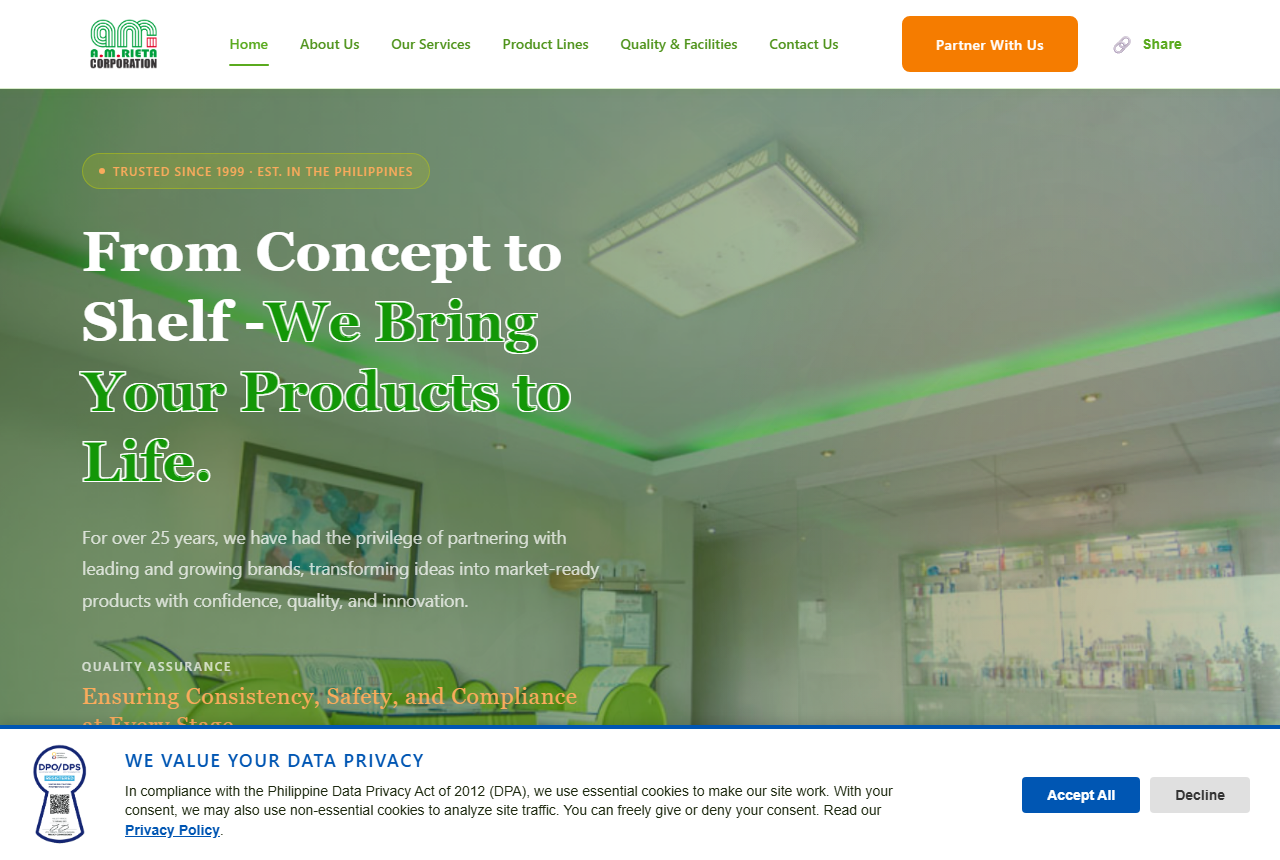
HQ: Kawit, Cavite · Type: ODM & contract manufacturer · Best known for: Broad personal-care ODM with ISO 22716 and cosmetic-drug capability
A.M. Rieta has been manufacturing since 1999 and describes itself as a full-service Original Development & Design Manufacturing partner. It states ISO 22716 cosmetics GMP certification since 2007, FDA GMP compliance and halal certification. Its nine product categories run from skin, hair, bath and baby care through deodorants and alcohol-based sanitisers to drug products, pet grooming and household cleaning. The FDA portal confirms an approved Cosmetic Manufacturer licence at its Kalayaan Road plant in Kawit, valid to September 2027, plus a separate importer/exporter licence and a drug-establishment record.
The drug licence is the part a process-minded buyer should notice. Products that stray into therapeutic claims, such as some anti-dandruff, antiseptic or medicated lines, move out of the cosmetics regime, and a plant already licensed for drug products can follow you there. The halal claim is company-stated and the certifier is not named on the homepage; ask for the certificate and its scope. The site’s data-privacy banner sat at the foot of our capture and did not cover the hero.
Visit A.M. Rieta Corporation →
2. Arkana Laboratories
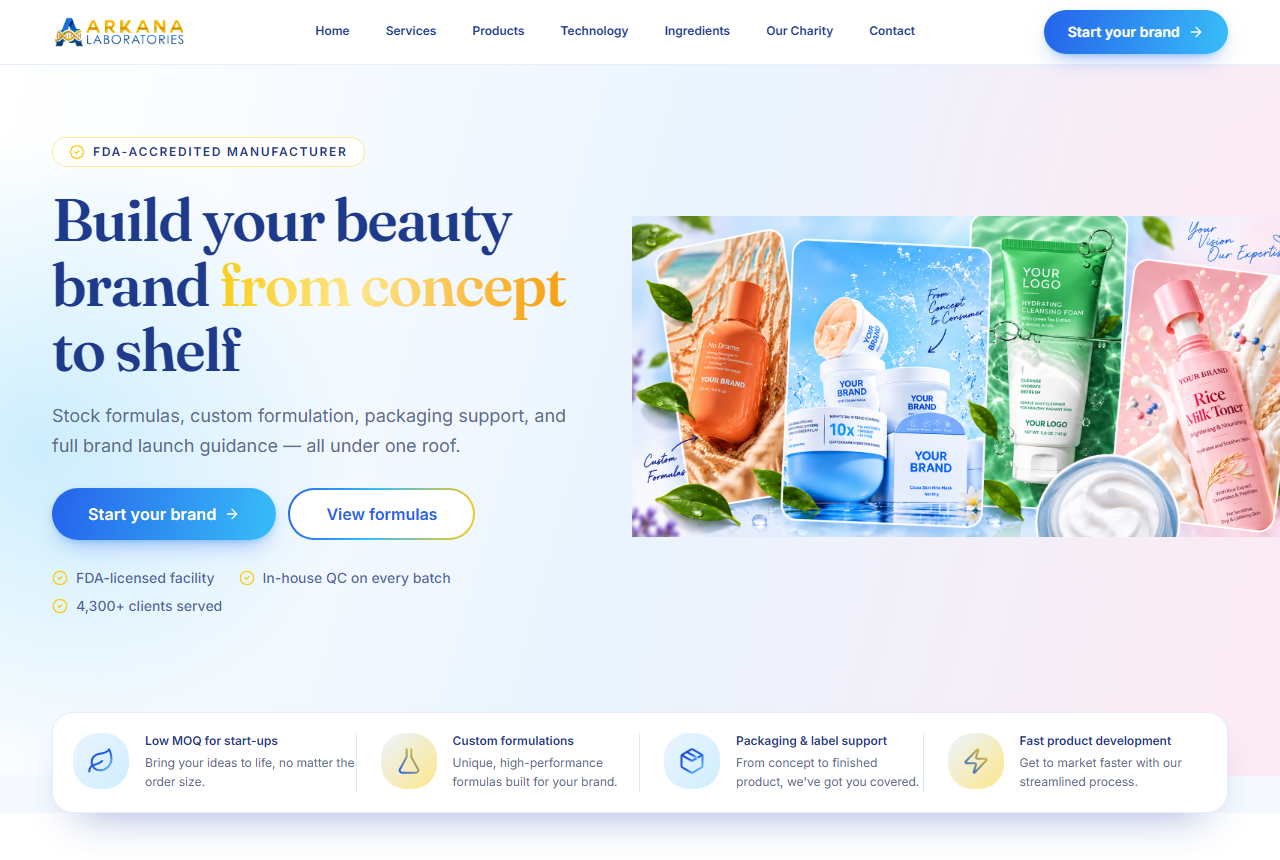
HQ: Cabanatuan City, Nueva Ecija · Type: Private label & custom formulation · Best known for: Start-up-friendly stock formulas, especially soaps and brightening care
Arkana Cosmetics Manufacturing, operated by 888 Dragonaire Corp., is the most start-up-oriented company on this list. Its site offers ready-to-brand stock formulas, custom formulation, packaging and label support, FDA documentation help for notifications and licences, and even sales-and-inventory software for small brands. It states it has served more than 4,300 clients and advertises low minimums for start-ups. Its showcased formulas lean towards soaps and brightening care: collagen, papaya, milk, tranexamic acid, vitamin C and charcoal variants.
The FDA portal returns two approved Cosmetic Manufacturer licences at its Champaca Street plant, both showing a validity date of 11 October 2026. That is almost certainly a renewal cycle rather than a problem, but it is exactly the detail a buyer should check: ask for the renewed licence before you sign. The other caution is structural. A plant serving thousands of small clients from a stock library is efficient, but a stock formula is not exclusive to you, so budget for customisation if differentiation matters.
3. Kosmetics Technologies
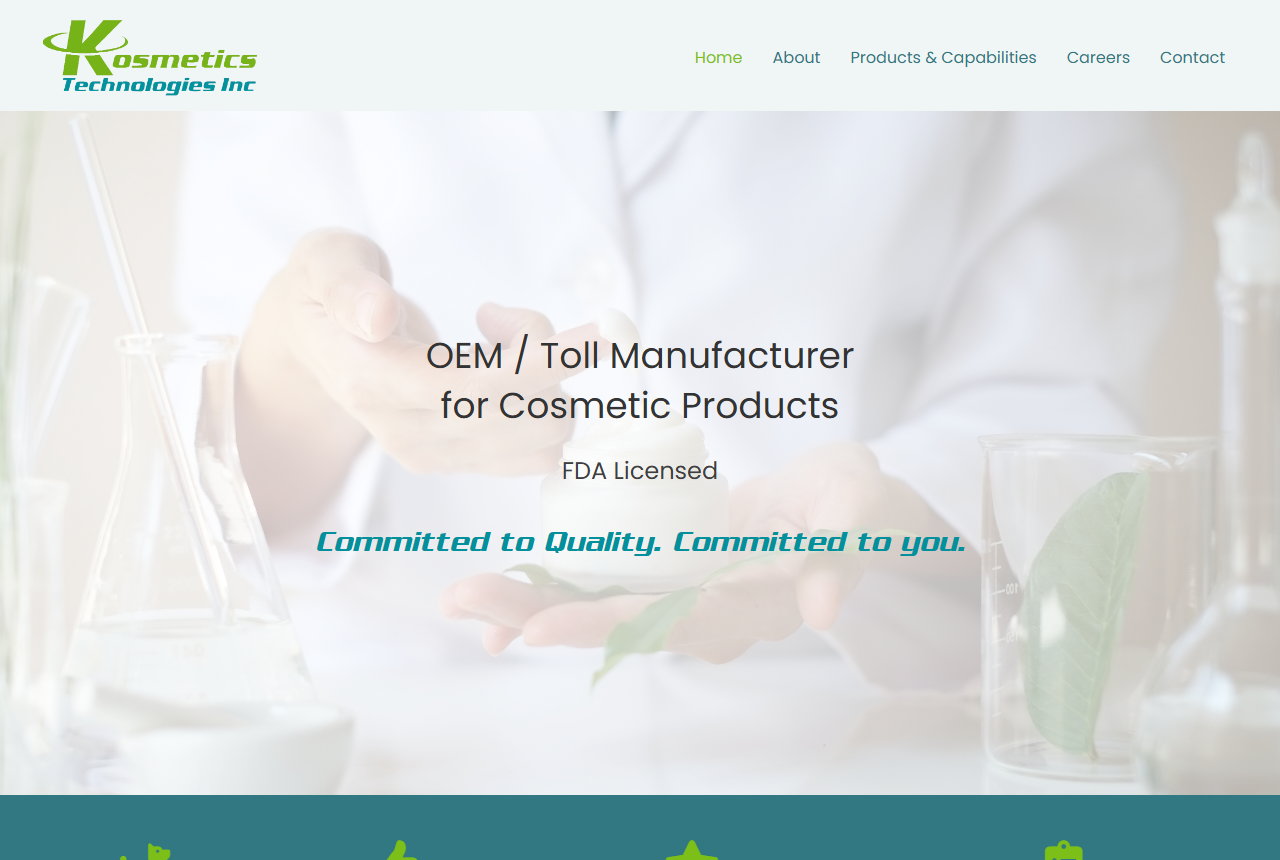
HQ: Quezon City, Metro Manila · Type: OEM & toll manufacturer · Best known for: Hair treatments and body care for salons, spas and hotels
Kosmetics Technologies Inc. states that its primary business is the development and toll manufacture of cosmetics for clients, and that it currently manufactures for more than twenty brands. Its process runs from concept and R&D through small-scale batches to scaled production, compounding, filling, labelling and QC. The capabilities list is unusually deep in hair care: keratin and argan treatments, hair spa, detox and mud masks, sulfate-free systems and styling products. It also covers hand, foot and nail care, facial creams and a short make-up line of liquid foundation, lip tint, BB cream and mascara.
The company publishes its licence as DOH-FDA No. CCRR-NCR-CM-0610, a legacy-format number that the FDA portal’s name search did not return on our research date. That is why it is labelled company-stated here. Ask for the current LTO and look it up yourself. For a salon chain, spa operator or hotel group, the depth of the hair and treatment catalogue is the reason to call.
Visit Kosmetics Technologies →
4. Orsolab
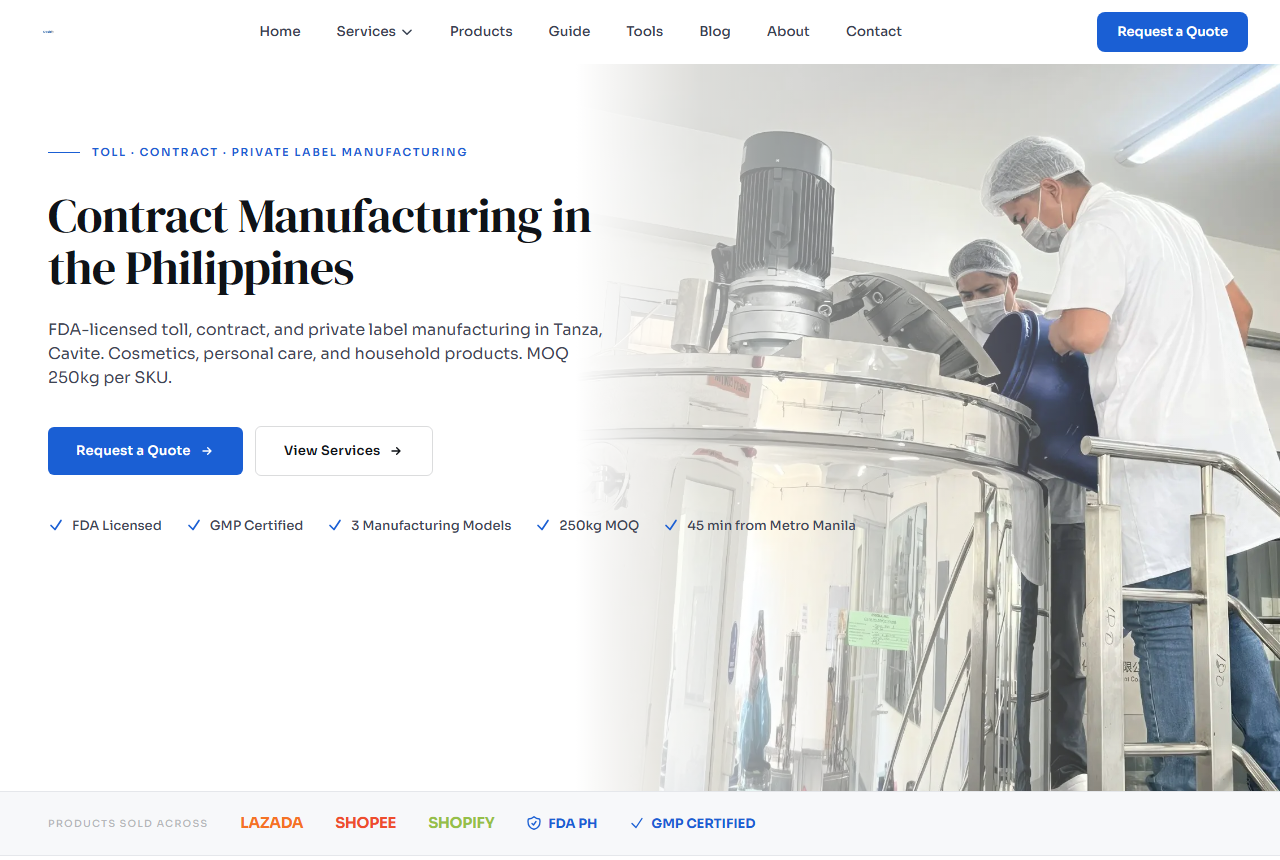
HQ: Tanza, Cavite · Type: Toll, contract & private label manufacturer · Best known for: A published 250 kg minimum and three clearly separated service models
Orsolab is the most transparent company on this list about how it works. It separates three models, toll (you supply materials), contract (it develops and runs everything) and private label (you brand its existing formulas), and publishes a minimum of 250 kg of bulk per SKU. Depending on fill size, that is roughly 1,250 to 8,300 units. Its cosmetics range covers serums, creams, lotions, sunscreens, anti-acne and whitening products, plus shampoo, body wash and feminine wash. It names retailers and grocery chains, hotels, aesthetic clinics and institutions as its target customers, about 45 minutes from Metro Manila.
It publishes its cosmetics LTO number, a separate household and urban hazardous substances licence, and states GMP certification after FDA audit. The portal’s name search returned no record on our research date, so the licence is labelled company-stated. The limitation is that detergents, disinfectants and fabric conditioner are made in the same facility. That is legal and common, but ask how compounding vessels, water systems and changeover cleaning are segregated between the two lines.
5. Rainiers Research & Development Institute
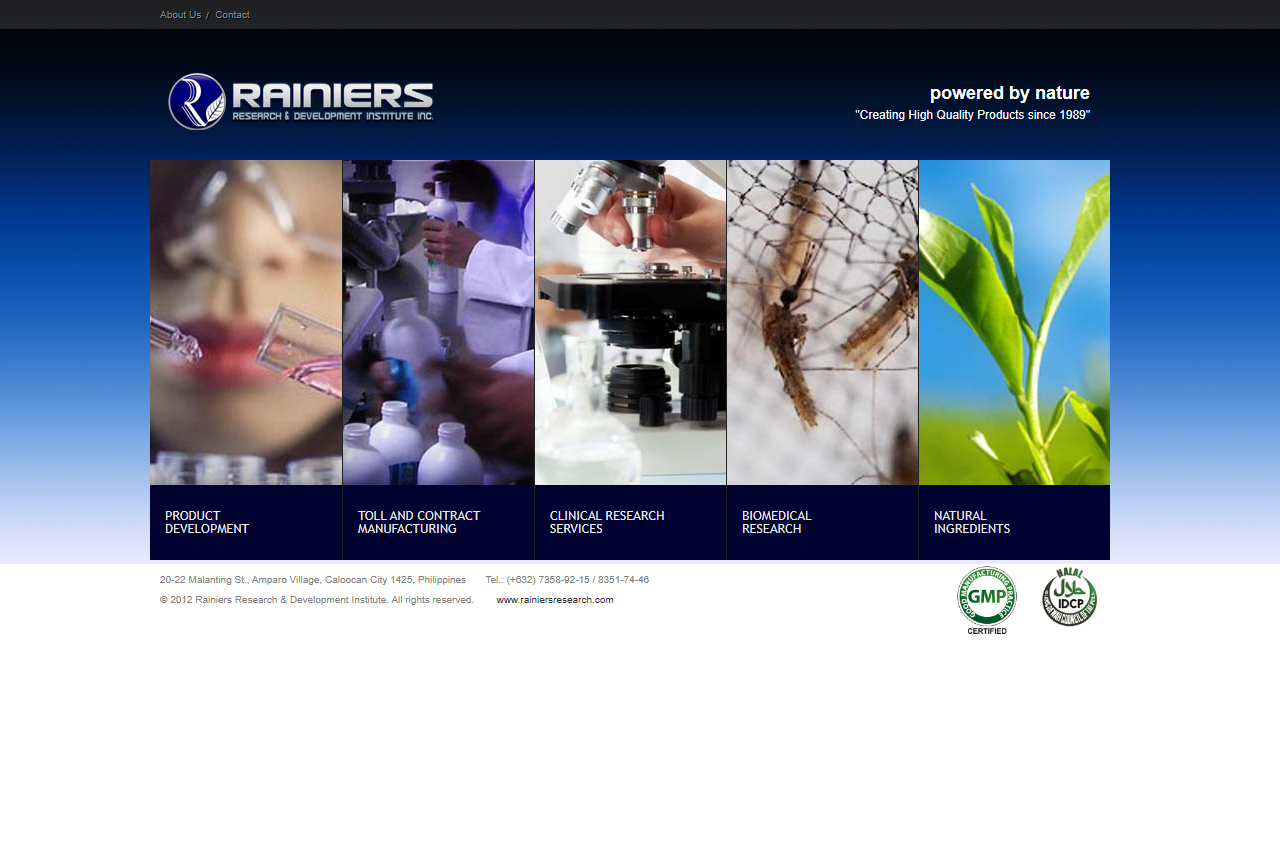
HQ: Caloocan, Metro Manila · Type: Product developer & toll manufacturer · Best known for: Herbal and natural formulations using Philippine plant ingredients; IDCP halal
Rainiers, a 100% Filipino-owned company founded in 1989, positions itself as a one-stop developer and toll manufacturer. Its speciality is formulations built on Philippine plants and minerals: lawat, gugo, akapulco, virgin coconut oil, calamansi, tawas and citronella. It states that its work was recognised at the 27th International Exhibition of Inventions in Geneva in 1999. It displays IDCP halal and GMP marks on its homepage, and says it obtained an FDA drug-manufacturing licence in 2022. The FDA portal confirms an approved Cosmetic Manufacturer licence at its Malanting Street plant, valid to January 2028.
Its published toll catalogue is detailed: shampoos with and without SLES and parabens, conditioners, toners, facial creams with sun protection, whitening lotions and even liquid foundation in shades described for Chinese, Malay and Indian skin tones. The IDCP is on Malaysia’s January 2026 list of recognised foreign halal bodies, which matters for export. The drawbacks are a website that has barely changed in a decade and a scope that also takes in pesticides and household products, so confirm which lines share equipment.
Visit Rainiers Research & Development Institute →
6. Refinette Cosmetic Manufacturing Corporation
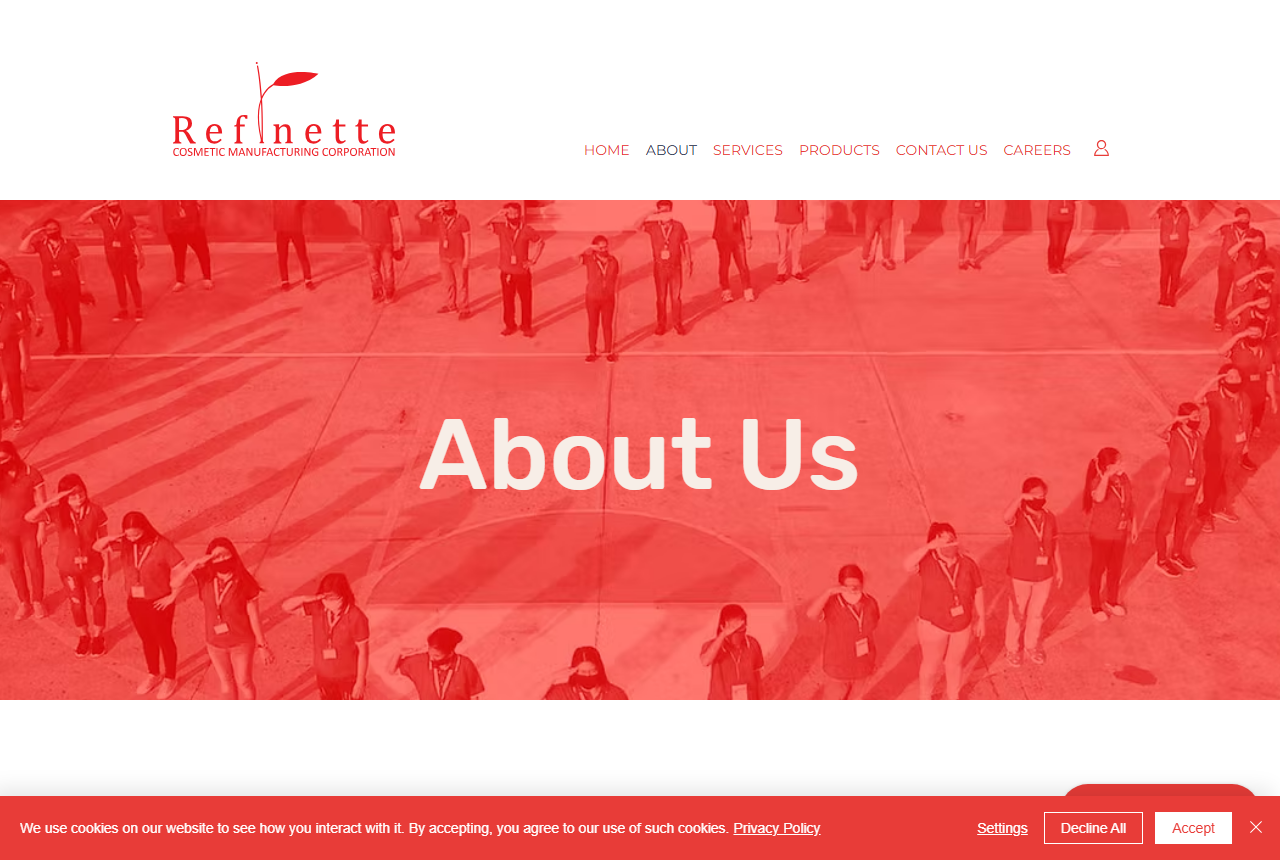
HQ: Guiguinto, Bulacan · Type: R&D-led contract manufacturer · Best known for: Scale, certification depth and soap capability
Refinette is the heavyweight here. It states 33 years in cosmetics manufacturing, more than 500 staff, its own fleet of delivery vans and trucks, and certification to both ISO 9001:2015 and ISO 22716:2007. It says it holds FDA licences as a GMP-certified cosmetic, food and drug manufacturer, and that it is halal certified. Its contract range covers transparent, plodded and opaque soaps; cosmetics as liquids, emulsions, serums, gels, creams, powders and colour; cosmetic drugs; and nutraceuticals. It also offers documentation help and product-claim substantiation, which few smaller plants mention.
The FDA portal returns approved Cosmetic Manufacturer licences at its Old Tabang Road plant valid to July 2037, the longest horizon on this list, together with food and drug records. For a brand planning retail distribution, the combination of scale, claim support and a long-dated licence is the strongest profile in the country. The trade-off is that it publishes an “economical MOQ” without a figure. Its homepage slider did not render in a headless browser, so we captured its About page instead.
Visit Refinette Cosmetic Manufacturing →
7. Universal Skin Cosmeceuticals
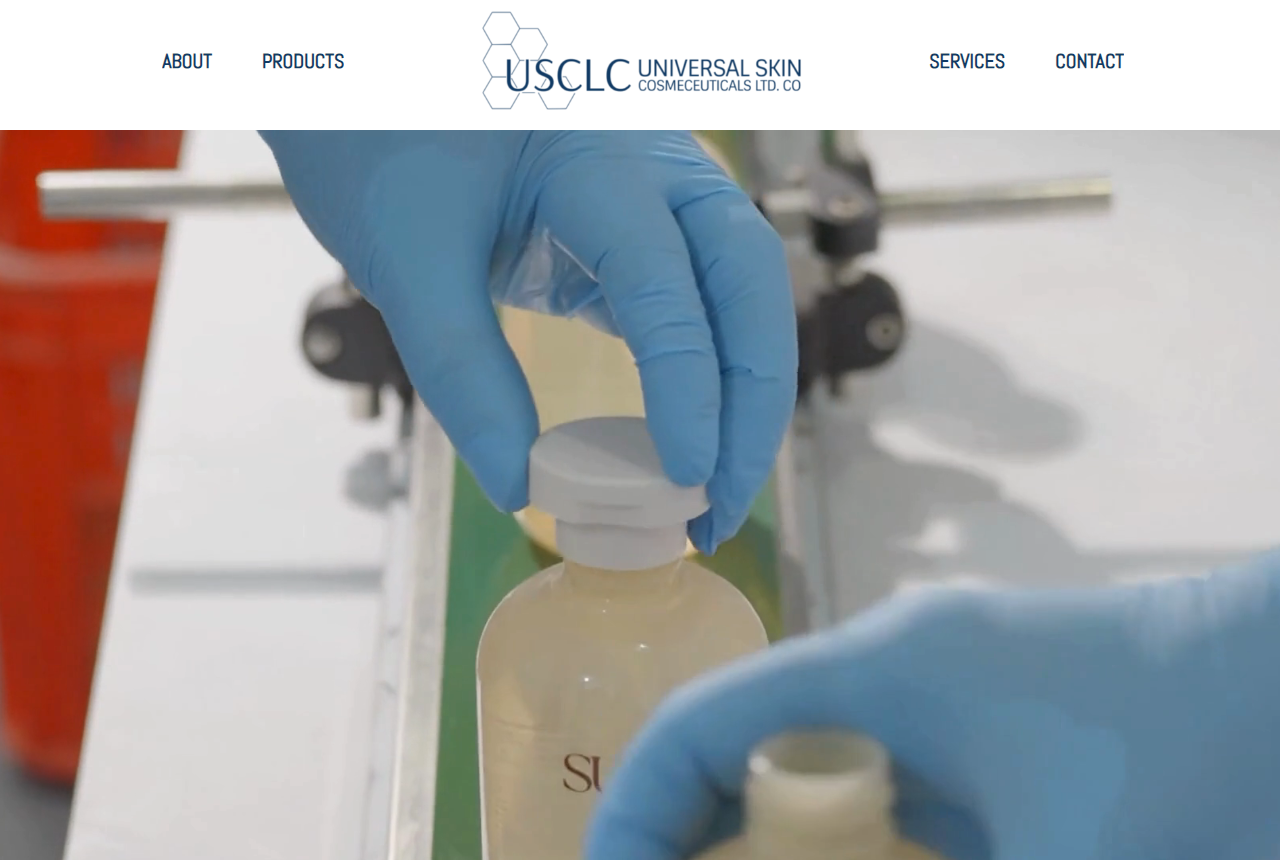
HQ: Bacoor, Cavite (office in Makati) · Type: Contract & private label manufacturer · Best known for: A clear menu of toll, all-in, stock and custom routes
Universal Skin Cosmeceuticals Ltd. Co. (USCLC) states that all of its products are made under the ASEAN guidelines for cosmetic GMP and Philippine FDA rules. It spells out its routes more clearly than most. Toll manufacturing, where you supply ingredients and packaging. An all-in service covering raw materials, QC, pilot batches, packaging development and graphic design. Hundreds of stock formulas with low minimums. And custom formulation from scratch or from your existing formula. It also offers help with FDA registration and product notification, and its scope extends to pet care and household products.
The FDA portal confirms an approved Cosmetic Manufacturer licence at its Molino II, Bacoor plant, valid to November 2027. The company’s stated ambition is to become a leading manufacturer in the ASEAN region. That framing suits a brand planning to notify the same product in more than one ASEAN market. It does not publish certifications beyond ASEAN GMP compliance, so ask directly about ISO 22716 and halal status if you need them.
Visit Universal Skin Cosmeceuticals →
8. Z Lab International
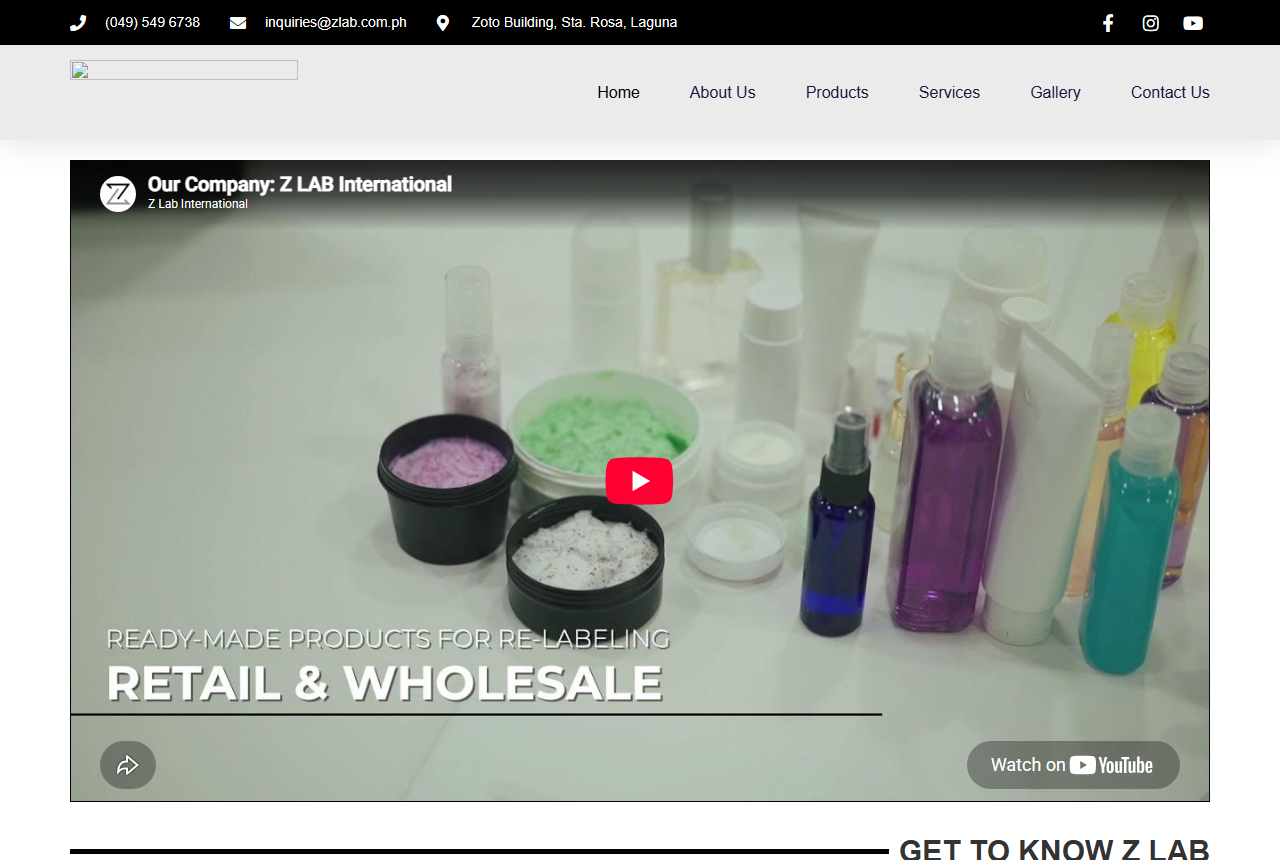
HQ: Santa Rosa, Laguna · Type: Manufacturer, ready-made relabelling & development · Best known for: Ready-made products for relabelling, retail and wholesale
Z Lab International describes itself as a full beauty and personal care manufacturer, offering sourcing, formulation, raw material procurement, manufacturing and product development. Its homepage leads with a video on ready-made products for relabelling for retail and wholesale, so it suits a reseller or retailer who wants stock product quickly. The site gives both 24 and 29 years of experience in different places. The FDA portal confirms an approved Cosmetic Manufacturer licence for Z Lab International Corporation at its Zoto Building plant in Santa Rosa, valid to November 2027.
Z Lab qualifies because the licence and the homepage check out. But its About and Services pages returned “page not found” on our research date and the logo did not load in our capture, so there was little published detail to verify beyond the homepage. Ask for a capability deck, a facility tour and reference products before shortlisting. The Laguna location is a practical plus for brands using the southern industrial corridor’s packaging suppliers.
Notable exclusions: who we looked at and left out
Several of these companies appear in other Philippine round-ups, so the reasons matter:
- LeiaPure Cosmetics Laboratories Manufacturing Corp. (Quezon City): a genuine full-cycle private-label business with a clean website, thousands of stock formulas and dozens of products notified under its own name. It was excluded because the FDA portal returned no Cosmetic Manufacturer licence under its name and its site does not publish one. It may operate under a differently named licensed entity; if so, ask it to show you that licence.
- Beauty Chef Manufacturing Co. / Chef RLU Beauty Products (Malabon): an end-to-end cosmetics and personal-care manufacturer with products notified under the Chef RLU name. It was excluded because no manufacturer licence was returned by the portal or published on its site.
- SCC Innovasia (Parañaque and Carmona, Cavite): a long-established contract manufacturer that names multinational partners on its site and captured cleanly. It was excluded because the portal’s name search returned no manufacturer licence and its interior pages returned errors, so there was nothing current to verify.
- GT Cosmetics Manufacturing (Liloan, Cebu): licensed (the portal confirms a Cosmetic Manufacturer licence valid to February 2028) and ISO 22716 certified by its own account, but its website is a consumer own-brand shop with no third-party manufacturing offer.
- O.L.C. Cosmetics Manufacturing (San Fernando, Pampanga): licensed (portal-confirmed, valid to October 2027) and an active toll manufacturer, but its website’s firewall served a “request blocked” page to our capture browser, so no clean screenshot was possible.
- South Care Cosmetics Manufacturing (San Pedro, Laguna): still holds an approved licence valid to October 2027, but its website domain has expired and now shows a parking page. It is still cited as live in several 2025–2026 round-ups.
- Kaiser Dream Skin Cosmetics Manufacturing (Biñan, Laguna): licensed (portal-confirmed, valid to June 2028), but its published domain did not resolve on our research date.
- Caisel Cosmetics: cited in rebranding round-ups, but no resolving company website was found.
The pattern is worth noting. In the Philippines, a missing web presence is a weaker signal than elsewhere, because much of the rebranding trade runs through Facebook pages and marketplace chats. Three of the excluded companies are licensed plants. They simply failed the web-capture screen that this list uses as a proxy for a maintained public presence.
What to compare before you commit
Philippine manufacturers vary less in equipment than in how they sell. The real differences show up in the questions below:
- Look up the licence yourself, then match the address. Search the company on the FDA verification portal, confirm the activity says Cosmetic Manufacturer and the decision says Approved, and check that the address matches the plant you will visit. A trader or distributor licence at an office address is not a factory. Our note on telling a factory from a trading company covers the other warning signs.
- Decide who holds the product notification. Many plants offer to file notifications for you. That is convenient, but if the notification sits in the manufacturer’s name, moving to another plant later means notifying again. If you want to own it, you will usually need your own trader LTO.
- Treat a stock formula as a starting point. Relabelled stock products are the fastest route to market and the reason Philippine minimums are so low. They are also shared. Our breakdown of the pros and cons of starting with a stock formula explains when to customise.
- Ask for minimums per component, not just per batch. A 250 kg bulk batch is small; 10,000 printed cartons is not. See our guide to what MOQ really means in cosmetics manufacturing.
- Check line segregation where household products share the site. Several plants here also make detergents, disinfectants or pesticides under separate licences. Ask how equipment, water and changeovers are separated, and ask to see the cleaning validation.
- Name the halal certifier. If you need halal status for export, ask which body issued the certificate and whether it covers your specific products. Then check the body against the destination country’s recognised list.
For a structured supplier checklist, use our guide to vetting an overseas cosmetics manufacturer, and browse more verified suppliers in the OEMHallmark manufacturer directory.
Frequently asked questions
How do I check if a cosmetics manufacturer in the Philippines is FDA licensed?
Search the company’s registered name on the Philippine FDA’s public verification portal at verification.fda.gov.ph. A licensed plant appears under the cosmetics licence records with its LTO number, the activity “Cosmetic Manufacturer”, its address, a decision of “Approved” and a validity date. Search variations of the name, because the portal matches the registered entity, which may differ from the brand on the website. If nothing appears, ask the company for its LTO certificate and search the number. A trader or distributor licence means the company can sell products but not manufacture them.
What is the minimum order for private label cosmetics in the Philippines?
It is low by regional standards, especially for stock formulas. Orsolab publishes 250 kg of bulk per SKU, which fills roughly 1,250 to 8,300 units depending on pack size. Arkana and Universal Skin Cosmeceuticals advertise low minimums for start-ups on stock formulas without a public figure. Custom formulations usually carry higher minimums because of development and stability work. The binding constraint is often packaging: printed tubes, decorated bottles and custom cartons carry their own supplier minimums. As of September 2026, get a written minimum for every component.
Can a foreign brand manufacture cosmetics in the Philippines and sell them in other ASEAN countries?
Yes. The Philippines applies the ASEAN Cosmetic Directive, so a product formulated to the ASEAN ingredient annexes and labelling rules in a licensed Philippine plant can generally be notified in other ASEAN member states without reformulation. Each market still requires its own product notification, filed by a locally established responsible company, and labels may need local-language or importer details. Ask the manufacturer for the product information file and GMP evidence, because the notifying company in each country must be able to produce them on request.
Are Philippine cosmetics manufacturers halal certified?
Some are. Three of the eight manufacturers profiled here claim halal certification: Refinette, A.M. Rieta and Rainiers, and only Rainiers names its certifier (IDCP) on its own site. Malaysia’s JAKIM list of recognised foreign halal certification bodies, as at 30 January 2026, names three Philippine bodies: the Islamic Da’wah Council of the Philippines (IDCP), the Halal Development Institute of the Philippines (HDIP) and the Halal International Chamber of Commerce and Industries of the Philippines (HICCIP). Ask for the certificate and confirm it covers your products.
Limitations of this research
This article is desk research, not an audit. No factory was visited, no quality system inspected, no sample produced and no reference customer interviewed. The FDA licence checks reflect the verification portal’s name search on 18 September 2026. The portal matches registered entity names, so a missing result means only that our searches did not return a record, not that a company is unlicensed. That is why two companies are listed as company-stated rather than excluded. Certifications, capacities, founding years and client counts are as published by each company. The web-capture screen that filtered this list is a proxy for a maintained public presence, not for manufacturing quality, and it excluded at least three licensed plants. Prices, minimum orders and lead times are not compared because they depend on formulation, packaging and volume.
Sources and update history
Primary sources: the eight manufacturers’ own websites (reviewed 18 September 2026); the Philippine FDA verification portal (licence records searched 18 September 2026) and main site; Republic Act No. 9711 and Republic Act No. 11967; the ASEAN Cosmetic Directive (via HSA Singapore); and JAKIM’s list of recognised foreign halal certification bodies (as at 30 January 2026). For comparison with a neighbouring ASEAN base, see our guide to cosmetic manufacturers in Vietnam.
Update history: 18 September 2026: first published. Eighteen candidates researched, fourteen resolved to a live website, eleven qualified on scope, eight passed the FDA licence and capture screens and are profiled.
Written and researched by Juanito Mozar. Fact-checked by Lay Kim Oon. Company screenshots were captured from each manufacturer’s live website on 18 September 2026 and are reproduced for identification. Regulatory summaries are general information, not legal or regulatory advice. Verify current requirements with the Philippine FDA or a qualified regulatory consultant before you commit to a market.