Poland is one of Europe’s largest cosmetics manufacturing bases, and a growing share of that capacity is sold as contract work rather than under the factory’s own brand. For a brand owner, that combination matters: EU-domiciled production under Regulation (EC) No 1223/2009, laboratories that will develop a formula from scratch, and cost structures that sit well below western Europe. The ten companies below are all real, currently operating Polish manufacturers whose official websites we opened and captured in July 2026.
Article type: researched listicle · Written and researched by Priya Nair, Indie Beauty Brand Strategist · Fact-checked by Evelyn Chong, Cosmetic Chemist & OEM Industry Analyst · Last reviewed 24 July 2026
Quick answer
Poland’s OEM/ODM cosmetics sector is split between large FMCG groups that run private-label lines for European retail chains and a long tail of mid-sized laboratories that develop custom formulas for independent brands. Companies such as Passage Cosmetics Laboratory, NISHA Manufacturing, CosmoLabs, Clover Cosmetics and Your Private Label all publish contract-manufacturing offers, work under ISO 22716 cosmetic GMP, and handle the EU safety dossier and CPNP notification that a brand needs before selling in the European Union. Minimum batches at the smaller laboratories start around 25–60 kg of bulk, which is unusually low for Europe.
Key takeaways
- Poland’s advantage is EU-domiciled manufacturing without western-European pricing — the product is already inside the single market, so there is no import clearance, no customs valuation and no third-country Responsible Person to appoint.
- The market splits cleanly in two: FMCG-scale groups (Dr. Miele Cosmed Group, Your Private Label / ŚWIT) built for retail-chain volumes, and boutique laboratories (NAAN, Cristal, CosmoLabs, Clover) that accept batches most large plants would refuse.
- Low bulk minimums are the standout: Clover Cosmetics states production from 25 kg of mass, NAAN Laboratorium Biokosmetyki from 60 kg. Bulk minimums are not the same as filled-unit minimums — packaging usually sets the real floor.
- Category specialisation is real. Chantal is a hair-care house, Popławska Group leans professional and salon products, Passage covers skincare through to colour cosmetics.
- Several Polish sites are Polish-language only or sit behind bot protection. That is a website decision, not a capability signal, but it does tell you something about how export-ready the sales process is.
How we chose, and who qualifies
Listed alphabetically by company name. The numbers are labels, not a ranking, and OEMHallmark does not sell placement.
To appear on this list a company had to meet all four screens, applied in July 2026:
- Physically manufactures in Poland. Trading companies, agencies and sourcing brokers were excluded, however good their websites are.
- Publicly offers contract manufacturing, private label or ODM. A pure own-brand house with no contract offer does not belong in an OEM/ODM list.
- Has a live, verifiable official website. We opened each site and captured the homepage; the screenshots in this article are those captures, not stock imagery.
- Makes cosmetics, not only supplements or household chemistry. Several companies here do both; cosmetics had to be a named product line.
We did not audit factories, inspect certificates, request quotations or test products. Everything below is drawn from each company’s own published material, which is why certifications are described as claimed rather than verified. If you are working through a shortlist for the first time, our guide to vetting an overseas cosmetics manufacturer sets out the documents to ask for before any deposit changes hands.
The list at a glance
| Company | Base | Best suited to | Main limitation |
|---|---|---|---|
| Chantal | Wiązowna (Duchnów) | Hair and scalp care brands | Narrow category focus |
| Clover Cosmetics | Katowice region | Small first runs, broad skincare | Boutique scale |
| CosmoLabs | Toruń | White-label skincare and hair care | Limited public technical detail |
| Cristal Cosmetics Laboratory | Kraków | Cosmetics plus supplements in one supplier | Polish-language site only |
| Dr. Miele Cosmed Group | Radom, Jawor, Gniezno | Retail-chain private label at scale | Own brands are the strategic priority |
| NAAN Laboratorium Biokosmetyki | Łódź | Natural and bio-positioned lines | Certification detail not published |
| NISHA Manufacturing | Puszczykowo, near Poznań | Custom formulation for niche brands | Not a commodity-price factory |
| Passage Cosmetics Laboratory | Gałków Duży, near Łódź | Multi-category programmes | Better fit for established brands |
| Popławska Group | Wrocław (Wilczyce) | Professional and salon products | Split focus across several sectors |
| Your Private Label (ŚWIT) | Warsaw; plants at Halinów and Morąg | Cosmetics, fragrance and household in one group | Volume-oriented |
1. Chantal
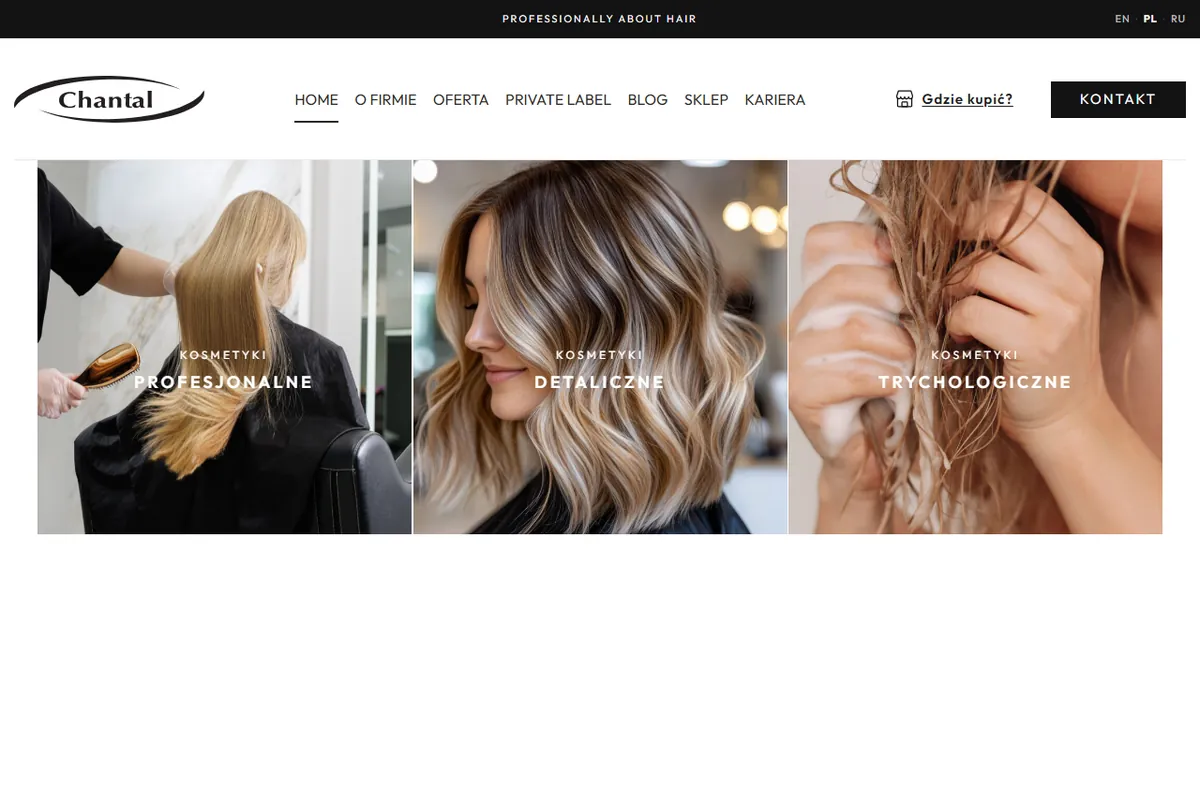
HQ: Wiązowna (Duchnów), near Warsaw · Type: Hair-care manufacturer with a private-label division · Best known for: Professional salon and trichological hair products
Founded in 1989, Chantal is one of Poland’s longer-established hair-cosmetics houses, running its own brands — Prosalon, Sessio, Intensis, Colorart and Hair Biotic — across salon and drugstore channels. That own-brand depth is the point: a factory that formulates colourants, bonding treatments and scalp products daily has a technical library a generalist contract house does not. Private label is listed as a distinct service in the site’s main navigation, and the multilingual site (Polish, English, Russian) signals an export-facing sales process. If your brief is anything other than hair and scalp, look elsewhere on this list.
2. Clover Cosmetics
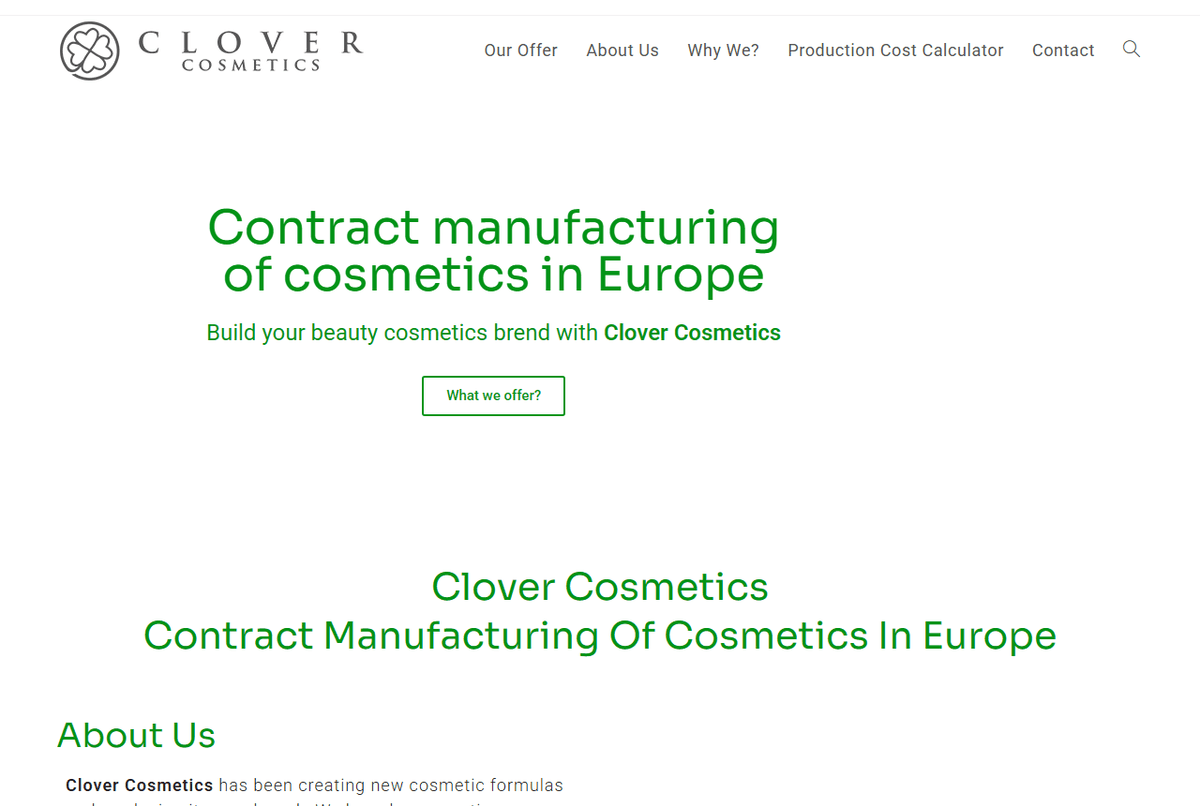
HQ: Katowice region, Silesia · Type: Contract manufacturer and private-label producer · Best known for: Very low bulk minimums across a wide skincare range
Clover markets its contract work through an English-language site at privatelabelscosmetics.com, and it is one of the few Polish manufacturers that publishes real numbers: production from 25 kg of cosmetic mass, private-label runs from around 1,000 pieces, and a catalogue of ready formulations spanning face, body, hair, men’s, baby and foot care. The company states it works to GMP (ISO 22716) principles and prepares the Safety Assessment Report, which is the document that actually gates an EU launch. For a first-time brand testing three or four SKUs, this is a realistic starting point rather than an aspirational one.
3. CosmoLabs
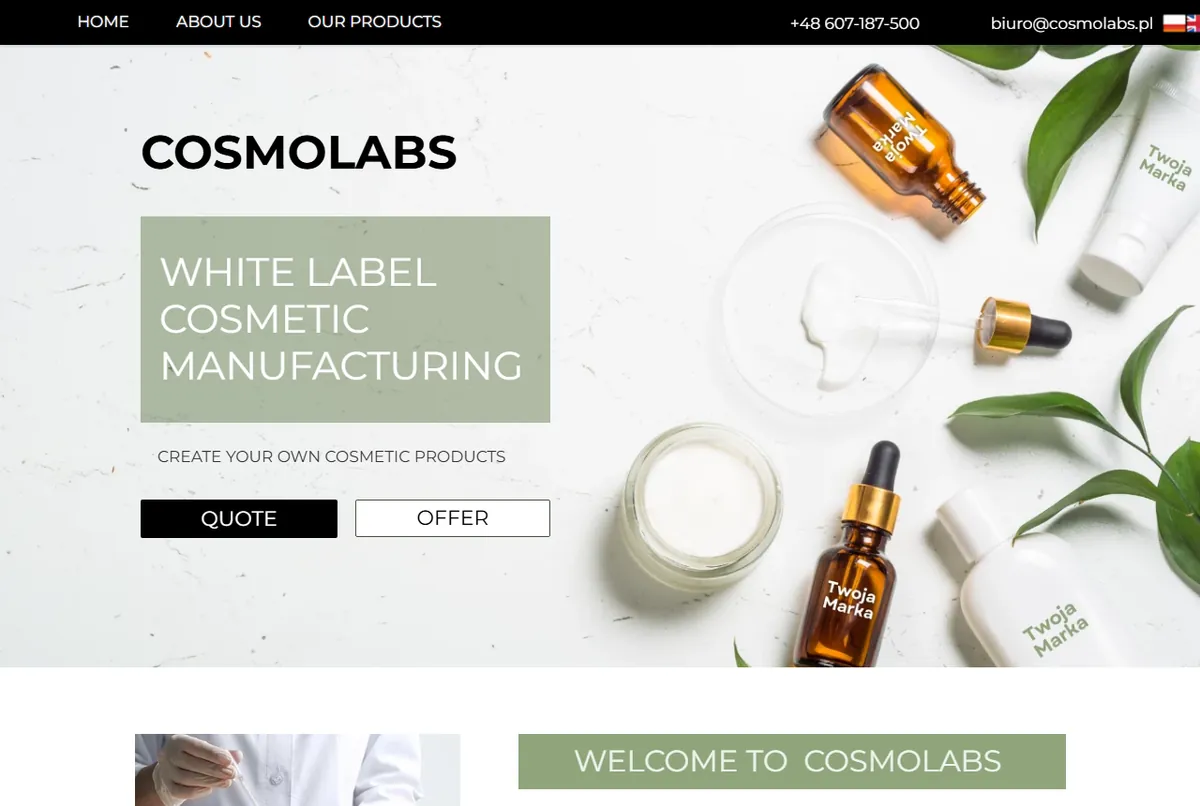
HQ: Toruń · Type: White-label and contract cosmetics manufacturer · Best known for: Flexible batch sizes on everyday skincare and hair care
CosmoLabs positions itself squarely as a white-label manufacturer: you pick from or adapt its formulations, it produces, fills, labels and hands over the documentation. The site states GMP certification to ISO 22716 issued by DEKRA, which is a named certification body rather than a vague claim, and describes willingness to run “even very small batches” without publishing a hard minimum. Product coverage is mainstream — creams, serums, masks, shampoos, hygiene products — so this is a supplier for brands whose differentiation lives in positioning and packaging rather than in exotic actives.
4. Cristal Cosmetics Laboratory

HQ: Kraków · Type: Family-owned contract laboratory · Best known for: Cosmetics and dietary supplements under one roof
Cristal is a family firm that runs contract manufacturing for both cosmetics and supplements, plus formula development, product registration and safety testing. For beauty brands moving into ingestible beauty, that dual capability removes an entire second supplier relationship — a genuine advantage that most cosmetic-only laboratories cannot match. The company makes a point of clients dealing directly with department managers rather than a sales layer, which tends to matter more on small, iterative projects than on large repeat orders. The website is Polish-language only, so expect the first exchange to set the working language.
Visit Cristal Cosmetics Laboratory →
5. Dr. Miele Cosmed Group
HQ: Poland, with plants at Radom, Jawor, Gniezno and Świętochłowice · Type: Listed FMCG group with a B2B private-label arm · Best known for: Retail-chain private label at industrial scale
Formerly Global Cosmed and renamed after a 2024 merger, Dr. Miele Cosmed Group is the largest operation on this list and the only Warsaw Stock Exchange-listed one. It manufactures its own household and personal-care brands while developing and producing private label for major European retailers, which is a different business from serving indie brands: the strengths are line capacity, retailer compliance and repeatable cost, not bespoke formulation for a first launch. Approach this group if your volumes are genuinely retail-scale, and expect its own-brand portfolio to remain the strategic priority.
Visit Dr. Miele Cosmed Group →
6. NAAN Laboratorium Biokosmetyki
HQ: Łódź · Type: Contract laboratory for care cosmetics · Best known for: Bio-positioned formulations from 60 kg batches
NAAN handles the full contract chain — formula development, testing, documentation, CPNP notification support, raw-material sourcing, production, packaging and logistics — with production starting from 60 kg and no long-term commitment required. The “biokosmetyki” framing signals a natural-ingredient orientation, though the site does not publish specific organic or GMP certificate numbers, so ask for those in writing. The combination of a low floor and no contractual lock-in makes NAAN a sensible choice for a brand that wants to produce on demand rather than forecast a year ahead.
Visit NAAN Laboratorium Biokosmetyki →
7. NISHA Manufacturing
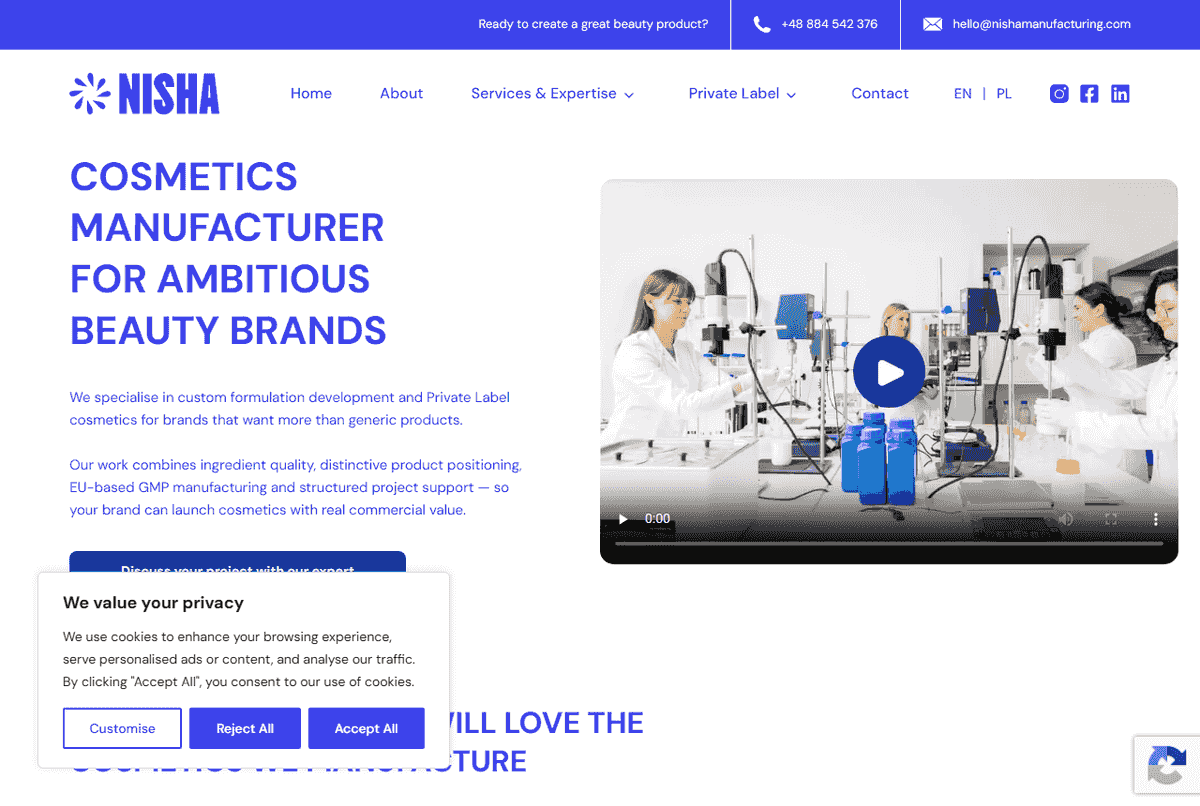
HQ: Puszczykowo, near Poznań · Type: Custom formulation and private-label manufacturer · Best known for: Niche brands that want a distinctive formula, not a catalogue product
NISHA is the most explicitly positioned company here: it states it works with brands that want “more than generic products”, and backs that with an R&D team, a database of more than 10,000 tested ingredients and a GMP facility audited annually against ISO 22716:2007. Coverage runs from serums and creams through body care and hair care into powder colour cosmetics such as blushes and bronzers. MOQ is described as flexible rather than published, which usually means it is negotiated per project — reasonable for custom development, and a reason to get the number in writing early.
8. Passage Cosmetics Laboratory
HQ: Gałków Duży, near Łódź · Type: Full-service private-label and contract manufacturer · Best known for: Breadth of categories and a long certification list
Trading since 1988, Passage is among the most complete contract operations in Poland: skincare, hair care, body care, colour cosmetics, and natural and vegan lines, supported by an in-house microbiology laboratory. The company publishes an unusually broad certification set — ISO 9001, ISO 22716 cosmetic GMP, ISO 14001, ISO 45001 and a 2025 Halal certificate — which matters if you intend to sell into Southeast Asian or Gulf markets as well as the EU. The trade-off is that a plant of this breadth is generally a better fit for brands with several SKUs and repeat volume than for a single trial product.
Visit Passage Cosmetics Laboratory →
9. Popławska Group
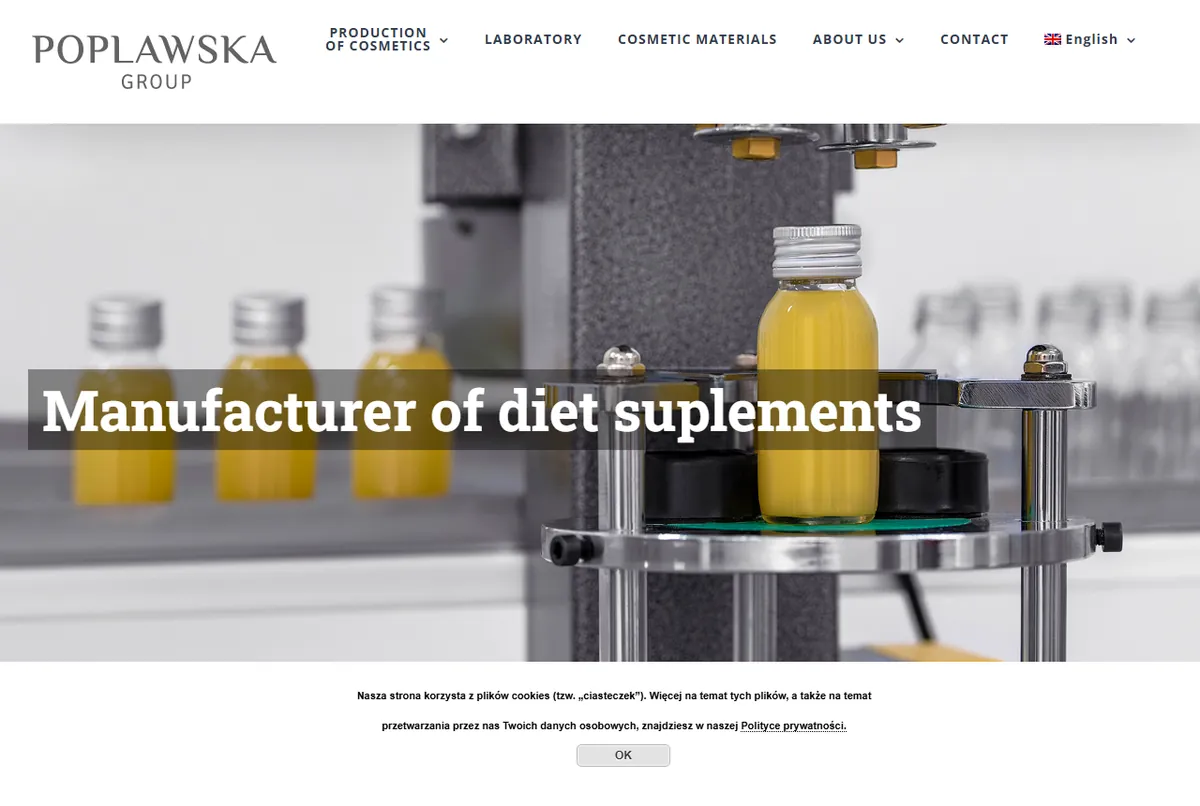
HQ: Wilczyce, near Wrocław · Type: Family group manufacturing cosmetics, liquid supplements and salon devices · Best known for: Professional and beauty-salon product lines
Popławska Group has been operating for more than 25 years and covers an unusual span: professional and home-care cosmetics, liquid dietary supplements, active raw materials, and treatment devices and disposables for beauty salons. Its own R&D laboratories handle testing and product registration, and the group holds the Polish “Naturalne Polskie” certificate for natural cosmetics; Forbes named it one of Poland’s hundred most valuable family companies in 2022. If you are building a professional or clinic-channel brand where product and device sit together, that breadth is an advantage — for a straightforward retail skincare line it can read as unfocused.
10. Your Private Label (ŚWIT Group)
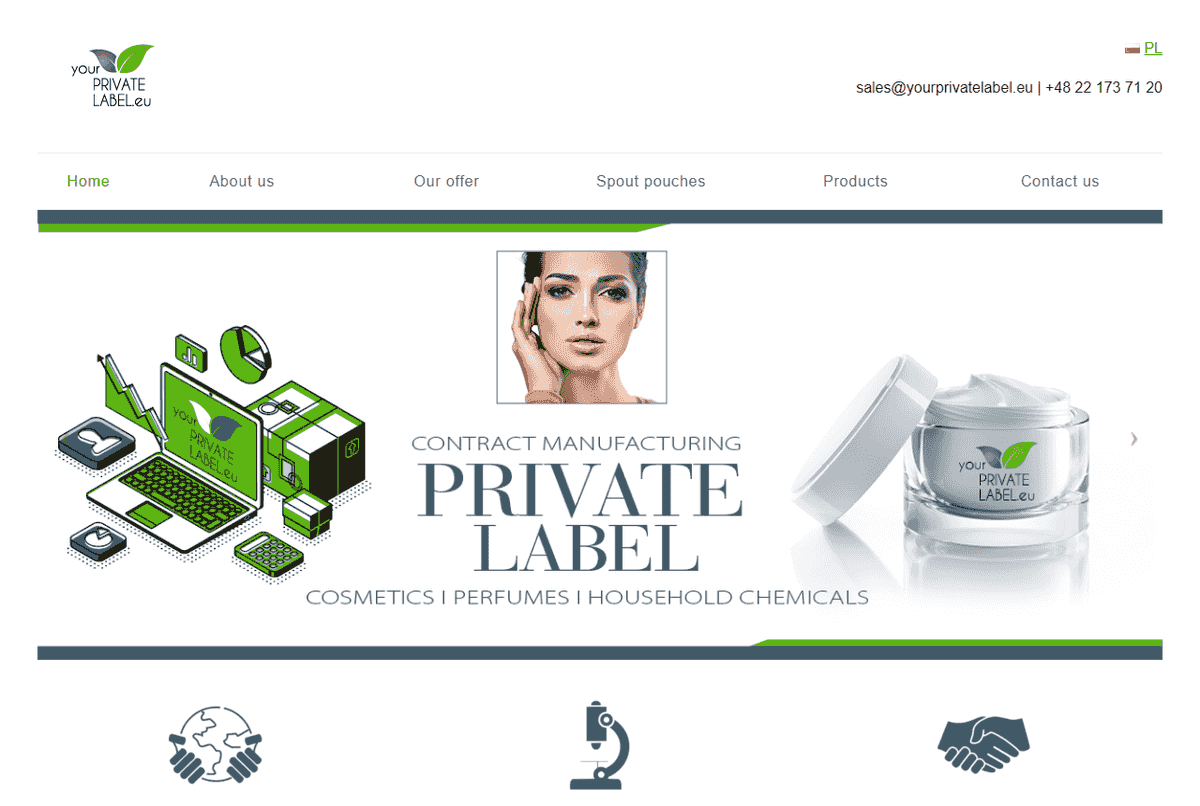
HQ: Warsaw, with plants at Halinów and Morąg · Type: Private-label and OEM/ODM arm of a long-established Polish manufacturer · Best known for: Cosmetics, fragrance and household chemistry from one group
Your Private Label is the contract-manufacturing face of ŚWIT Group, a Polish producer whose history runs back to 1944. The offer is structured in three tiers — ready-made private-label formulas, custom development through an in-house R&D department, and full OEM/ODM production — and the group cites GMP, ISO 22716, ISO 9001 plus CPSR, FDA and SGS compliance in its documentation. The unusual element is scope: perfumes, personal care and laundry or household products can be produced alongside cosmetics, which suits distributors and retail groups building a multi-category own label more than a single-focus beauty brand.
What Polish manufacturing means for your compliance file
Cosmetics made in Poland are governed by Regulation (EC) No 1223/2009, the same law that applies across the European Union. Before a product is placed on the EU market it needs a Product Information File, a Cosmetic Product Safety Report signed by a qualified safety assessor, and notification through the Cosmetic Products Notification Portal (CPNP). Poland adds a national layer: under the Act of 4 October 2018 on cosmetic products, manufacturers must also register in the national Cosmetic Products Register, and market surveillance is carried out by the Chief Sanitary Inspectorate (Główny Inspektorat Sanitarny, GIS) together with the Trade Inspection.
Two practical consequences. First, the Responsible Person named on your label must be established in the EU — if your company is not, the manufacturer or a service provider has to take that role, and you should agree in the contract who owns the dossier if the relationship ends. Second, an EU-made product does not automatically clear other markets: selling the same formula in Malaysia, the UK or the Gulf means a separate notification each time. Our comparison of OEM, ODM and private label explains how much of that documentation burden each model actually transfers to the factory.
Notable exclusions
Screening only counts if you can see what it removed. These companies were researched and left out:
- Elfa Pharm and Barwa Cosmetics. Both are genuine Polish manufacturers, but their websites sat behind an automated bot-verification wall throughout our research window, so we could not open and verify the pages we would be sending readers to.
- Clarena. A real Kraków-area laboratory with a private-label offer, excluded because its homepage served a consumer discount pop-up over the entire hero, which we do not screenshot around.
- Pollena Ostrzeszów. An established manufacturer, but its public site is built around its own consumer brands and an e-shop rather than a contract-manufacturing offer, so it failed the OEM/ODM screen.
- IOC. Presented as a contract manufacturer, but the only page we could reach was a profile hosted on a third-party industry portal rather than a company-controlled website.
- Ziaja, Dr Irena Eris, Eveline and Bielenda. Large and well-known Polish cosmetics companies, but they are primarily own-brand houses without a published contract-manufacturing offer for external brands.
Methodology, limitations and conflicts
Research window: 24 July 2026. Candidates were identified through open web research, then screened against the four criteria in the section above. Each surviving company’s official website was loaded in a real browser at 1280 px and captured; every screenshot in this article is that capture, dated to the research window. Sites that returned a parked page, an error, a bot-verification challenge or a modal covering the homepage were rejected rather than worked around.
What we did not do: we did not visit any factory, inspect any certificate, request a quotation, test a product, or contact any company. Certifications, batch minimums and capability claims are reported as published by each company and should be independently verified before you commit. Batch minimums in particular are quoted as bulk mass, which is not the same as the number of filled units you can order — packaging minimums usually set the real floor, and pricing follows a different curve again, as our guide to payment terms and deposits sets out.
If you spot an error, tell us and we will correct it and log the change below.
Frequently asked questions
Is it cheaper to manufacture cosmetics in Poland than in Germany or France?
Generally yes on labour and overhead, which is why several western European brands run Polish contract production. But the gap narrows once you account for raw materials and packaging, which are traded at similar prices across the EU, and it can disappear entirely on complex formulations where the deciding factor is laboratory capability rather than hourly cost. Treat country-level cost claims as a starting hypothesis and compare landed cost per filled unit on your actual specification, not per kilogram of bulk. See our Germany manufacturer list for the comparison set.
What is the smallest order a Polish cosmetics manufacturer will accept in 2026?
Among the companies on this list, the lowest published figures are 25 kg of bulk at Clover Cosmetics and 60 kg at NAAN Laboratorium Biokosmetyki, with several others describing minimums as flexible or negotiated per project. Bulk mass is only half the answer: your packaging supplier’s minimum, often several thousand units for a custom component, usually determines the real order size. Ask for the minimum expressed in filled units of your chosen pack before you plan a launch.
Do I need a Responsible Person in the EU if my brand is based outside Europe?
Yes. Regulation (EC) No 1223/2009 requires a Responsible Person established within the European Union to be named on the packaging and to hold the Product Information File, regardless of where the brand owner sits. Many Polish manufacturers will take that role, or introduce a specialist provider. Agree in writing who holds the dossier, who pays for updates, and what happens to it if you change supplier — a Responsible Person you cannot leave is a commercial lock-in dressed as compliance.
Update history
- 24 July 2026 — First publication. Ten manufacturers screened, verified and captured; five companies documented in Notable exclusions.
Sources: each company’s official website as captured on 24 July 2026; Regulation (EC) No 1223/2009 and the European Commission CPNP portal; the Polish Act of 4 October 2018 on cosmetic products. Screenshots are homepage captures from the research window and may not reflect later site changes. This article is editorial research, not a certification check — verify certifications, capacity and contractual terms directly with any manufacturer before entering an agreement.
Building a European sourcing shortlist? Compare this list with our guides to OEM/ODM cosmetic manufacturers in the UK, Italy and the Dutch contract manufacturers serving northern Europe.