The Netherlands is one of the easiest places in Europe to get a private-label cosmetic made — and one of the hardest to research. Dutch contract manufacturers are mostly mid-sized, family-held businesses that fill for supermarket chains, pharmacy groups and export brands without ever putting their client list online. Search “cosmetics manufacturer Netherlands” and you get aggregator pages that recycle the same ten names, several of which no longer have a working website. This list is different: every company below was found, opened and screenshotted on 28 August 2026, and anything that did not resolve to a real, live corporate site was cut and named in the exclusions.
Written and researched by Marcus Tan, Private Label & Beauty Sourcing Consultant · Fact-checked by Priya Nair, Indie Beauty Brand Strategist · Research period: 26–28 August 2026.
Quick answer: who makes cosmetics on contract in the Netherlands?
Ten Dutch companies with verified live websites take third-party cosmetics work as of August 2026: Cosmetize (Harderwijk), Delarange Cosmetics (Zeewolde), Frisson (Dronten), Girasol Natural Products (Breda), Hegron Cosmetics (Purmerend), Mondial Cosmetics (Alkmaar), Personal Care Concepts (Heerhugowaard), Rapide International (Haaksbergen), Rebel Nature (Amsterdam) and RedPharma (Almere). Most are full-service: formula development, bulk manufacture, filling, artwork and EU compliance paperwork under one roof. Colour cosmetics capacity is concentrated in Alkmaar; oral care and lip care in Flevoland; natural and certified-organic work in Amsterdam and Breda.
Key takeaways
- The Dutch sector is mid-scale and service-led, not volume-led. Typical minimums start around 2,000–5,000 units per SKU for skincare and haircare, and closer to 10,000 for makeup — low by Asian standards, high by Italian artisan-lab standards.
- Colour cosmetics is the country’s stand-out capability. Mondial Cosmetics in Alkmaar states filling capacity above 40 million units a year across lipstick, mascara, foundation and nail categories, which is unusual depth for a country this size.
- Several Dutch manufacturers hold ISO 13485 alongside ISO 22716 — Rapide, Delarange and RedPharma all describe medical-device work. That matters if your product sits near the cosmetic/medical borderline (barrier creams, scar gels, oral rinses).
- The regulator you deal with is not a Dutch product-approval body. Cosmetics in the Netherlands run on EU Regulation (EC) No 1223/2009, notification through the CPNP portal, and market surveillance by the NVWA. There is no pre-market licence to obtain.
- Several names that appear on other “top 10 Netherlands” lists are dead. Two of the companies most often cited now resolve to domain-for-sale parking pages. Recycled listicles keep them alive; a capture check does not.
Who this list is for, and how we chose
This list is for a brand owner deciding whether to place a first or second production run in the Netherlands — usually someone comparing Dutch quotes against German contract manufacturers, Polish cost-driven factories or an Italian colour specialist. It is not a ranking. The numbering below is a label for navigation only; entries are ordered alphabetically by company name, and nothing on this page is sold.
Eligibility was applied before writing, and it was binary:
- Physically manufactures cosmetics in the Netherlands. Traders, wholesalers, sourcing agents and ingredient distributors were cut, however large — if the company’s own site says production happens at partner factories, it is not a manufacturer for this purpose.
- Offers third-party work. Own-brand-only cosmetic houses and consumer webshops were cut.
- Cosmetics is a core line, not a side division. A company whose output is household cleaning chemicals with a cosmetics footnote was cut.
- The official website resolves and renders. Each site was opened in headless Chrome at 1280×860 on 28 August 2026 and the resulting image inspected. Parked domains, dead hosts, blank hero sections and shots where a consent modal covered the page identity were rejected rather than published.
Capabilities, certifications and capacity figures below are company-stated, taken from each manufacturer’s own website on the capture date. We did not audit any factory, inspect a certificate, or place a test order. Treat every line as a starting point for your own supplier due diligence, not as a verified fact about production quality.
The list at a glance
| Company | Base | Best suited for | Main limitation |
|---|---|---|---|
| Cosmetize | Harderwijk | Broad premium private label across nine categories | MOQ published only on request |
| Delarange Cosmetics | Zeewolde | Lip care and oral care at European scale | Narrower fit for colour cosmetics |
| Frisson | Dronten | Small brands wanting CPNP paperwork handled | Half the plant runs cleaning products |
| Girasol Natural Products | Breda | Natural, vegan and halal-positioned formulas | Little public detail on capacity |
| Hegron Cosmetics | Purmerend | High-volume hair, bath and body for retail | Mass-market orientation, not prestige |
| Mondial Cosmetics | Alkmaar | Makeup: lipstick, mascara, foundation, nail | Makeup MOQs are the highest here |
| Personal Care Concepts | Heerhugowaard | Skin and hair co-development with startups | Site is Dutch-only |
| Rapide International | Haaksbergen | Wide catalogue plus medical-device capability | Cosmetic/device split may slow scheduling |
| Rebel Nature | Amsterdam | 100% natural briefs from 2,000 units | Natural-only scope by design |
| RedPharma | Almere | Borderline cosmetic / medical-device products | Youngest company on the list (2017) |
What EU law and the NVWA expect before you produce in the Netherlands
There is no Dutch product licence for cosmetics. A product made in Zeewolde and a product made in Milan sit under the same rulebook: Regulation (EC) No 1223/2009. What that means in practice for a first Dutch run is four things.
A Responsible Person established in the EU. Someone with an EU address must hold the Product Information File and answer to authorities. If your company sits outside the EU, either your manufacturer takes the role, an appointed RP service takes it, or your EU distributor takes it — and the third option is the one that quietly locks you in, because the notification is then filed in their name. This is the single most common trap in EU market entry for a non-EU brand.
A safety assessment before sale. The Product Information File must contain a Cosmetic Product Safety Report signed by a qualified assessor. Dutch manufacturers routinely arrange this, but check whether the fee is inside the quoted unit price or billed separately — it is a per-formula, not per-unit, cost.
CPNP notification. Every product is notified to the Cosmetic Products Notification Portal before it goes on the market. Frisson, for example, states it handles CPNP registration as part of its service; others expect you or your RP to do it.
Market surveillance by the NVWA. The Nederlandse Voedsel- en Warenautoriteit enforces the Warenwetbesluit cosmetische producten in the Netherlands. It inspects after the fact — sampling products, checking labels, checking that a PIF actually exists at the address on file. Its most common findings are unremarkable and avoidable: ingredient lists that do not match the formula, missing batch identification, and fragrance allergens that should have been declared and were not. Check the CosIng database against your final INCI list before artwork is signed off.
Almost every manufacturer below cites ISO 22716, the cosmetics GMP standard. It is a voluntary certification against ISO 22716:2007, not a licence — ask for the certificate, the certifying body and the expiry date, the same way you would request any other supplier document.
1. Cosmetize
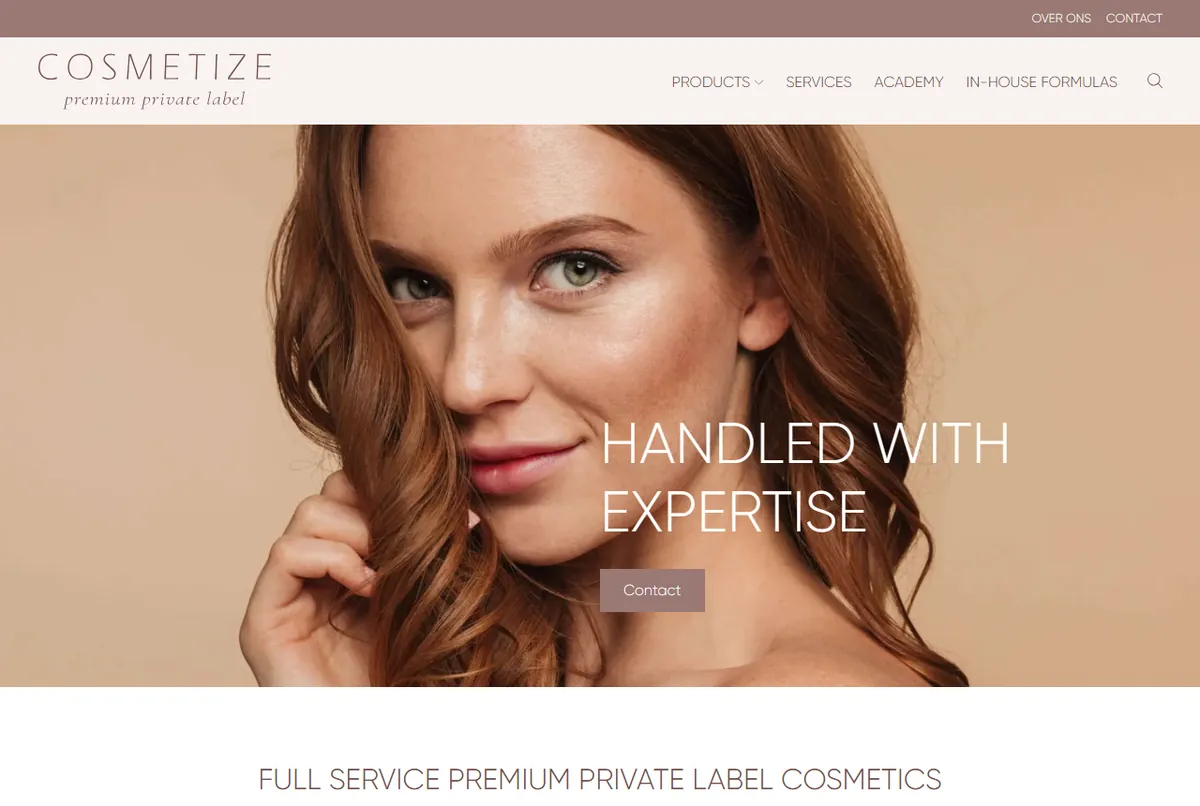
HQ: Van Leeuwenhoekstraat 11, Harderwijk, Gelderland · Type: Full-service private label manufacturer · Best known for: Breadth — nine product categories under one roof
Cosmetize positions itself as a premium private-label house and backs it with the widest published category list of any company here: face care, sun care, makeup, home fragrance, body care, hand and foot care, hair care, perfume and baby care. It runs its own formulation library, arranges challenge, stability and compatibility testing through independent laboratories, and states that production follows GMP practice from raw material intake to packing. For a brand that wants a coherent multi-category range from one supplier rather than three, this is the shortest route on the list. The catch is transparency: MOQs are behind a request form, and the breadth means you should confirm which categories are filled in-house and which are subcontracted.
2. Delarange Cosmetics
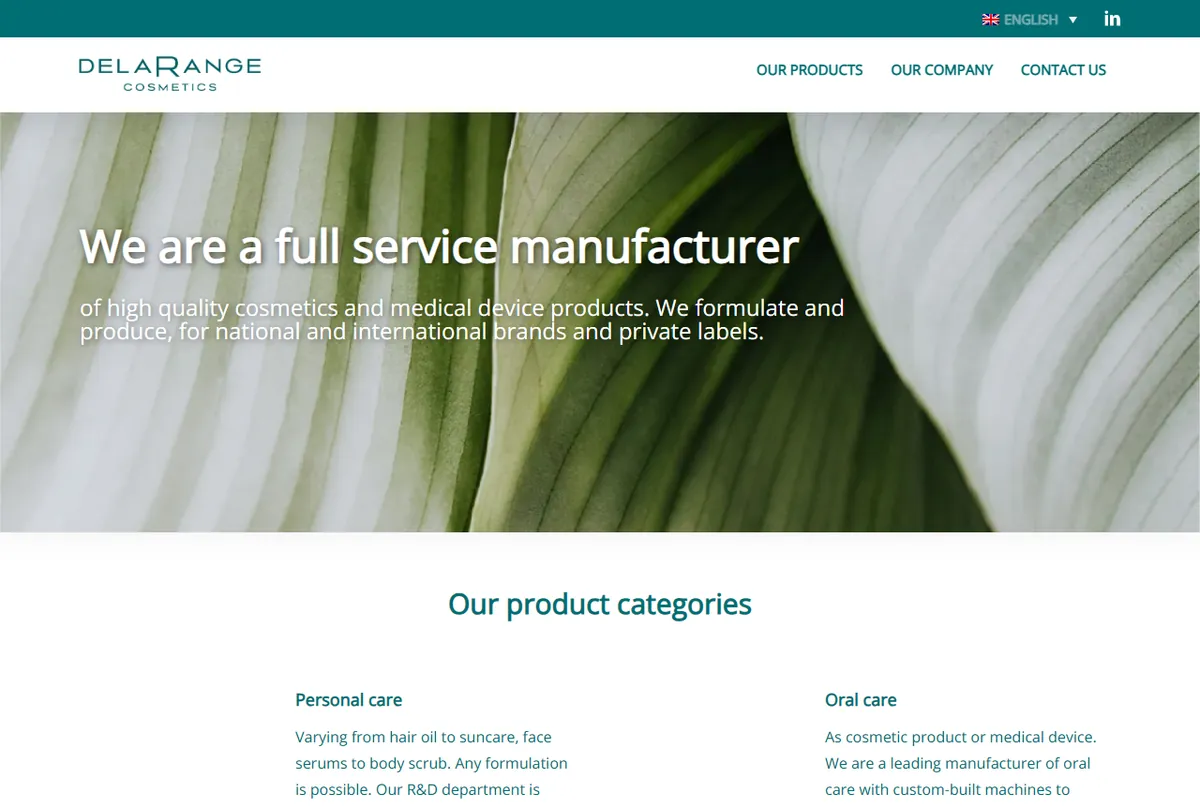
HQ: Edisonweg 36, Zeewolde, Flevoland · Type: Full-service manufacturer, cosmetics and medical devices · Best known for: Lip care and oral care
Delarange International describes itself as a full-service manufacturer of cosmetics and medical device products, and it is the clearest category specialist on this list: the company claims more than 30 years in lip care and calls itself one of Europe’s largest lip-care suppliers. Its second pillar is oral care — toothpaste, mouthwash, oral foam and mouth spray — a format most cosmetic contract manufacturers will not touch because it needs dedicated lines. It states ISO 13485 for the device side plus BRCGS and SGS certification. If your product is a lip balm, a lip treatment or anything oral, Delarange should be on your quote list; if it is a colour palette, look elsewhere first.
3. Frisson
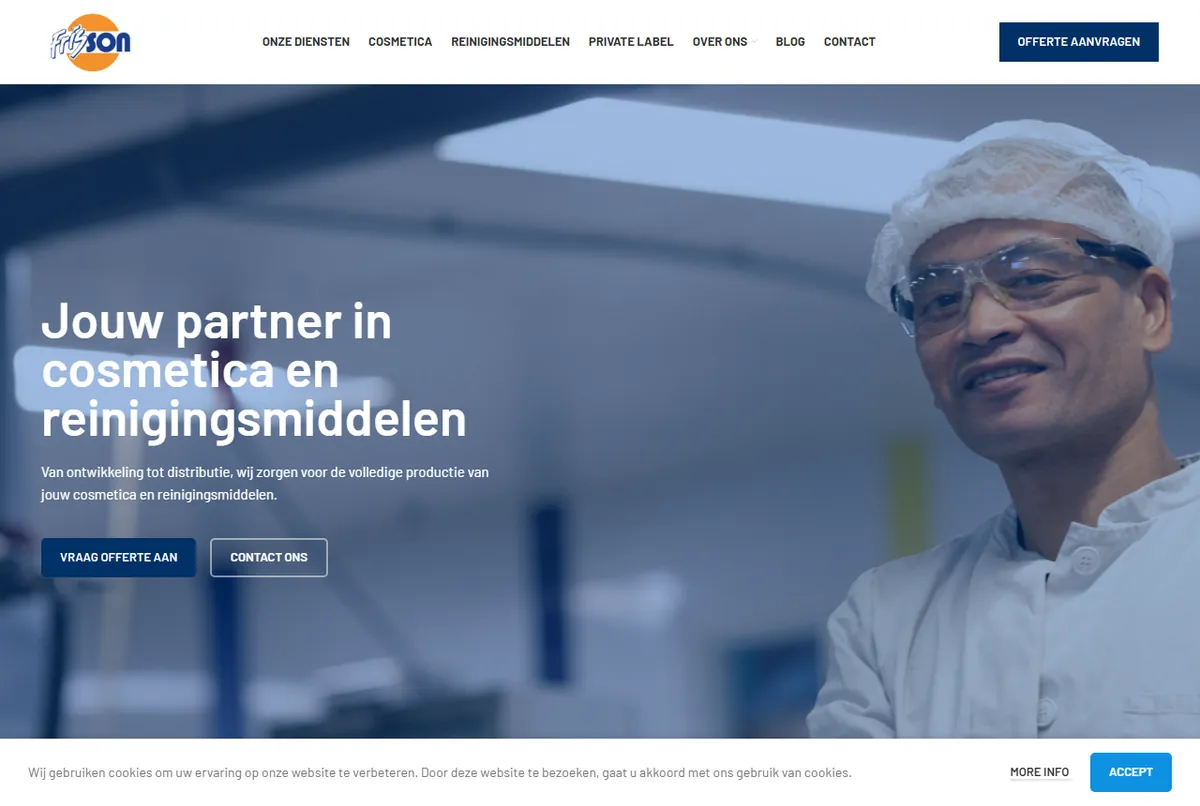
HQ: Houtwijk 27, Dronten, Flevoland · Type: Private-label producer, cosmetics and cleaning products · Best known for: Handling the compliance file for smaller brands
Frisson runs two parallel private-label lines — cosmetics and cleaning products — from one site in Dronten, with more than 35 years of stated experience and its own R&D laboratory. On the cosmetics side it makes creams and butters, perfumes, soaps, shampoos, shower gels, sun-care products and sprays, and quotes roughly three to four weeks from formula approval to finished goods. What makes it worth a call is the paperwork: it explicitly takes on safety data sheets, label copy, safety assessments and CPNP registration, which is the part first-time brand owners most often underestimate. The trade-off is focus — a plant that also fills detergents is a different environment from a cosmetics-only facility, so ask directly how lines and warehousing are separated.
4. Girasol Natural Products
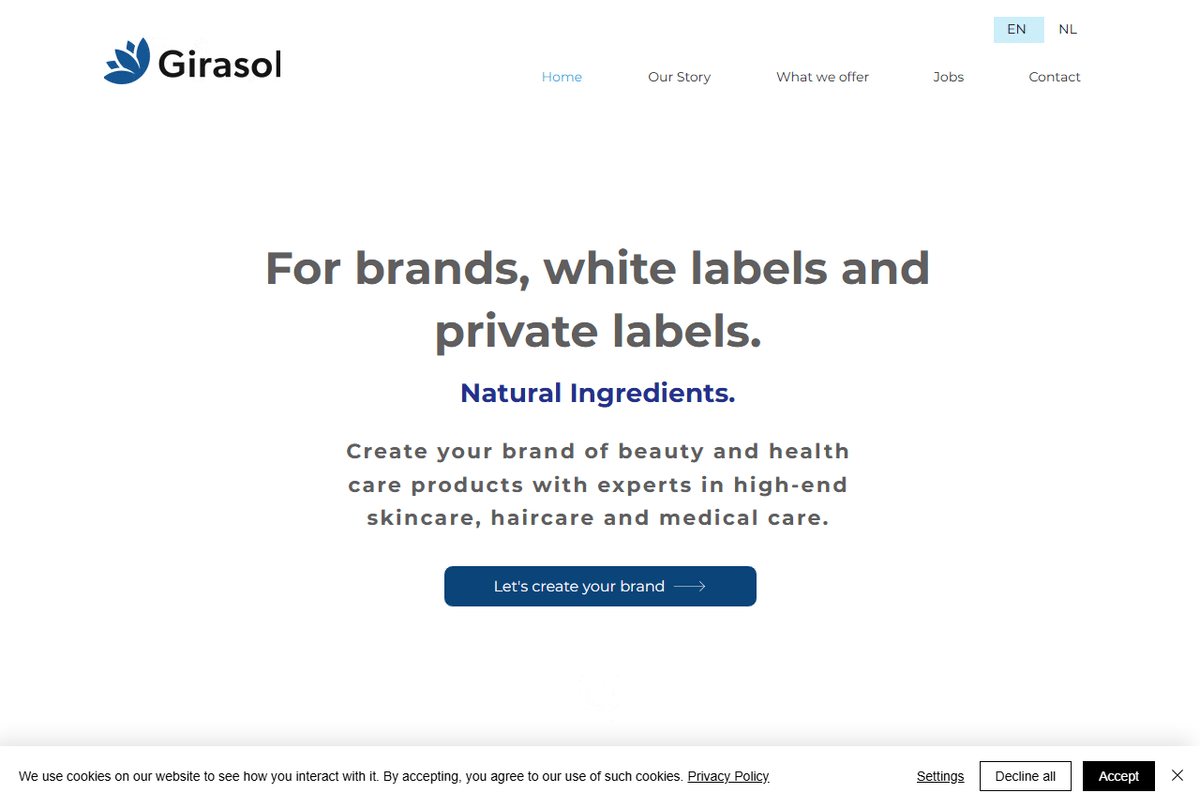
HQ: Minervum 7357, Breda, North Brabant · Type: Private label and white label manufacturer · Best known for: Natural, vegan and halal-positioned formulation
Girasol makes skincare, haircare and medical-care products for other people’s brands and leads with natural ingredients, stating that it can develop 100% natural, vegan and halal formulations. It is a certified B Corporation, which is a meaningful signal in a sector where “sustainable” is usually a marketing word rather than an audited status — B Corp certification is renewed against a published assessment, so it is checkable. The service scope covers formula development, raw material selection, production, filling, labelling and regulatory support. What the site does not publish is capacity or minimum order quantity, so budget an early call to establish whether your volumes fit before you invest in samples.
Visit Girasol Natural Products →
5. Hegron Cosmetics
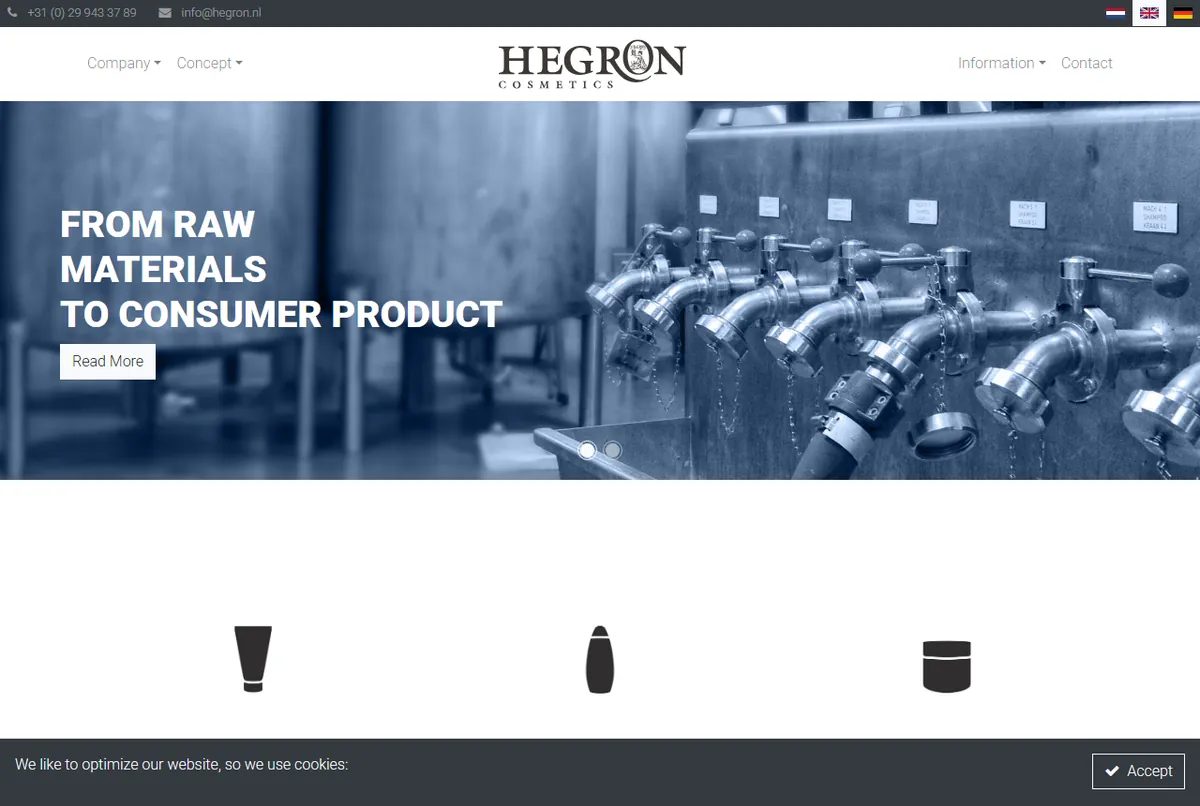
HQ: Van IJsendijkstraat 174, Purmerend, North Holland · Type: Private label, A-brand and own-brand manufacturer · Best known for: Retail-scale hair, bath and body
Hegron is the closest thing the Netherlands has to a classic European personal-care factory: in cosmetics since 1960, around 175 staff, an in-house microbiology and development laboratory, and a stated fleet of production tanks and multifunctional filling lines built for fast changeovers. Its category list is the retail shelf — hair care, bath and shower, liquid hand soap, styling, skincare, body care, hand and nail, foot care, baby and kids, sun care, deodorant and perfume — and it holds ISO 22716 along with NCV, BDIH and Cosmetics Europe memberships. It is a strong fit if you are producing at supermarket or drugstore volumes. It is a weaker fit for a 2,000-unit prestige launch, where a smaller lab will give you more attention.
6. Mondial Cosmetics
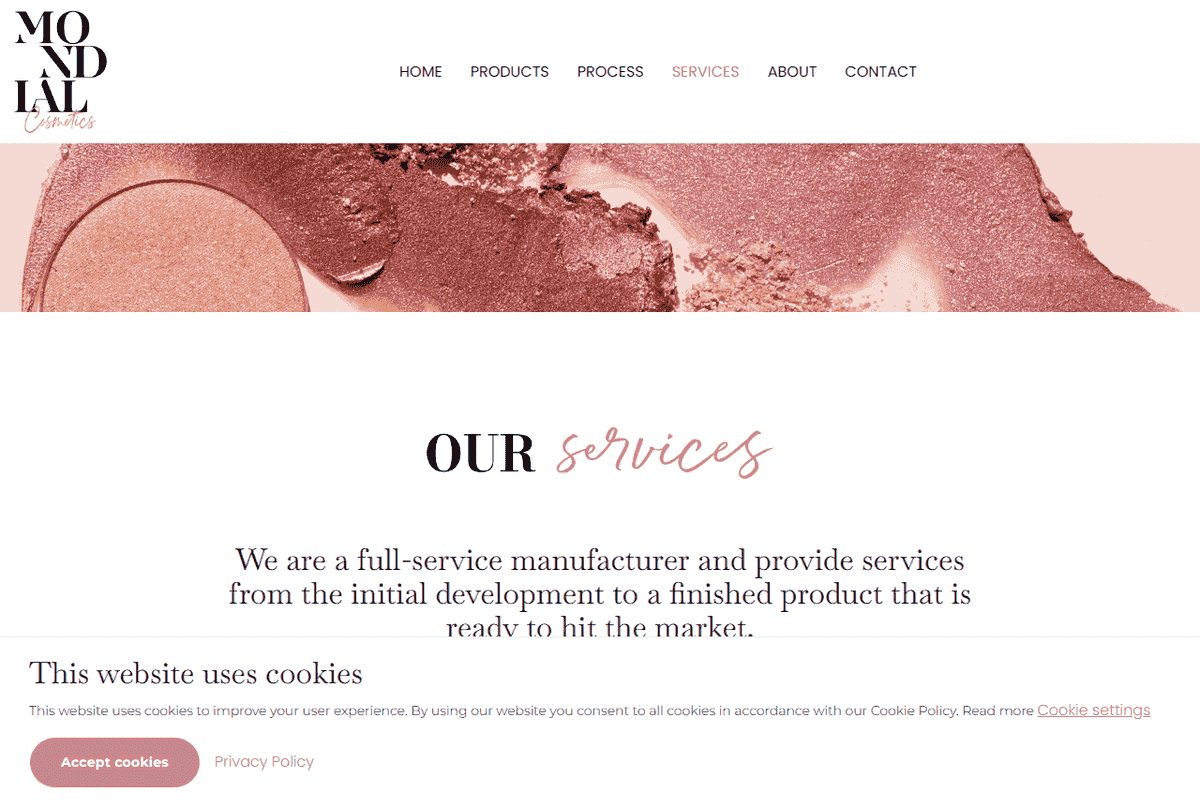
HQ: Berenkoog 39, Alkmaar, North Holland · Type: Full-service colour cosmetics manufacturer · Best known for: Lipstick, mascara, foundation and nail production at volume
Mondial has been producing cosmetics in one form or another since 1936 and describes itself as the largest Dutch company developing and making makeup. The numbers it publishes are the reason it belongs on any European colour shortlist: filling capacity above 40 million units a year, plus 1,750 m² of warehousing. Colour is a genuinely different discipline from skincare — shade matching, pigment dispersion, mould tooling for bullets and pans — and very few contract manufacturers outside Italy and Korea carry it properly. Expect makeup minimums around the 10,000-unit mark and a longer development runway than a cream. Note that ownership changed in 2023, so ask how that has affected lead times and account management.
7. Personal Care Concepts
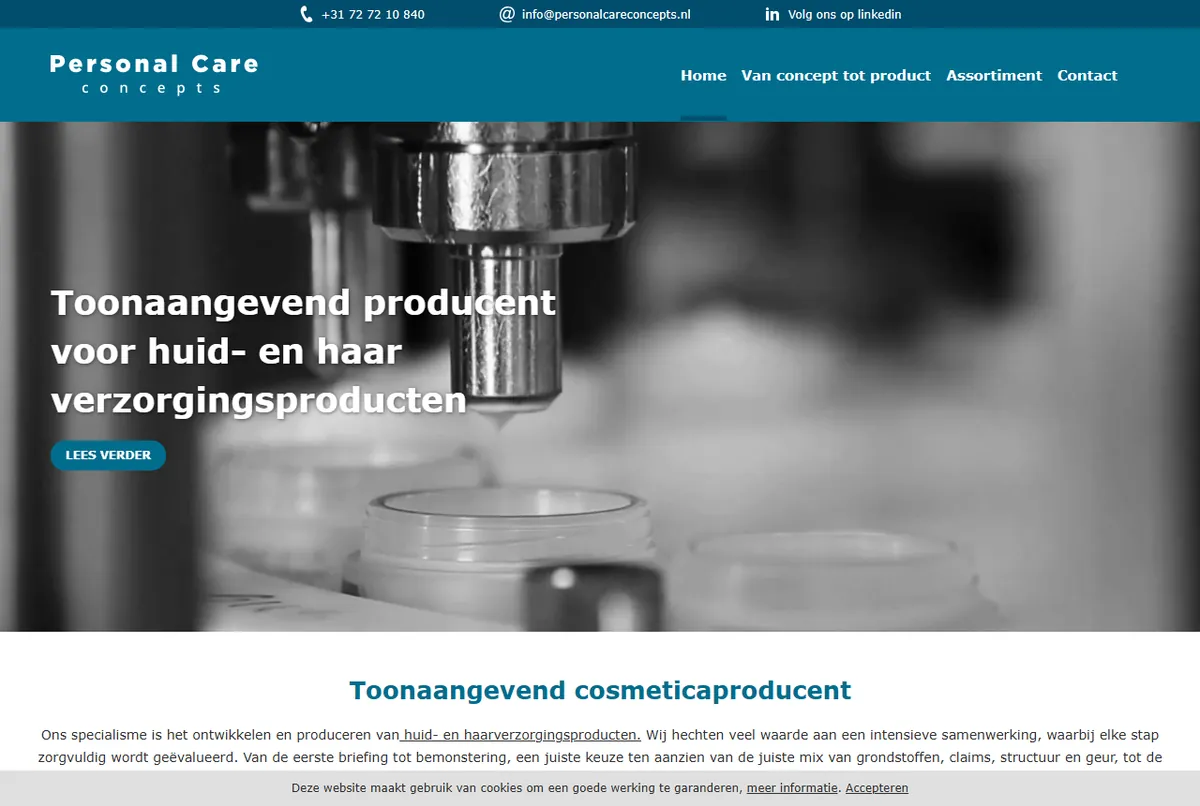
HQ: Echo 4, Heerhugowaard, North Holland · Type: Full-service skin and hair care producer · Best known for: Co-development with startups and pharmacy brands
Personal Care Concepts is a specialist rather than a generalist: skin and hair care, plus medical and natural cosmetic products, made for retail brands, pharmaceutical companies, online sellers and startups. It states ISO 22716 certification and compliance with Regulation 1223/2009, and frames its process as co-creation — briefing, sampling, raw material and claim decisions, then texture and fragrance, evaluated step by step rather than handed over as a finished stock formula. That suits a brand that has a point of view about its formula but no laboratory. The practical hurdle is language: the site is Dutch-only, which is a fair signal about where its customers are, so open the conversation in English early to confirm export support.
Visit Personal Care Concepts →
8. Rapide International
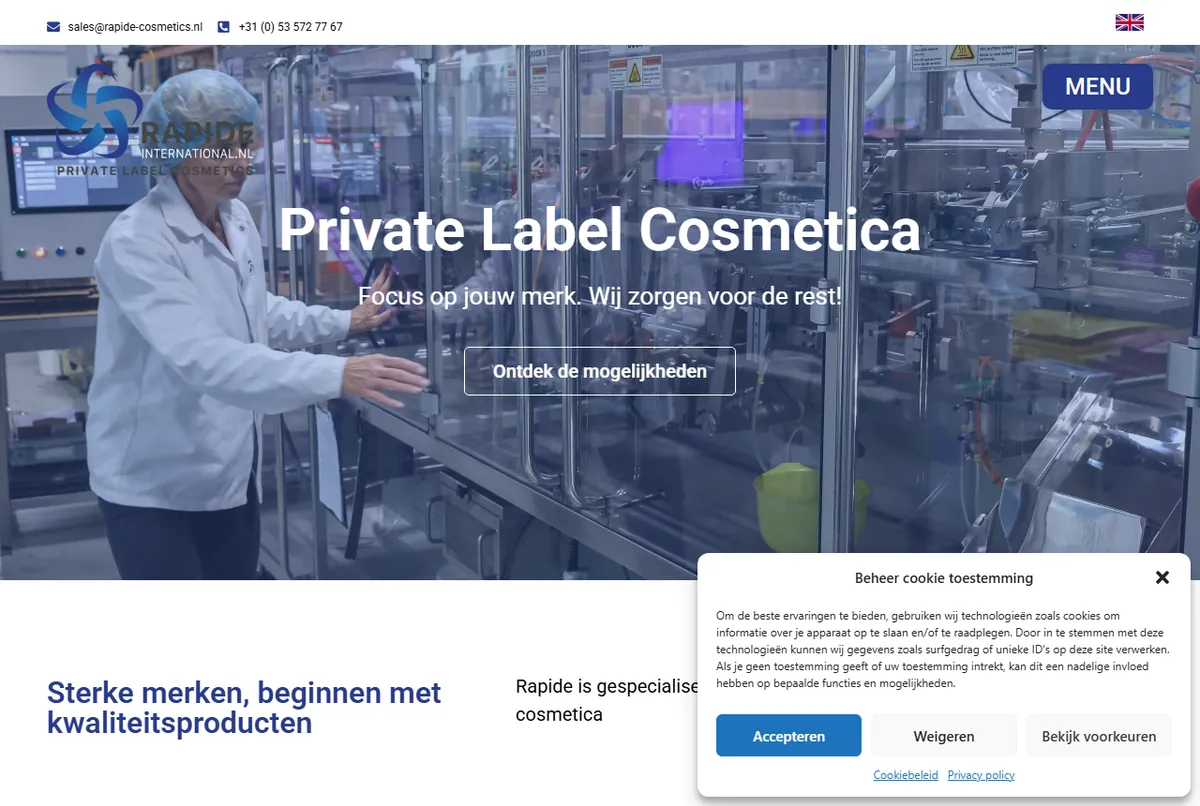
HQ: Tolstraat 6, Haaksbergen, Overijssel · Type: Private label manufacturer, cosmetics and medical devices · Best known for: Dual ISO 22716 and ISO 13485 operation
Rapide International develops and produces private-label cosmetics and medical devices to ISO 22716 and ISO 13485, covering facial care, body care, baby care, sun protection, hair care, eau de toilette and home fragrance, with an in-house R&D laboratory, regulatory guidance, packaging advice and printing. The dual-standard setup is the reason to shortlist it: if your range mixes a straightforward moisturiser with something that classifies as a device in the EU, keeping both under one quality system removes a whole layer of coordination. The same duality is the risk — device batches carry stricter documentation and can compete with cosmetic runs for line time, so agree scheduling priority in writing before you commit.
9. Rebel Nature
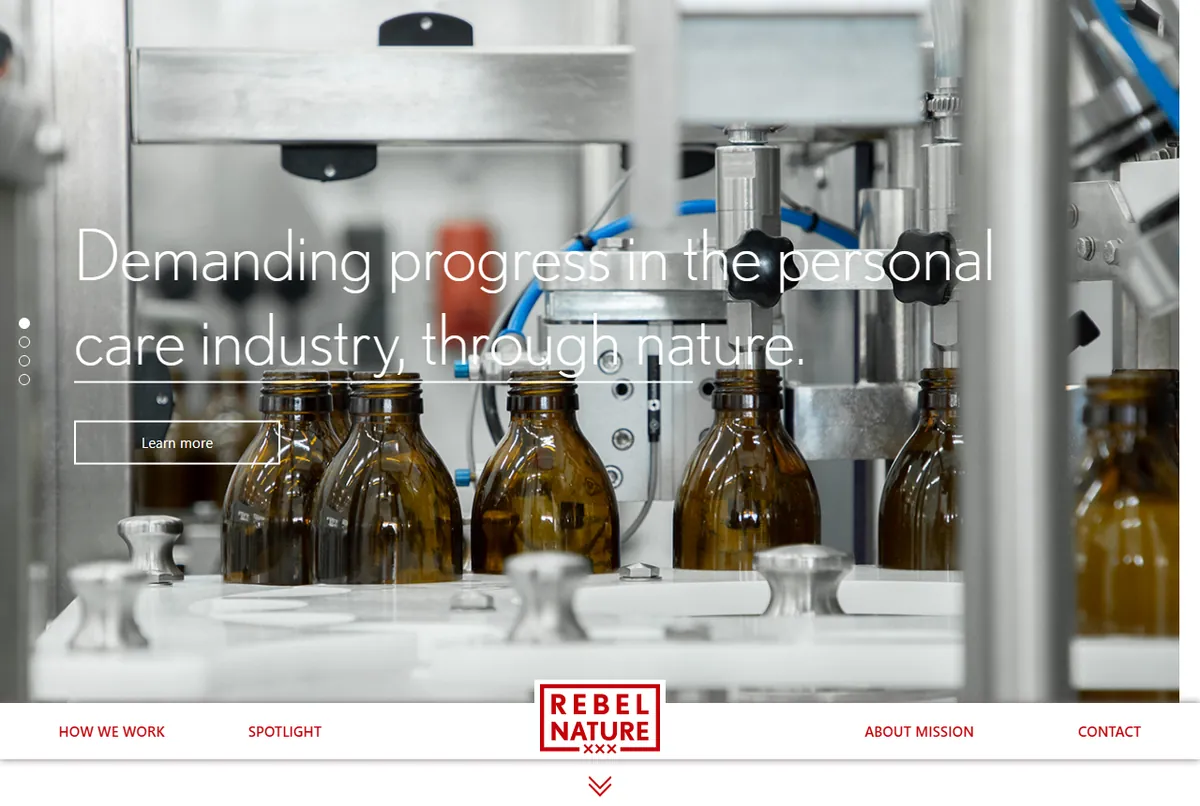
HQ: Zamenhofstraat 150, Amsterdam · Type: Contract manufacturer for natural personal care · Best known for: Low minimums on genuinely natural formulas
Rebel Nature develops and manufactures personal care products for brands working in the 100% natural segment, and it is the most accessible entry point on this list: stated minimums start at 2,000 pieces and scale past 50,000, across solid sticks, liquids, creams and powders. It works from a library of more than 500 natural or nature-derived raw materials and holds an EcoVadis Silver rating, which places it in the upper band of assessed suppliers in its sector. The scope is deliberately narrow — if your formula needs a conventional preservative system, a strong synthetic actives package or high-pigment colour, this is not the right plant. For a clean-beauty launch that wants small first batches and quick restocks, it is close to ideal.
10. RedPharma
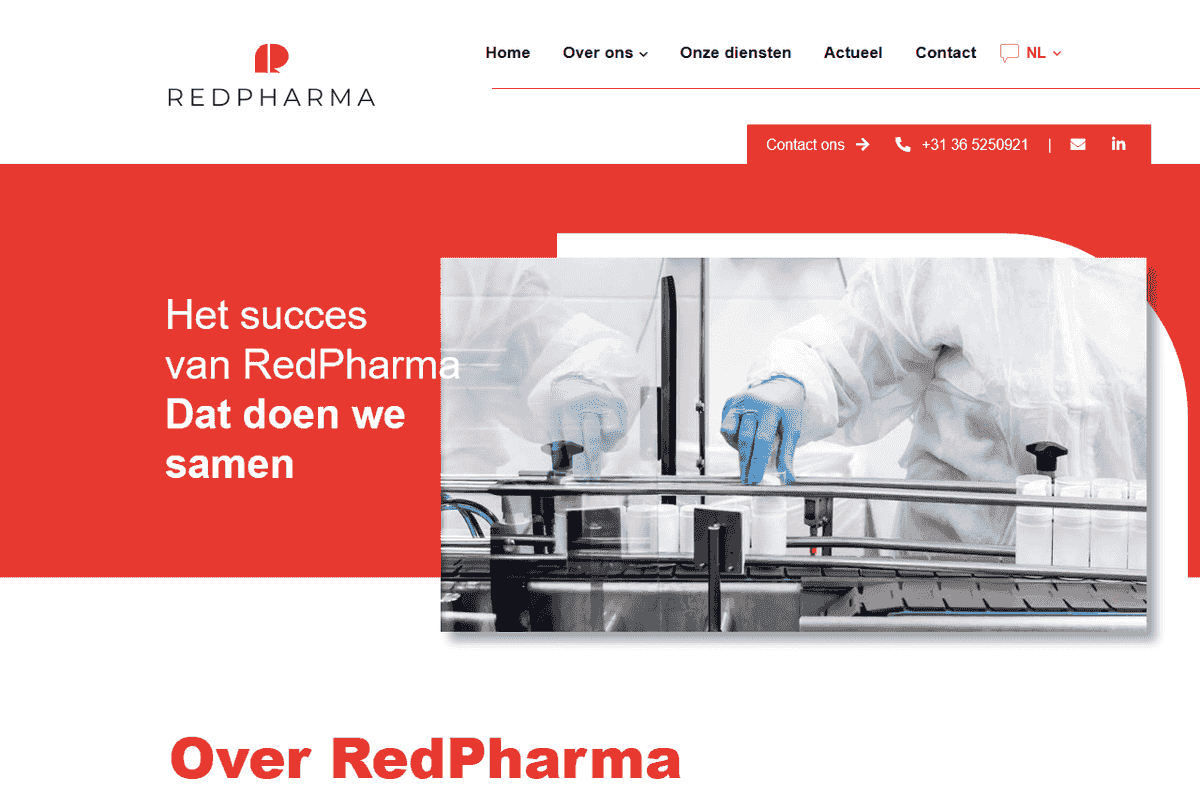
HQ: Draaibrugweg 31, Almere, Flevoland · Type: Contract manufacturer, cosmetics and medical devices · Best known for: Liquids and semi-solids on the cosmetic/device borderline
RedPharma Productie was founded in 2017 and is the youngest company here, built around development and production of cosmetics, cosmeceutical-style products and medical devices in liquid and semi-solid forms — gels, creams, lotions. It runs separate R&D, QA/QC/RA, production and logistics functions, and its regulatory-affairs emphasis is unusually visible for a company of its age, which is what you want if your product claims sit close to a medical borderline. It announced a production-capacity expansion on its own news page, a useful signal of demand. Being young cuts both ways: fewer reference years than Hegron or Mondial, so ask for references in your specific product form and check how long the current lines have been validated.
Notable exclusions: who we looked at and left out
Sixteen Dutch companies were researched. Six were dropped on scope or evidence grounds, and naming them is more useful than hiding the screen:
- Topbrands Europe (Oud-Beijerland) — captured cleanly and is a serious business at roughly €475 million turnover, but its own site describes an FMCG distributor and private-label developer that produces through partner factories. Excluded under the “must physically manufacture” rule, not on quality.
- Vipack (Landgraaf) — captured cleanly and appears on other Netherlands cosmetics lists, but its homepage states it develops and produces private-label liquid laundry and cleaning products. Wrong category.
- Jan Dekker (Wormerveer) — captured cleanly, real personal-care laboratory, but it is an ingredients and raw-material business, not a finished-goods contract manufacturer.
- Cobeco Pharma (Dordrecht) — captured cleanly and genuinely makes private label, but its catalogue is led by intimate wellness and food supplements rather than cosmetics. Same scope screen.
- B Futurist (Amsterdam) and Special Cosmetics (Wormerveer) — a wholesaler of branded beauty products and a consumer webshop respectively. Neither offers third-party manufacturing on the reachable site.
- Vitalforce Cosmetics (Breda) and Oxygen (Hulst) — both are still cited as live Dutch private-label manufacturers in 2026 round-ups. Both domains now serve “this website is for sale” parking pages. This is the clearest argument for capture-checking a list rather than copying one.
Methodology and limitations
Candidates were gathered by searching in English and Dutch for contract manufacturing, private label and loonproductie terms, then cross-checked against third-party directories. Sixteen official domains were tested with a browser user agent; twelve resolved. Each resolving site was captured in headless Chrome at 1280×860 with a virtual time budget of 18–22 seconds on 28 August 2026, and every image was inspected before use.
Two captures use an interior page rather than the homepage, and we say so rather than quietly swapping: Mondial Cosmetics is shown on its Services page because a consent banner cut through the homepage hero headline, and RedPharma is shown on its Over RedPharma page because the homepage hero renders blank in headless Chrome even at 22 seconds. Rejections were all presentation or scope failures, not judgements about the companies.
What this article did not do: no factory was visited, no certificate was inspected, no sample was ordered, and no client reference was contacted. Certification claims, capacity numbers, MOQ figures and category lists are company-stated as at 28 August 2026 and can change without notice. Prices and minimums in particular vary by formula, pack format and season — treat any number here as an order of magnitude, and see our guide to how MOQ, lead time and turnkey pricing actually work before you compare quotes. When you do get quotes, compare landed cost rather than unit price, and read the deposit and payment terms as carefully as the specification. Brands running the numbers on their own retail margin should also read our pricing guide for private-label beauty.
You can browse verified manufacturer profiles across markets in the OEMHallmark manufacturer directory.
Frequently asked questions
Which country is better for private-label cosmetics, the Netherlands or Poland?
It depends on what you are buying. Poland is the stronger choice on unit cost and on very large runs; its contract-manufacturing base is bigger and prices are typically lower for comparable skincare. The Netherlands wins on service depth, English-language project management, logistics through Rotterdam and Schiphol, and specific capabilities that are scarce elsewhere in Europe — makeup at volume, oral care, and cosmetic/medical-device dual certification. For a first 3,000-unit launch where you need hand-holding, Dutch suppliers are usually easier. For a repeat 100,000-unit order, get quotes from both. See our Poland listicle for direct comparisons.
What is a realistic minimum order quantity with a Dutch cosmetics manufacturer in 2026?
Company-stated figures from the manufacturers on this list cluster around 2,000–5,000 units per SKU for skincare, haircare and body care, and roughly 10,000 units for colour cosmetics, where tooling and shade-matching costs have to be spread. Rebel Nature publishes the lowest entry point at 2,000 pieces. Those numbers are per stock-keeping unit, not per order — a three-shade launch is three MOQs. Minimums also move with pack format: a custom-moulded component can raise the floor sharply even when the bulk formula does not.
Do I need a Dutch entity or licence to have cosmetics made in the Netherlands?
No. There is no Dutch pre-market licence for cosmetics and no requirement to register a Dutch company. What EU law requires is a Responsible Person established somewhere in the EU who holds the Product Information File, a signed safety assessment, and a CPNP notification before the product is sold in the EU. If you are outside the EU, decide deliberately who takes the Responsible Person role — your manufacturer, a paid RP service, or your distributor. If the distributor holds it, the notification is in their name and moving away from them later means re-notifying every product.
Can Dutch manufacturers produce halal or certified-natural cosmetics?
Some can, but verify the specific certificate rather than the claim. Girasol Natural Products states it offers halal as well as vegan and 100% natural formulations, and Rebel Nature is built entirely around natural and nature-derived raw materials with an EcoVadis Silver rating. For halal in particular, the question that matters is which certifying body issued the certificate and whether the market you are selling into recognises it — a European halal certificate is not automatically accepted by every importing authority in Asia, and that recognition question, not the formula, is usually what delays a shipment.
Update history
- 28 August 2026 — First publication. Sixteen Dutch companies researched, twelve domains resolved, ten captured clean and published; six named in exclusions, including two dead domains still cited elsewhere as active manufacturers.
Sources: each manufacturer’s official website, captured and read on 28 August 2026; Regulation (EC) No 1223/2009 via the European Commission cosmetics legislation portal; the EU Cosmetic Products Notification Portal; the CosIng ingredient database; ISO 22716:2007; and the NVWA cosmetics pages. Company capabilities, certifications and capacity figures are company-stated and were not independently audited. This article is editorial research, not a recommendation to contract with any company named — verify certificates, capacity and references directly before you place an order.
Related: Top 10 OEM/ODM Cosmetic Manufacturers in Switzerland (2026) — ten Swiss contract manufacturers, with eligibility rules and what the Swiss Made ordinance requires.