Switzerland is a small country with an outsized cosmetics reputation, and a genuine third-party manufacturing base sits behind it. Roughly 60 manufacturers belong to the Swiss Cosmetic and Detergent Association (SKW), which reckons its members account for around 90 per cent of the national industry and about CHF 2 billion in annual export turnover. A meaningful slice of that capacity is contract work — laboratories in Vaud, Ticino, St. Gallen, Bern and Zürich that formulate, fill and pack under someone else’s brand name. This guide profiles ten of them, each verified against its own live website during the first week of September 2026.
Switzerland is not a cheap place to manufacture, and no honest list should pretend otherwise. What it offers instead is a specific combination: small and mid-size batch capability, a formulation culture built around actives and sensorial skincare, and the legally controlled “Swiss Made” indication of source — which for cosmetics means at least 60 per cent of manufacturing costs and 80 per cent of research, development and production costs must arise in Switzerland, with the quality-defining manufacturing steps performed there. That is a claim you buy, not a claim you borrow.
Key takeaways
- Switzerland sells positioning, not price. Every manufacturer below competes on formulation depth, batch traceability and the Swiss Made indication — not on unit cost against Poland, Turkey or China.
- Batch sizes are genuinely small at the boutique end. Publicly stated figures range from around 100 units for a private-label programme to 100–15,000 kg per production batch, which suits brands launching a tight range rather than a national retail rollout.
- Switzerland is outside the EU but ingredient-aligned with it. Swiss cosmetics law adopts the EU annexes by dynamic reference, so an ingredient banned in the EU is banned in Switzerland — but there is no CPNP notification, and market control runs through cantonal laboratories instead.
- Two of the largest Swiss names are missing from this list on purpose. Mibelle Group and Steinfels Swiss are real, substantial manufacturers whose sites could not be captured cleanly in this research window; both are named in the exclusions section with the reason.
- Certification depth varies widely. ISO 22716 cosmetics GMP is common; Swissmedic pharmaceutical GMP, COSMOS organic and ISO 13485 for medical devices each appear only once or twice across the ten.
Who should read this, and what it answers
This guide is for brand owners and sourcing managers deciding whether a Swiss contract manufacturer belongs on their shortlist — typically for a premium skincare, cosmeceutical or clean-beauty line where the country of manufacture is part of the product story. It answers three questions: which Swiss companies genuinely offer OEM/ODM work to third parties, what each is best suited to, and what Swiss regulation actually requires of you. It does not answer what any of them will quote you; pricing and minimum order quantities are project-specific and none are published in a form worth reprinting. If you are still deciding between a Swiss and a lower-cost European base, our comparison of local versus overseas cosmetics manufacturing is the better starting point.
Eligibility and how this list was built
Every company below had to clear four screens before it could appear:
- It must physically manufacture in Switzerland. Distributors, brand developers producing through partner factories, and raw-material suppliers were excluded, however well they rank for Swiss manufacturing keywords.
- It must openly offer third-party work. The company’s own website has to present contract manufacturing, private label, white label or ODM services to external brands. Own-brand-only producers were excluded even when they are famous.
- Its catalogue must be cosmetics or personal care — skincare, hair, body, sun, deodorant or fragrance. Businesses where cosmetics sit as a minor division beside cleaning chemicals or unrelated categories were excluded.
- Its live website had to be captured cleanly on 4 September 2026 in a standard desktop browser window. Parked domains, maintenance pages, misconfigured hosting and screenshots where a consent or promotional overlay covered the hero were rejected rather than published.
Fifteen Swiss candidates were researched, fourteen resolved to a live site, and eleven captured cleanly; ten are profiled here. The numbering is alphabetical by company name, not a ranking. OEMHallmark does not sell ranking positions and does not score these companies against each other — the ordering is a navigation aid only. Company facts below (locations, certifications, batch ranges, founding years) are taken from each company’s own published material and are labelled as company-stated where they cannot be independently verified. No factory was audited and no sample was produced for this article.
What Swiss cosmetics regulation means for your product
Switzerland is not an EU or EEA member, so the rulebook differs from the one your European contract manufacturers usually quote. Cosmetics fall under the Federal Act on Foodstuffs and Utility Articles and, specifically, the FDHA Ordinance on Cosmetic Products (VKos) of 16 December 2016. The Federal Food Safety and Veterinary Office (FSVO) holds federal responsibility; day-to-day market surveillance is carried out by the cantonal laboratories, which sample and inspect after products are already on sale.
Three practical consequences follow. First, there is no pre-market notification portal — nothing equivalent to the EU’s CPNP. Switzerland runs a self-monitoring model, which shifts the burden onto your documentation rather than onto a submission. Second, you still need a full product information file and safety assessment; a Swiss factory will normally build the technical dossier, but confirm in writing who owns it and whether it transfers if you change supplier. Our explainer on the cosmetic product safety report sets out what that file has to contain. Third, the responsible person for Switzerland must be a natural person contactable by the Swiss authorities and cannot sit abroad — a detail that surprises brands assuming their EU responsible person covers both markets.
On ingredients, Swiss law adopts the annexes of EU Regulation (EC) No 1223/2009 by dynamic reference, so restricted and prohibited substance lists move in step with Brussels automatically. The FDHA amended VKos with effect from 1 January 2026 to tighten limits on certain furocoumarins, which is the kind of change a competent Swiss manufacturer should raise with you unprompted. For the manufacturing-quality side, ISO 22716 remains the reference standard — see our guide to cosmetic GMP and ISO 22716 for what a certificate does and does not prove.
The list at a glance
| Company | Base | Best suited to | Main limitation |
|---|---|---|---|
| alpinacos AG | Kägiswil / Büron | Natural and functional care, full-service private label | German-language site; certifications not itemised on the homepage |
| Cosmetolab SA | Wädenswil, Zürich | Natural-active skincare with a long formulation heritage | No certifications named publicly |
| Cosmotec | Vouvry, Valais | Face and body care built around Alpine spring water | Narrower category range than the larger houses |
| Frike Group | Mönchaltorf, Zürich | Aerosols, foams and unusual formats; certified natural cosmetics | Cosmetics sit alongside a wider industrial group |
| Intercosmetica Neuchâtel SA | Neuchâtel | Established skincare OEM/ODM with formal quality certification | Group-owned, so priorities may follow parent programmes |
| M. Opitz & Co. AG | St. Gallen | Brands wanting cosmetic and pharmaceutical GMP under one roof | Site is German-first; smaller family operation |
| MySwissLab+ | Forel | Low-volume launches and colour cosmetics | Founded 2018 — the shortest track record here |
| Swiss Cosmetic Technology (SCT) | St-Prex, Vaud | Professional-use and clinic-channel formulations | Certification detail is shown as logos, not named standards |
| Swiss VitalCare GmbH | Heimberg, Bern | Cosmeceuticals and ready-to-licence collections | Stated batch floor of 100 kg suits mid-size, not micro, runs |
| Temmentec AG | Sumiswald, Bern | Skincare-focused OEM/ODM with a long site history | Skincare only — no colour or fragrance capability shown |
Company details as published on each manufacturer’s own website, reviewed 4 September 2026. Alphabetical order.
1. alpinacos AG
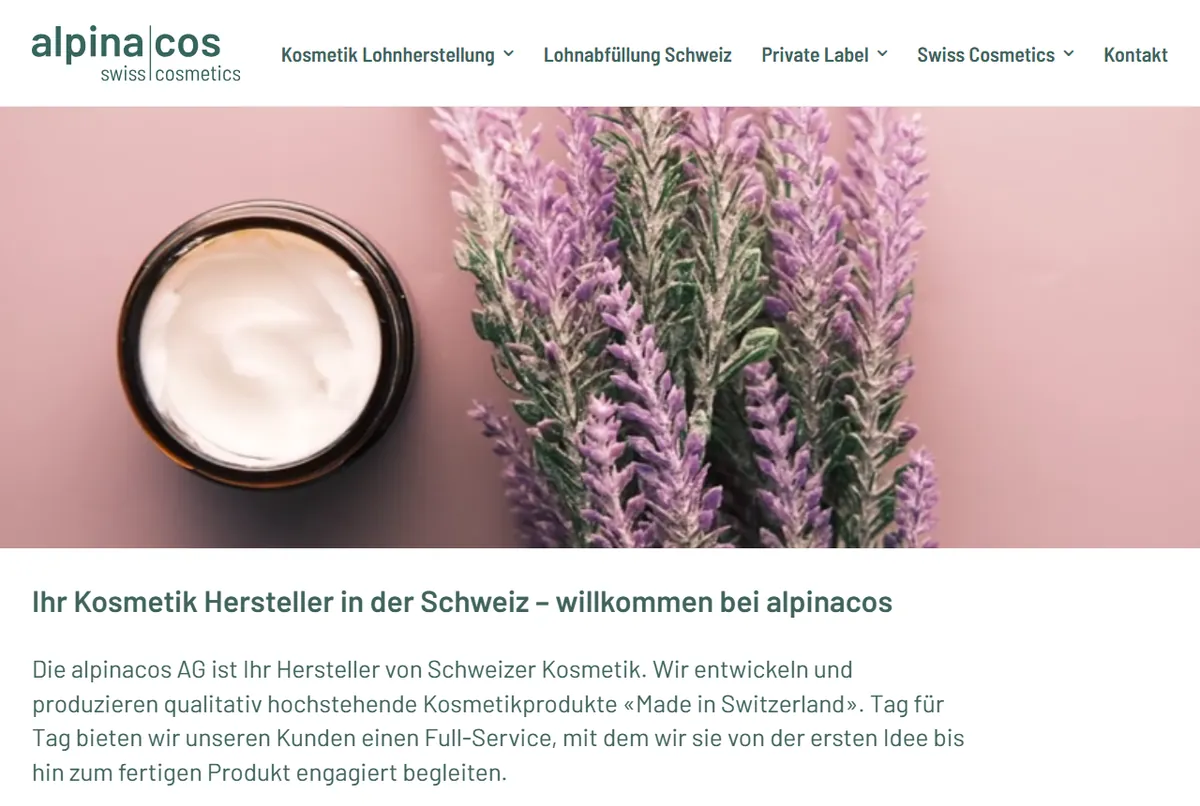
HQ: Kägiswil, Obwalden (production in Büron, Lucerne) · Type: Full-service contract manufacturer & private label · Best known for: Natural and functional care made in Switzerland
alpinacos presents itself plainly as a Swiss cosmetics manufacturer offering the full chain — formulation development from house recipes or from scratch, production, filling, labelling, assembly and dispatch. The split between an Obwalden head office and a Lucerne production site is worth noting when you plan factory visits. Its own site refers to holding the certificates customary in the industry without itemising them, so ask for the actual certificate scans and expiry dates early rather than taking the phrase at face value.
This is a sensible first call for a brand wanting a genuinely Swiss natural-care range with a single point of contact from concept to pallet, and it is comfortable working in German — useful if your team is DACH-based, less so if you need English-language technical files by default.
2. Cosmetolab SA
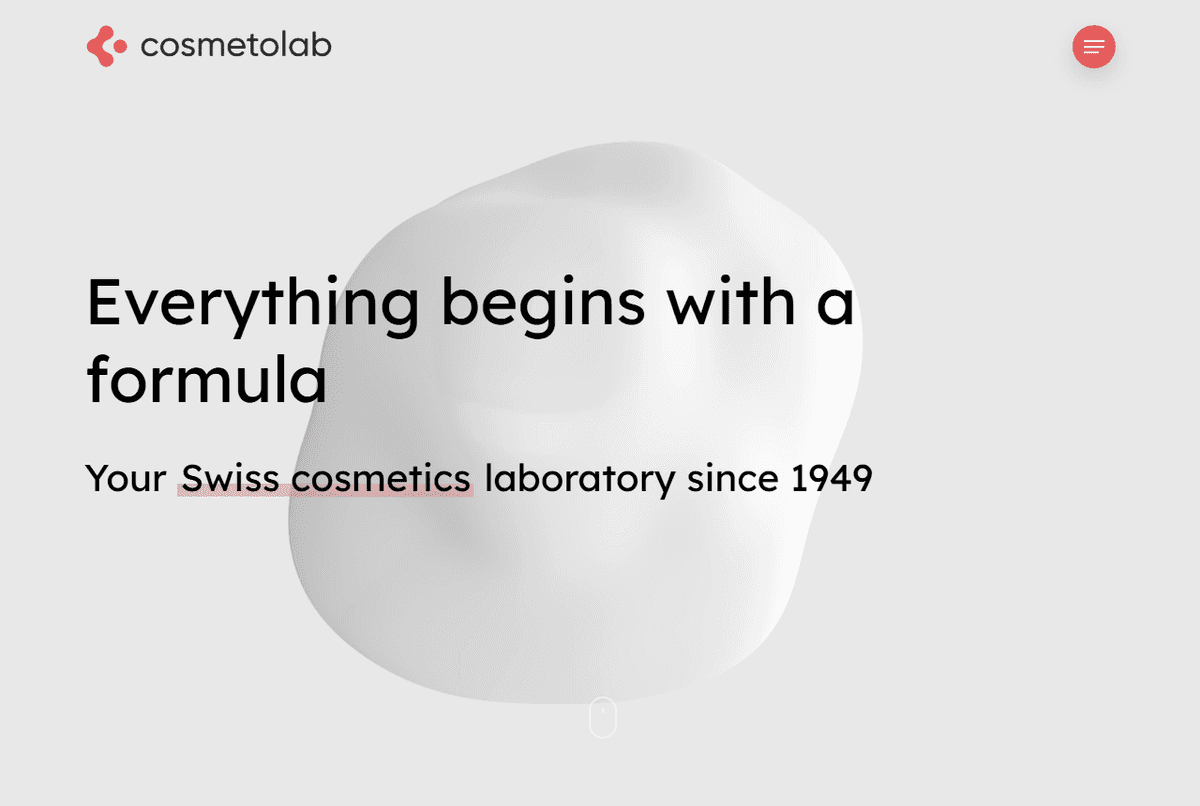
HQ: Wädenswil, Zürich · Type: Cosmetics laboratory & contract manufacturer · Best known for: Natural-active skincare formulation since 1949
Cosmetolab describes itself as a Swiss cosmetics laboratory operating since 1949, working with a stated library of more than 250 natural active ingredients and covering formulation, production, packaging, quality control and logistics. It positions its output as vegan and cruelty-free with full batch traceability, and it explicitly serves both new brands and companies already trading.
The formulation-first framing is the draw here: this is a house that leads with the recipe rather than the filling line, which suits a brand whose differentiation is a specific active or texture. The counterweight is that no certification is named on the public site, so the GMP conversation has to happen in the first meeting rather than being settled in advance.
3. Cosmotec
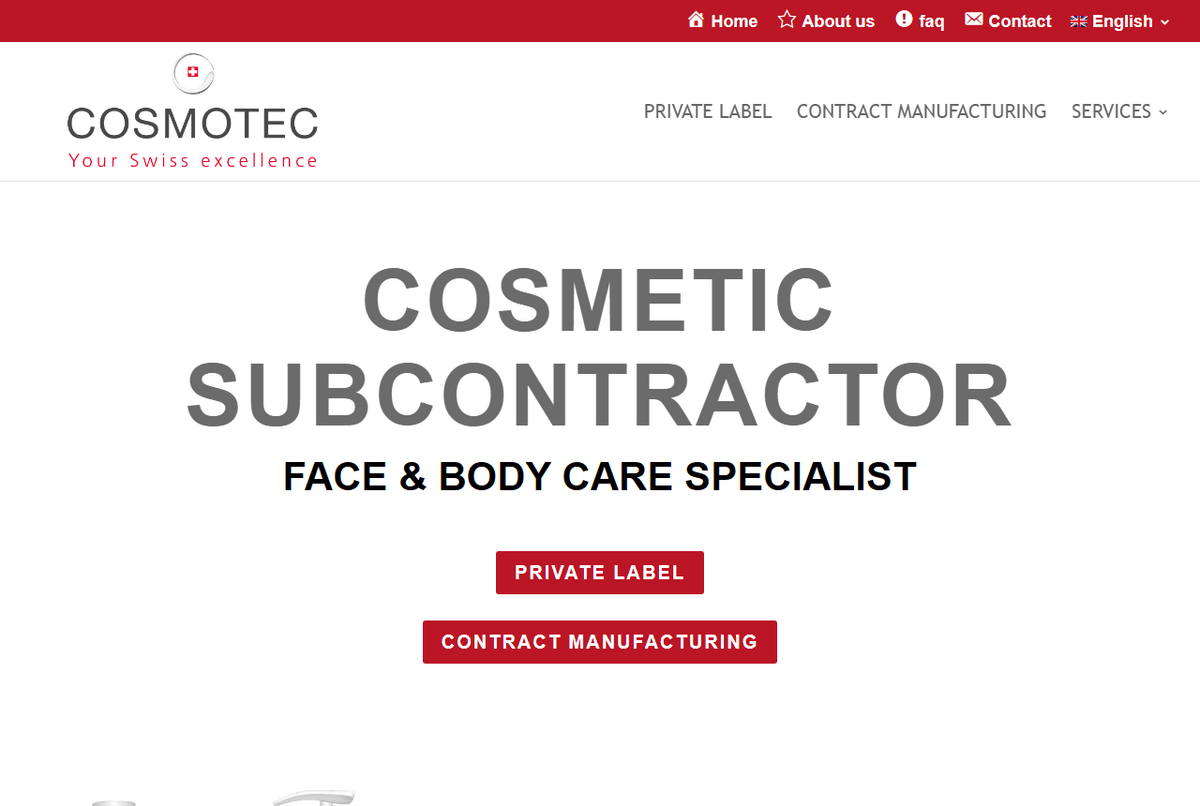
HQ: Vouvry, Valais · Type: Cosmetic subcontractor & private label · Best known for: Face and body care formulated with Alpine spring water
Cosmotec calls itself a cosmetic subcontractor and face-and-body-care specialist, operating from the Valais since 1988 and citing ISO 22716 GMP certification. Its offer covers private label, custom contract formulation, an in-house R&D laboratory, regulatory assistance, production, packaging and logistics, with a stated emphasis on cosmetics built around pure Alpine spring water.
Of the smaller houses on this list, Cosmotec is the one with the clearest named GMP position and the most defined product story. The trade-off is scope: hair care appears in its range but the centre of gravity is face and body, so a brand planning a broad multi-category launch will likely need a second supplier.
4. Frike Group
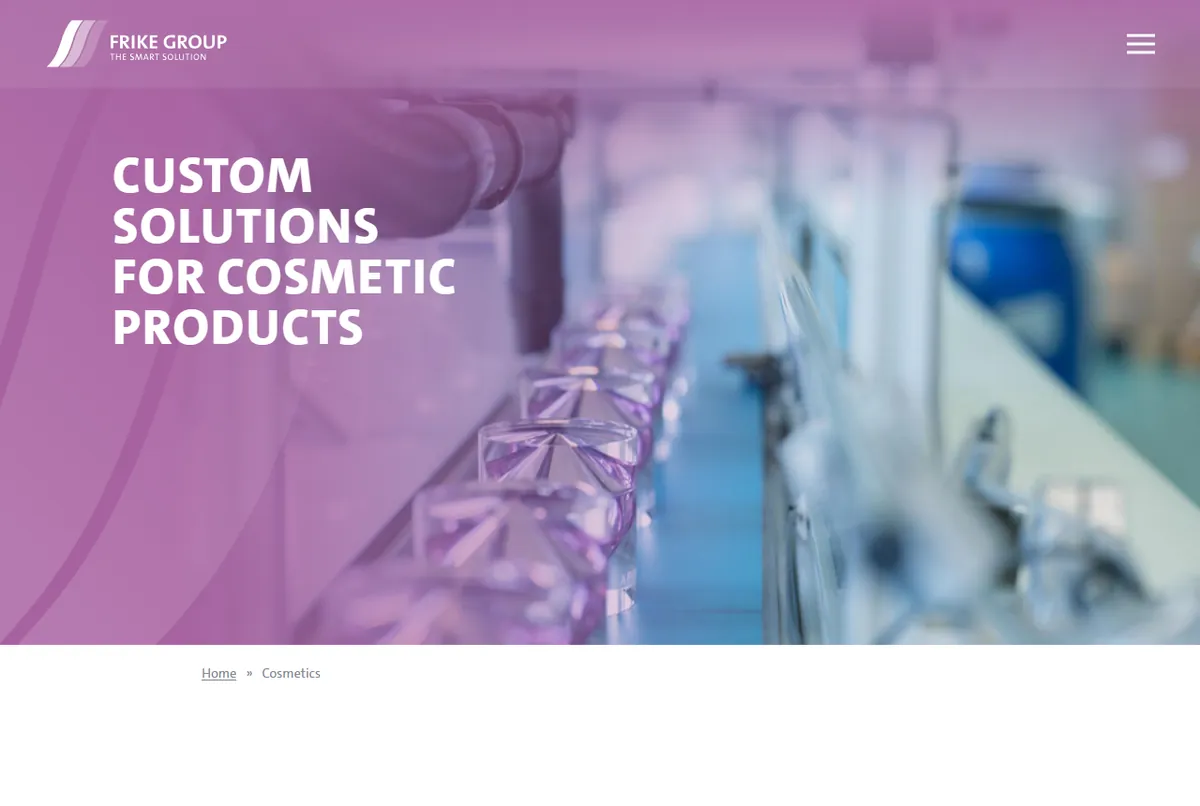
HQ: Mönchaltorf, Zürich · Type: Contract manufacturer & filler · Best known for: Aerosols, foams and sprays alongside conventional emulsions
Frike is the format specialist here. Its cosmetics division lists aerosols as foams, sprays and gels, plus creams, emulsions, gels, liquids, oils, powders, pastes, serums and waxes, filled into aluminium, plastic and glass containers from 50 ml to 3,000 ml as well as sachets and recycled-material alternatives. Categories span facial and body care, hair, sun protection, deodorants, oral care and powder cosmetics, and the group publishes ISO 9001 and ISO 22716 alongside COSMOS and EcoCert certification.
If your product needs a pressurised or unusual format — a mousse, a dry shampoo, a propellant sunscreen — this is the most obviously equipped Swiss option on the list, and the certified-natural credentials are unusually well documented. Note that cosmetics is one arm of a broader industrial group, so establish early how your programme is prioritised against its other business lines.
5. Intercosmetica Neuchâtel SA
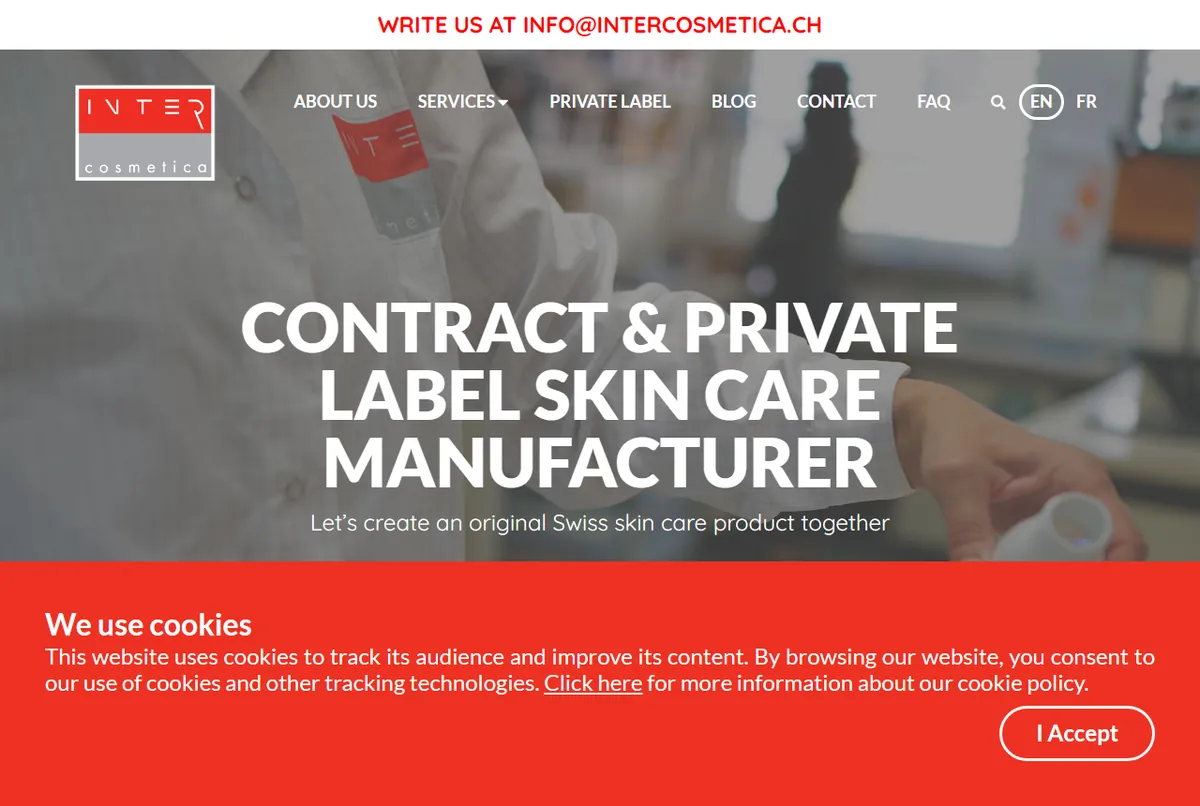
HQ: Neuchâtel · Type: OEM private label & full-service ODM · Best known for: Long-established Swiss skincare contract manufacturing
Intercosmetica states more than 60 years in the cosmetic industry and holds both ISO 22716:2007 and ISO 9001:2015, covering formulation, packaging and filling for skincare. It is part of the Zepter International group, which gives it a corporate backbone most of the boutique laboratories on this list do not have.
For a brand that wants documented quality management rather than a promise of it, this is among the better-evidenced entries — the certifications are named, dated by standard version, and tied to a facility with a long operating history. The group ownership cuts both ways: it brings stability, but a small external brand should ask directly about capacity allocation against internal programmes.
6. M. Opitz & Co. AG
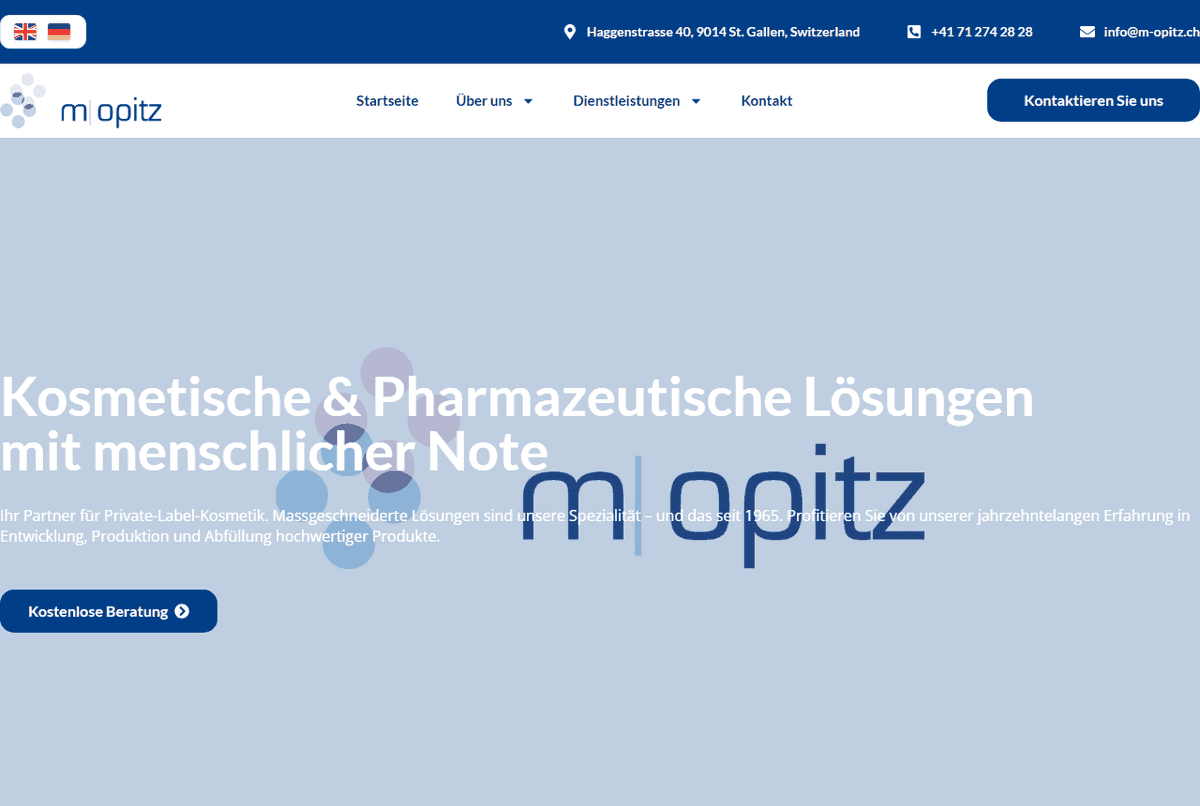
HQ: St. Gallen · Type: Contract manufacturer, filler & private label · Best known for: Cosmetic and pharmaceutical production under one roof
Founded in 1965 and now in its third generation of family management, M. Opitz develops, produces and fills cosmetic and pharmaceutical products from a single St. Gallen site. The company states ISO 9001 and ISO 22716 cosmetics GMP alongside Swissmedic pharmaceutical GMP — a combination that only one other company here comes close to.
That dual-GMP position is the reason to shortlist it. If your roadmap includes a product that may drift toward a medicinal or borderline claim, or you want dermatological credibility in the manufacturing story, a factory already inspected to pharmaceutical standards changes the conversation. The site leads in German and this is a mid-size family firm, so expect a relationship-led rather than an account-managed process.
7. MySwissLab+
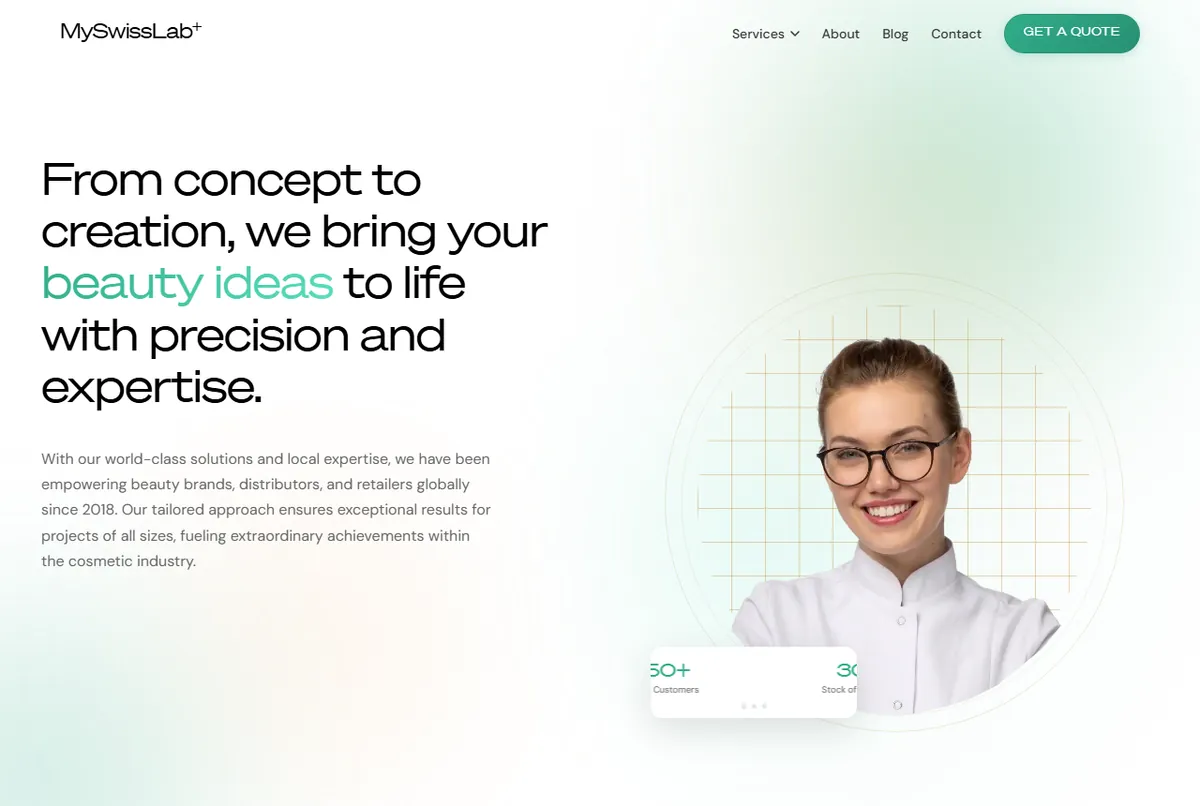
HQ: Forel · Type: Private label, white label & custom formulation · Best known for: Low minimum quantities and colour cosmetics
MySwissLab is the most accessible entry point on this list for a small brand. It states ISO 9001:2015 accreditation and adherence to ISO 22716 cGMP, and publishes a private-label starting point of around 100 units — a figure worth confirming per format, since caps, decoration and packaging rarely move at the same minimum as bulk. Its scope covers makeup, styling and hair care as well as skincare, plus microbiology, preservative-efficacy and stability testing and safety-report preparation.
The in-house testing offer is the genuinely useful part: it removes a coordination headache for founders who would otherwise be managing a separate laboratory. Weigh that against the shortest track record here — the company dates its work from 2018 — and ask for references in your specific category. Our note on the trade-offs of low-MOQ manufacturing covers what you give up at that end of the market.
8. Swiss Cosmetic Technology (SCT)
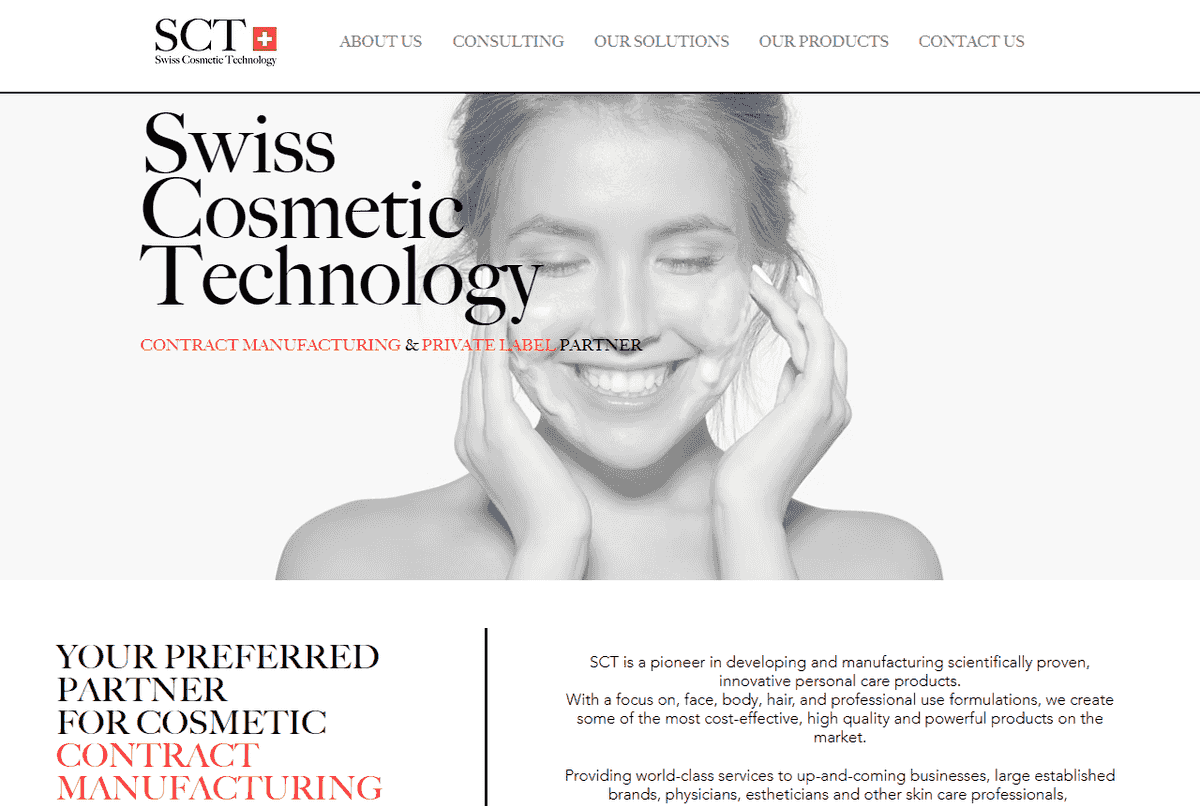
HQ: St-Prex, Vaud · Type: Contract manufacturing & private label · Best known for: Professional-use and clinic-channel formulations
SCT states more than 30 years in the industry and a team including pharmacists and physicians, producing serums, creams, gels, oils, lotions, soaps and shampoos across face, body, hair and professional-use ranges. It also bundles the non-manufacturing services many small brands need — regulatory support for international markets, branding and packaging design, and logistics — and advertises a private-label range delivered within roughly three months.
The professional and physician-channel orientation is the differentiator: if you are selling into clinics, spas or esthetician networks rather than retail, that experience is worth more than a marginal price difference. Certification is displayed as GMP and ISO logos without the standard being named on the page, so ask for documents before you brief a formulation.
Visit Swiss Cosmetic Technology →
9. Swiss VitalCare GmbH
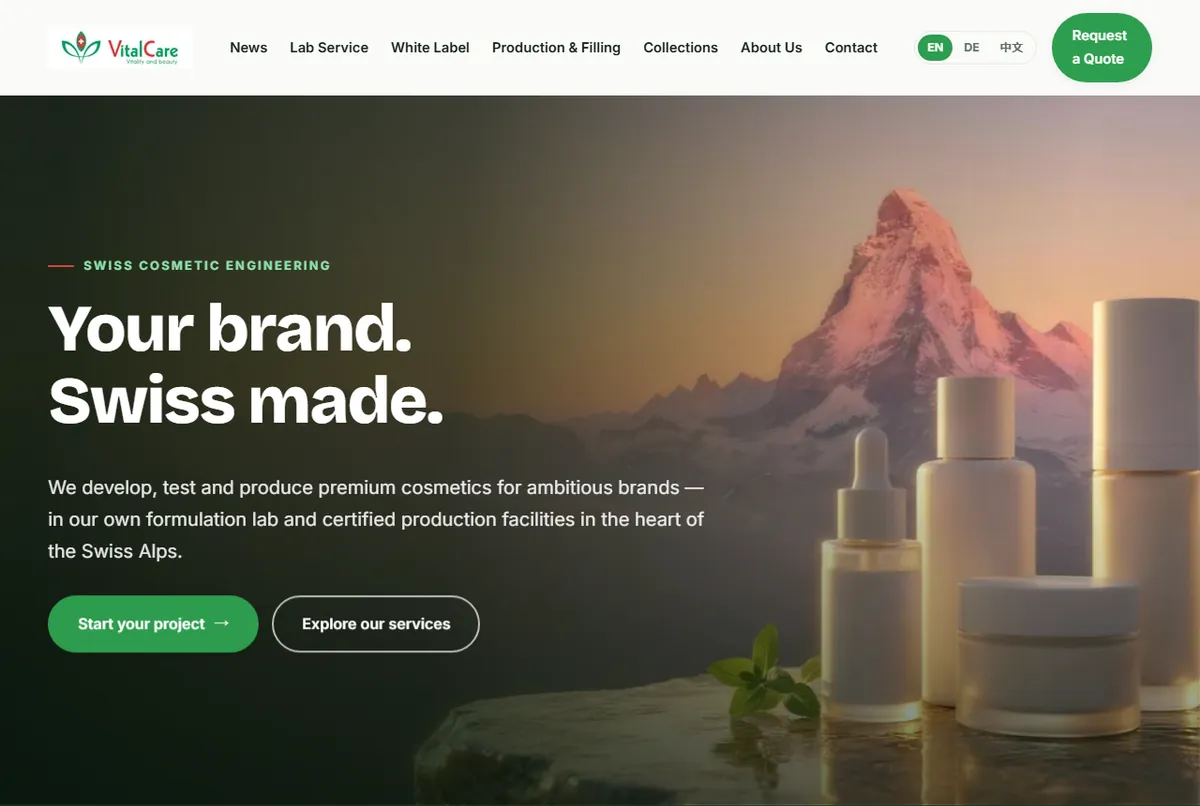
HQ: Heimberg, Bern (near Interlaken) · Type: Formulation lab, white label & OEM/ODM · Best known for: Cosmeceuticals and licensable ready-made collections
Swiss VitalCare states over 20 years developing, testing and producing cosmetics and para-pharmaceutical products, with ISO 22716 cGMP production, SQS ISO 9001:2015, COSMOS Organic/BDIH and cruelty-free certification. Production capacity is given as 100 kg to 15,000 kg per batch, and it offers twelve ready-to-launch collections — anti-ageing, sun care, anti-acne, radiance, lifting and firming among them — that a brand can license under its own name.
This is the most certification-dense entry on the list and the clearest fit for a brand that wants a credible range on shelf quickly without funding bespoke formulation. The published batch floor of 100 kg is the constraint to check against your forecast: for a 50 ml cream that is thousands of units, which is a different commitment from a 100-unit private-label trial.
10. Temmentec AG
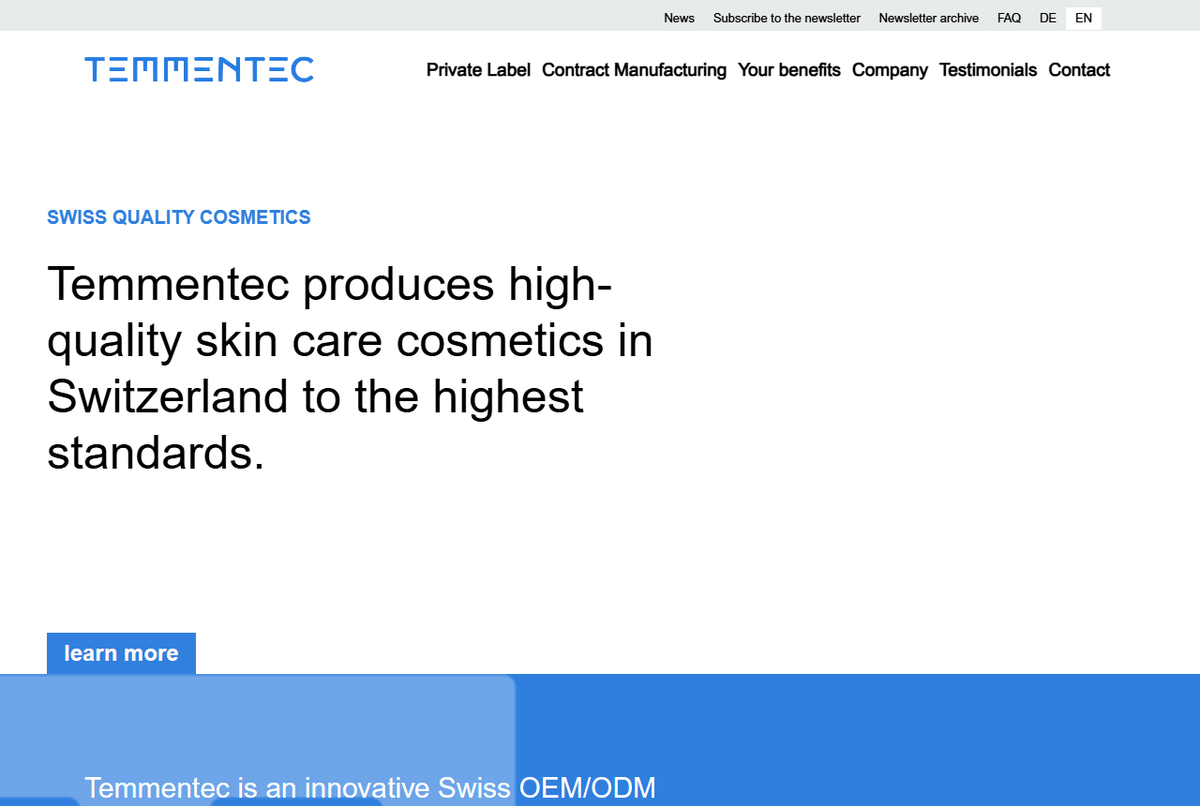
HQ: Sumiswald, Bern · Type: OEM/ODM contract manufacturer · Best known for: Skin care cosmetics, with the site in operation since 1916
Temmentec describes itself as an innovative Swiss OEM/ODM manufacturer of skin care cosmetics for both start-ups and large companies, offering product development, manufacturing, packaging, quality assurance and logistics either individually or as one integrated package. Its Sumiswald location has been in operation since 1916, and it publishes an EcoVadis Bronze sustainability rating from 2023.
The willingness to take individual steps rather than only turnkey projects is genuinely useful: a brand that already owns its formula but has outgrown a smaller filler can buy production alone. Scope is the limitation — this is a skincare house, so colour cosmetics, fragrance and aerosol formats are not part of the offer.
Notable exclusions — who was considered and left out
Naming the companies that did not make the list is as informative as the list itself, because several are widely cited elsewhere:
- Mibelle Group (Buchs, Aargau) — by revenue the largest private-label personal care manufacturer in Switzerland and among the largest in Europe, now part of the Spanish Persán group. Excluded here only because a full-screen consent dialogue sat over the hero on capture, so no clean verified screenshot could be produced. Its orientation is also mainly retailer private label rather than open contract work for independent brands.
- Steinfels Swiss (Winterthur) — a genuine private-label cosmetics and home-care manufacturer and a division of Coop, trading on Swiss quality since 1832. Rejected on the same capture rule: stacked privacy and newsletter modals covered the hero on both the homepage and the private-label page.
- Swissskintec (Herrliberg) — a real contract manufacturer and filler for baby, children’s and luxury cosmetics, but on 4 September 2026 its website returned a “this site is currently undergoing maintenance” page. We do not link readers to a site we cannot verify.
- Jüstrich Cosmetics AG (Diepoldsau, St. Gallen) — an established Swiss contract manufacturer whose domain returned a “domain not configured” server page and a mismatched TLS certificate during this research window. Worth re-checking; not listable today.
- Carasa Lab — ranks strongly for Swiss cosmetic manufacturing searches but is registered and produces in Oiartzun, Gipuzkoa, Spain. A landing page targeting a country is not a factory in it, and this is the second time the same company has surfaced in our country research under a different flag.
- Weleda AG (Arlesheim) — one of the best-known cosmetics manufacturers on Swiss soil, excluded under the third-party rule: it manufactures its own brand rather than offering contract production to others.
- SwissNess Cosmetics (Belmont-sur-Lausanne) — captured cleanly and qualifies on every screen, with stated capacity from 100 to 10,000 litres per batch across cosmetics and perfumery in ISO 8 clean rooms. Held over only to cap this list at ten; a strong candidate for the next update.
- ENOVA SWISS (Giubiasco, Ticino) — an ISO 13485 laboratory developing dermocosmetics, peels and aesthetic medical devices for third parties. Identified late in the research window and not screenshot-verified in time, so it is flagged here rather than profiled.
What to compare before you commit
A Swiss shortlist narrows quickly once you push past the homepage. Four things separate the ten above in practice.
The real batch floor, per format. A stated minimum of 100 units almost never applies uniformly — the bulk may be flexible while the printed carton, the decorated bottle or the custom cap carries its own minimum in the thousands. Ask for the minimum on every line of the bill of materials, not the headline figure. Our explainer on MOQ, lead time and turnkey covers where those numbers actually come from.
Who owns the formula and the dossier. A house formula adapted for you is usually not yours to take elsewhere. If exit rights matter, settle them before development starts, in writing, alongside who holds the product information file and what happens to it if you change supplier.
Whether “Swiss Made” is actually available to you. The indication is legally defined, not decorative. If most of your value sits in imported bulk or a foreign-filled component, your product may not qualify even though it was assembled in Switzerland — and the marketing premium you priced in disappears. Get the manufacturer to confirm in writing whether your specific formulation and packaging plan meets the threshold.
Documentation before pricing. Certificates, audit reports, stability protocols and change-control procedures tell you more about a factory than a quotation does. The documents to request from a cosmetics manufacturer is the list we would send first, and the broader method in vetting an overseas manufacturer applies to Switzerland as much as anywhere else.
If Switzerland turns out to be too expensive for your first run, the comparable European bases we have profiled are the Netherlands, Poland, Italy and Germany — and the full set of profiled companies sits in the OEMHallmark manufacturer directory. For the arithmetic of what a Swiss unit cost does to your retail price, see our breakdown of the cost of manufacturing a private label skincare product.
Frequently asked questions
Do I need to notify a cosmetic product in Switzerland before selling it?
No. Switzerland has no pre-market notification portal equivalent to the EU’s CPNP. It operates a self-monitoring model under the Ordinance on Cosmetic Products (VKos): you must hold a complete product information file and safety assessment, manufacture under GMP, and be able to produce that documentation on request. Enforcement happens after launch, through sampling and inspection by cantonal laboratories under the Federal Food Safety and Veterinary Office. You must also name a responsible person who is a natural person reachable in Switzerland — that role cannot be delegated to an EU-based representative. Requirements change; confirm the current position before you launch.
Can a product made in Switzerland be sold in the EU without reformulating?
In most cases yes, because Swiss cosmetics law adopts the ingredient annexes of EU Regulation (EC) No 1223/2009 by dynamic reference, so restricted and banned substance lists stay aligned. The difference is procedural rather than chemical: to sell in the EU you still need an EU-established responsible person, a CPNP notification and EU-compliant labelling, none of which Swiss compliance provides. Treat the Swiss dossier as a strong starting point that an EU responsible person adapts, not as a finished EU submission. Confirm the position with a regulatory adviser for your specific formulation.
What does “Swiss Made” legally require for a cosmetic product?
For cosmetics, the Swiss indication of source requires that at least 60 per cent of manufacturing costs and at least 80 per cent of research, development and production costs arise in Switzerland, and that the activities which particularly determine the product’s quality take place there. The framework sits in the Swissness legislation administered by the Swiss Federal Institute of Intellectual Property and has applied since January 2017. Filling an imported bulk in Switzerland does not automatically qualify. Ask your manufacturer to confirm in writing whether your specific formulation and packaging plan clears the thresholds before you print the claim.
Is a Swiss manufacturer realistic for a brand launching only a few thousand units?
Sometimes, but the answer depends entirely on which company you approach. At one end, MySwissLab publishes a private-label starting point around 100 units; at the other, Swiss VitalCare states batch capacity from 100 kg, which for a 50 ml cream translates to thousands of units per run. The bulk minimum is rarely the binding constraint anyway — decorated packaging and printed components usually carry higher minimums than the formulation. Get a per-component minimum quote from two or three of the smaller houses before concluding Switzerland is out of reach.
Limitations of this research
This article is desk research, not an audit. No factory was visited, no quality system was inspected, no sample was produced and no reference customer was interviewed. Certifications, batch capacities, founding dates and service scopes are as published by each company and are marked as company-stated where they cannot be verified independently; certificates expire and scopes change, so request current documents directly. The capture rule that filtered this list — a clean screenshot on a single day — is a proxy for a live, maintained web presence, not for manufacturing quality: two of the largest Swiss manufacturers were excluded by it despite being entirely legitimate businesses. Prices, minimum order quantities and lead times are not compared here because they vary by formulation, packaging and volume, and any published figure would mislead more than it informs.
Sources and update history
Primary sources: the ten manufacturers’ own websites (reviewed 4 September 2026); the FDHA Ordinance on Cosmetic Products (VKos) and the Federal Act on Foodstuffs and Utility Articles; the Swiss Cosmetic and Detergent Association (SKW) for the industry framework and the dynamic reference to EU annexes; the Swiss Federal Institute of Intellectual Property for the Swiss Made ordinance for cosmetics; and EU Regulation (EC) No 1223/2009 for the referenced ingredient annexes.
Update history: 4 September 2026 — first published; fifteen candidates researched, fourteen resolved, eleven captured cleanly, ten profiled.
Written and researched by Priya Nair. Fact-checked by Evelyn Chong. Company screenshots were captured from each manufacturer’s live website on 4 September 2026 and are reproduced for identification. Regulatory summaries are general information, not legal or regulatory advice — verify current requirements with the Federal Food Safety and Veterinary Office, your cantonal authority, or a qualified regulatory consultant before you commit to a market.