Canada is the quiet option in North American cosmetics sourcing: a manufacturing base that fills for United States retail shelves without being in the United States, on a currency that has run well below the US dollar for a decade. The ten companies below are real, currently trading Canadian manufacturers whose official websites we opened and captured in August 2026 — not a directory scrape, and not a list of trading agents.
Article type: researched listicle · Written and researched by Marcus Tan, Private Label & Beauty Sourcing Consultant · Fact-checked by Priya Nair, Indie Beauty Brand Strategist · Last reviewed 7 August 2026
Quick answer
Canada’s OEM/ODM cosmetics sector splits into three tiers. At the top sit large private-label houses filling retail-scale volume, led by Apollo Health & Beauty Care in Toronto. In the middle are established mid-size contract manufacturers such as Clamar Cosmetics, ATS Health & Beauty Care and Vicora Cosmeceuticals, most of them clustered in the Greater Toronto Area. The third tier is a genuinely low-minimum group — Pinnacle Cosmetics and Nature’s Own Cosmetics both publish a no-MOQ private-label offer, which is unusual anywhere. Cosmetics sold in Canada are regulated by Health Canada under the Cosmetic Regulations, not by a pre-market approval system.
Key takeaways
- Canada’s real structural advantage is proximity plus currency: a Toronto or Vancouver factory ships into the United States on ground freight under CUSMA rules of origin, priced in Canadian dollars.
- The lowest published minimums in this entire listicle series are Canadian. Pinnacle Cosmetics and Nature’s Own Cosmetics both advertise no MOQ on private-label lines — a genuine entry point for a first SKU, with the packaging caveat below.
- Geography is concentrated. Seven of the ten are in Ontario, six of those in or beside Toronto. British Columbia contributes two specialist labs; Alberta contributes one. Quebec’s largest player is absent for the reason given in Notable exclusions.
- Regulation here is post-market, not pre-market. Health Canada requires a Cosmetic Notification Form within ten days of first sale and enforces the Cosmetic Ingredient Hotlist — there is no product licence to wait for, which shortens launch timelines relative to markets with pre-market registration.
- Several of these companies also hold a Health Canada Site Licence for natural health products or a US FDA registration. That matters if your formula crosses into OTC or NHP territory, and it is the single most useful thing to confirm before you shortlist.
How we chose, and who qualifies
Listed alphabetically by company name. The numbers are labels, not a ranking, and OEMHallmark does not sell placement.
To appear on this list a company had to pass all four screens, applied in August 2026:
- Physically manufactures in Canada. Sourcing agents, importers and foreign laboratories running Canada-targeted landing pages were excluded, however convincing the page. This screen removes more candidates than any other in this market.
- Publicly offers contract manufacturing, private label or ODM. An own-brand producer with no contract offer does not belong in an OEM/ODM list.
- Has a live, verifiable official website. We loaded each site in a real browser and captured the page; every screenshot below is that capture.
- Makes cosmetics or personal care as a named product line, not only supplements, cleaning chemistry or pharmaceutical contract work.
We did not audit any factory, inspect any certificate, request a quotation or test a product. Everything below comes from each company’s published material, which is why certifications are reported as claimed rather than verified. If this is your first overseas or cross-border shortlist, our guide to vetting an overseas cosmetics manufacturer sets out which documents to request before any deposit moves.
The list at a glance
| Company | Base | Best suited to | Main limitation |
|---|---|---|---|
| Apollo Health & Beauty Care | Toronto, ON | Retail-scale private label and control label | Built for volume, not for a first trial SKU |
| ATS Health & Beauty Care | Toronto, ON | Hair care and textured-hair programmes | Published MOQ of 5,000 pieces per SKU |
| Clamar Cosmetics | Pickering, ON | Colour cosmetics with formula validation | No certifications published on the site |
| Cosmaceutical Research Lab | Surrey, BC | OTC drug and NHP-adjacent personal care | West-coast base, away from the Ontario cluster |
| Cosmetic Labs Canada | Sault Ste. Marie, ON | Small brands wanting label and packaging done too | Remote location; northern Ontario freight |
| DBO Labs | Burnaby, BC | Formulation-led skincare and hair care | Boutique scale; no published certifications |
| Nature’s Own Cosmetics | North York, ON | Colour cosmetics and special-effects makeup | Catalogue-driven; less custom-formulation depth |
| Pinnacle Cosmetics | Etobicoke, ON | First-time brands testing colour and skincare | Stock-formula model; limited custom development |
| Swift Innovations | Ponoka, AB | Natural and bioactive-led formulation | Small; strongest on R&D rather than scale |
| Vicora Cosmeceuticals | North York, ON | Organic-certified and US-export skincare | No published minimums or capacity figures |
1. Apollo Health & Beauty Care
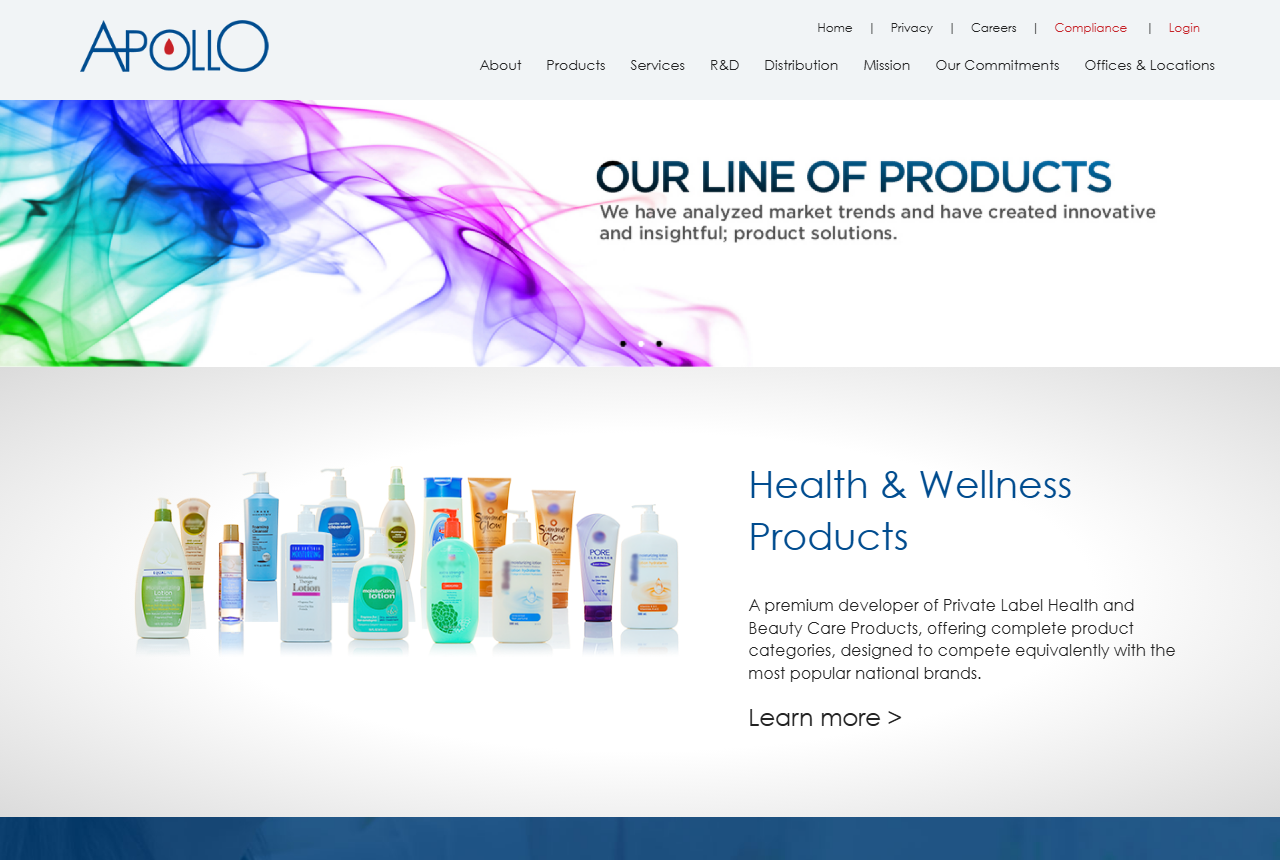
HQ: 1 Apollo Place, Toronto, Ontario · Type: Private label, control label and contract manufacturer · Best known for: National-brand-equivalent personal care at retail volume
Apollo describes itself as the largest private label and control label personal care manufacturer in Canada, and the published range supports that positioning: liquid soap and sanitisers, body wash, hair care, skin care, specialty bath, kids and baby care, and seasonal gift programmes. The company states its R&D team maintains a library of independently tested national-brand-equivalent generics, which is the classic control-label model — the retailer’s own line sitting beside the brand it benchmarks. Distribution is named across North America plus Latin America, Europe and Asia. This is not a starter factory: the offer is built around mass, drug and specialty retail programmes, so expect the conversation to begin at volumes a first-time brand will not have.
Visit Apollo Health & Beauty Care →
2. ATS Health & Beauty Care
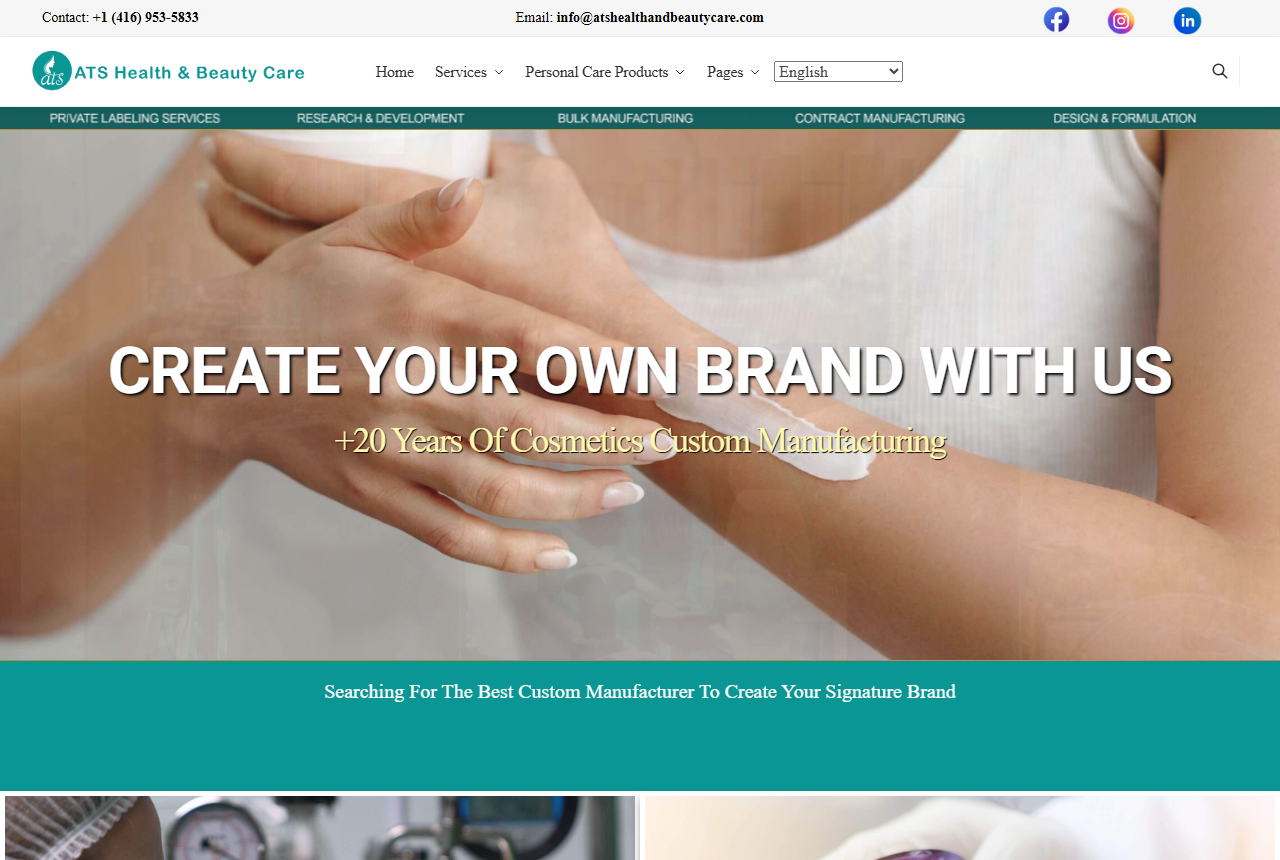
HQ: Toronto, Ontario · Type: Private label, contract and bulk manufacturer · Best known for: Hair care, including a dedicated curly and textured-hair line
ATS states more than twenty years in custom cosmetics manufacturing and runs a fuller service stack than most mid-size Canadian factories — private labelling, bulk manufacturing, R&D, and design and formulation are each presented as separate offers rather than bundled. Hair care is the visible strength, with shampoos, conditioners, styling creams and treatments alongside a specific curly-hair range, and skin, bath and body sit beside it. The site publishes an SGS certification and a Health Canada licence for NPN manufacturing, which is more disclosure than several competitors give. It also publishes a minimum of 5,000 pieces per SKU — useful honesty, but a real barrier if you are testing one product.
Visit ATS Health & Beauty Care →
3. Clamar Cosmetics Inc.
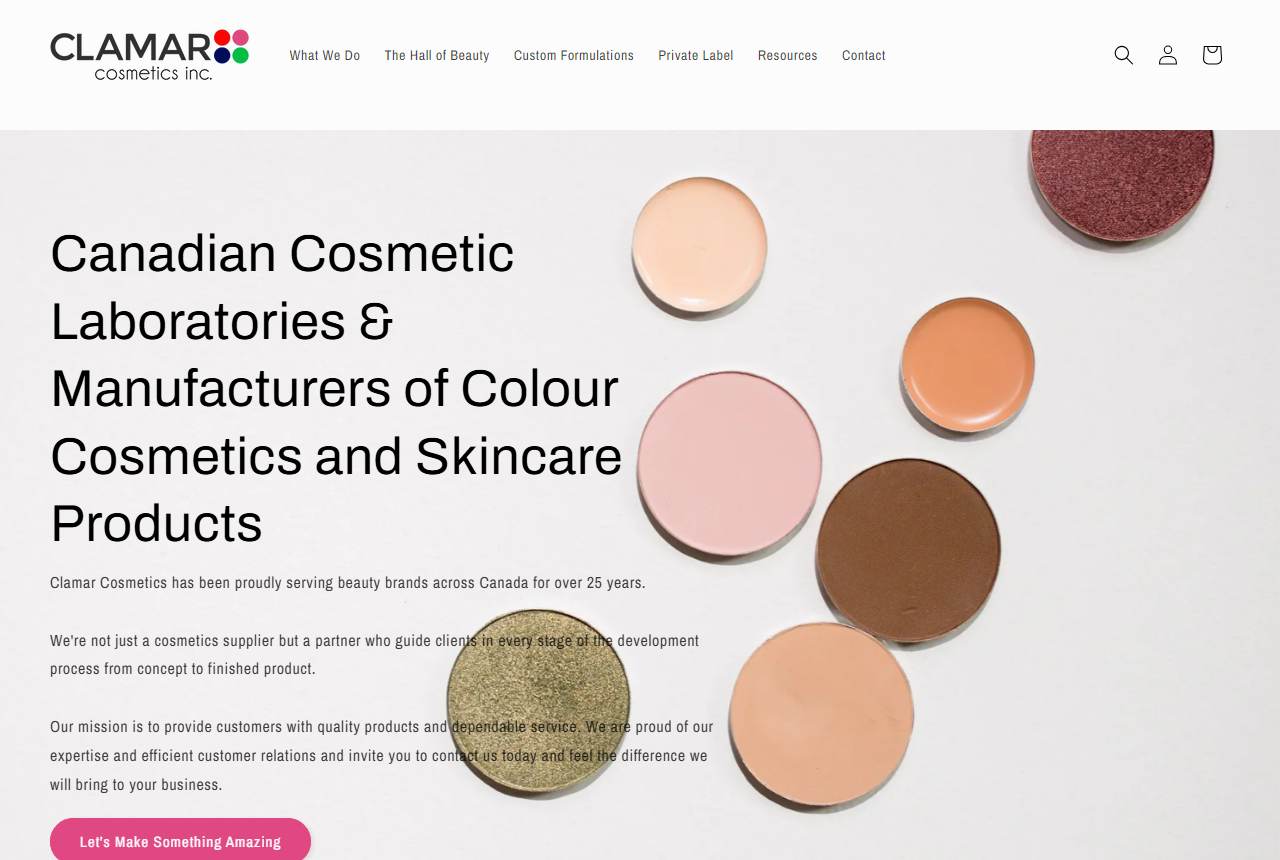
HQ: 1050 Salk Road, Pickering, Ontario · Type: Contract manufacturer and private-label colour house · Best known for: Colour cosmetics, bulk compounding and formula validation
Clamar has been manufacturing east of Toronto for more than twenty-five years and is the clearest colour specialist on this list: lipsticks, foundations, eyeshadows and mascaras compounded in-house across liquid, cream, powder and hot-pour processes, with skincare, hair care and fragrance filling alongside. The site states more than 750 new formulations a year and around 250 entrepreneurs supported annually, which reads as a business built on many small programmes rather than a few large ones. It also offers formula validation for brands moving an existing formula into larger production — a genuinely useful service that few contract manufacturers advertise separately. The gap is disclosure: no certifications, capacity figures or minimums appear on the site, so all three go on your first-call list.
4. Cosmaceutical Research Lab Inc.
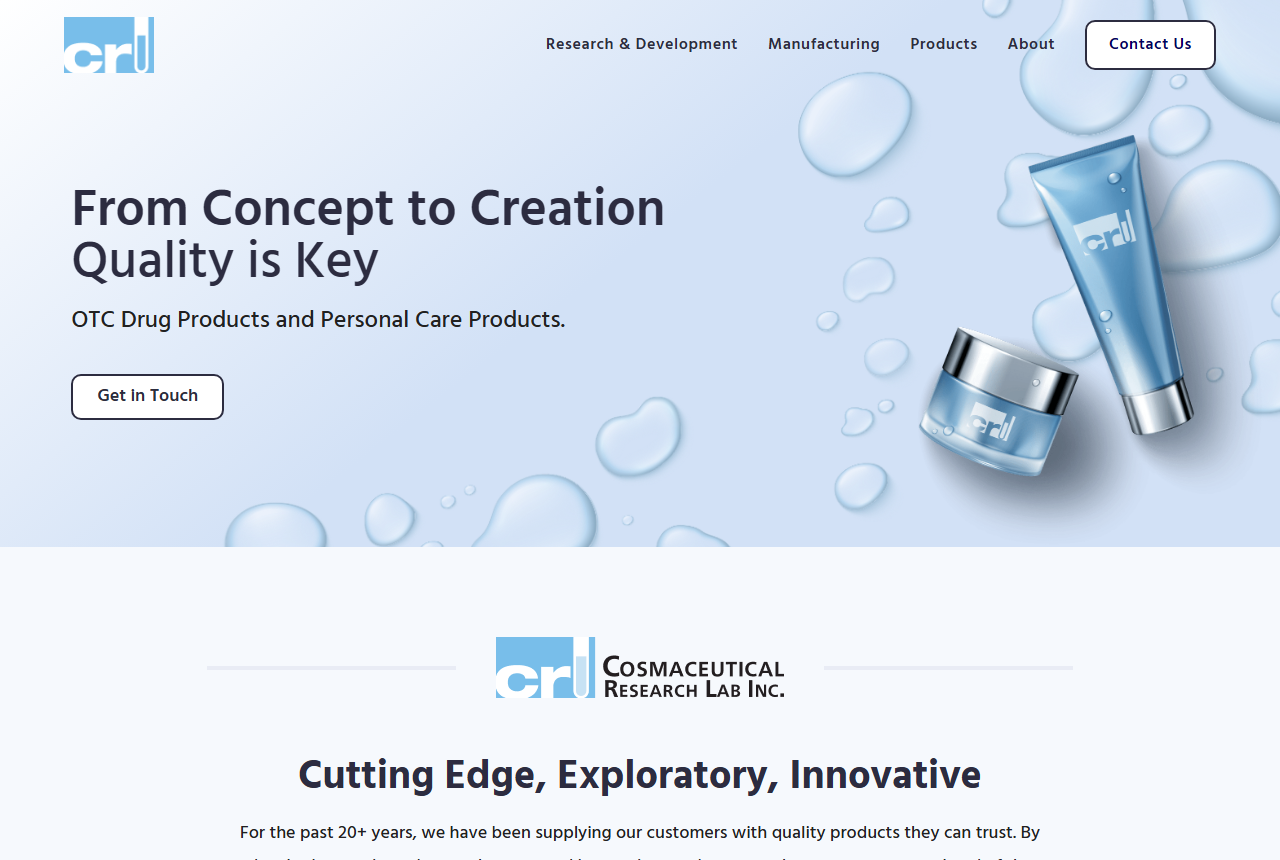
HQ: Surrey, British Columbia · Type: Contract manufacturer and R&D laboratory · Best known for: Personal care that crosses into OTC drug and natural health product territory
Cosmaceutical Research Lab states over twenty years in the business and describes itself as 100% Canadian owned and operated. What distinguishes it from the Ontario cluster is its licence set: alongside cGMP and US FDA registration, it publishes a Health Canada Drug Establishment Licence and a Natural Health Products licence. If your formula carries an active that pushes it out of cosmetic classification — a sunscreen, an anti-dandruff shampoo, an antiperspirant — that combination is the practical reason to call a lab like this rather than a pure cosmetics filler. Skincare, hair care and OTC drug products are the named categories; no minimums or capacity numbers are published.
Visit Cosmaceutical Research Lab →
5. Cosmetic Labs Canada
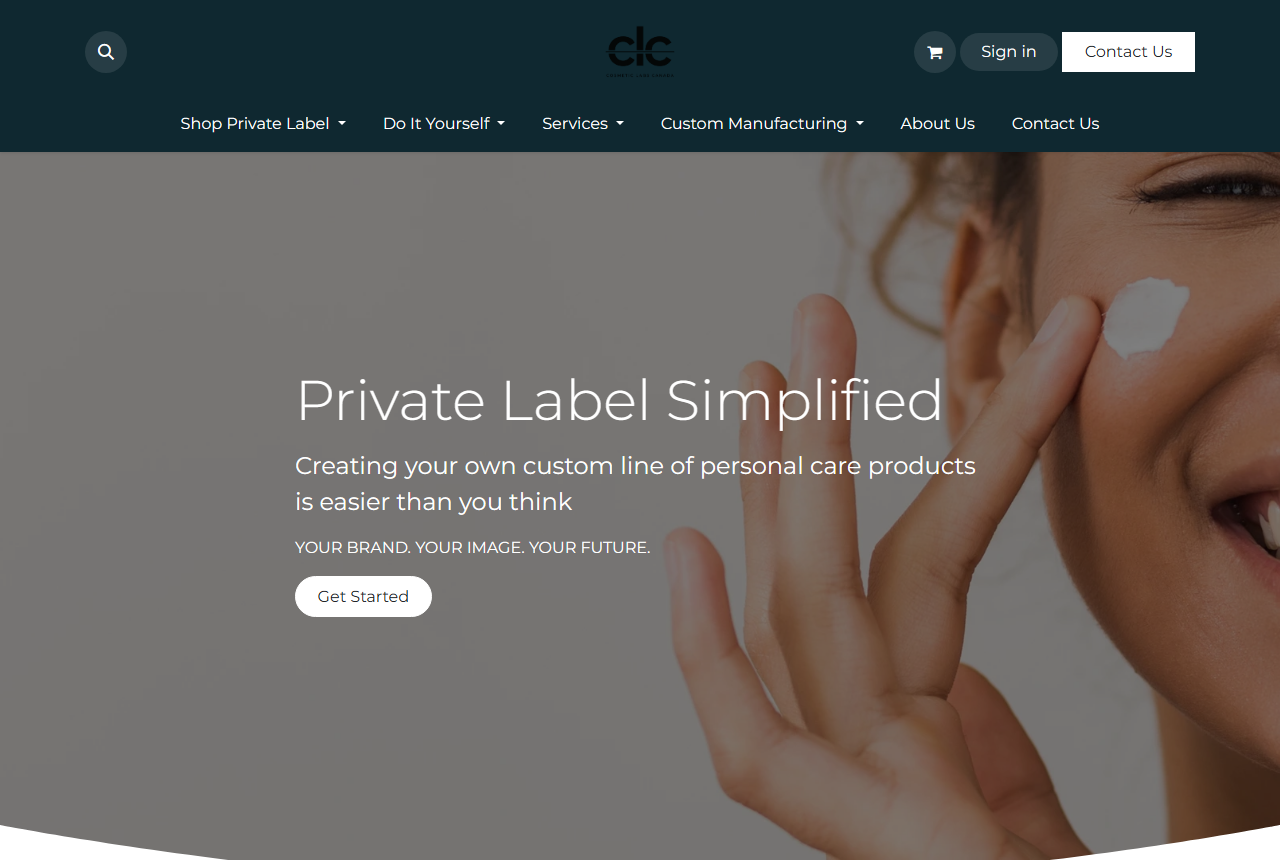
HQ: 298 Wellington Street West, Sault Ste. Marie, Ontario · Type: Private label and custom manufacturer with in-house design · Best known for: Turnkey private label including artwork, labels and packaging print
Cosmetic Labs Canada is the most complete turnkey offer here for a brand with no design resource: alongside skincare, hair care, bath and body, men’s grooming, kids and pet care, it runs graphic design, digital mockups, label and box design, and screen and foil printing in-house. It publishes low minimums and a turnaround of as little as twenty-one business days from label approval, and states that manufacturing happens in its own Canadian facility under GMP guidelines and Health Canada compliance, with the Made in Canada mark. The team is described as holding over fifty years of combined experience rather than the company claiming that age itself — worth reading precisely. The practical trade-off is location: Sault Ste. Marie is a five-hundred-mile drive from Toronto, which shows up in freight on heavy liquid formats.
6. DBO Labs
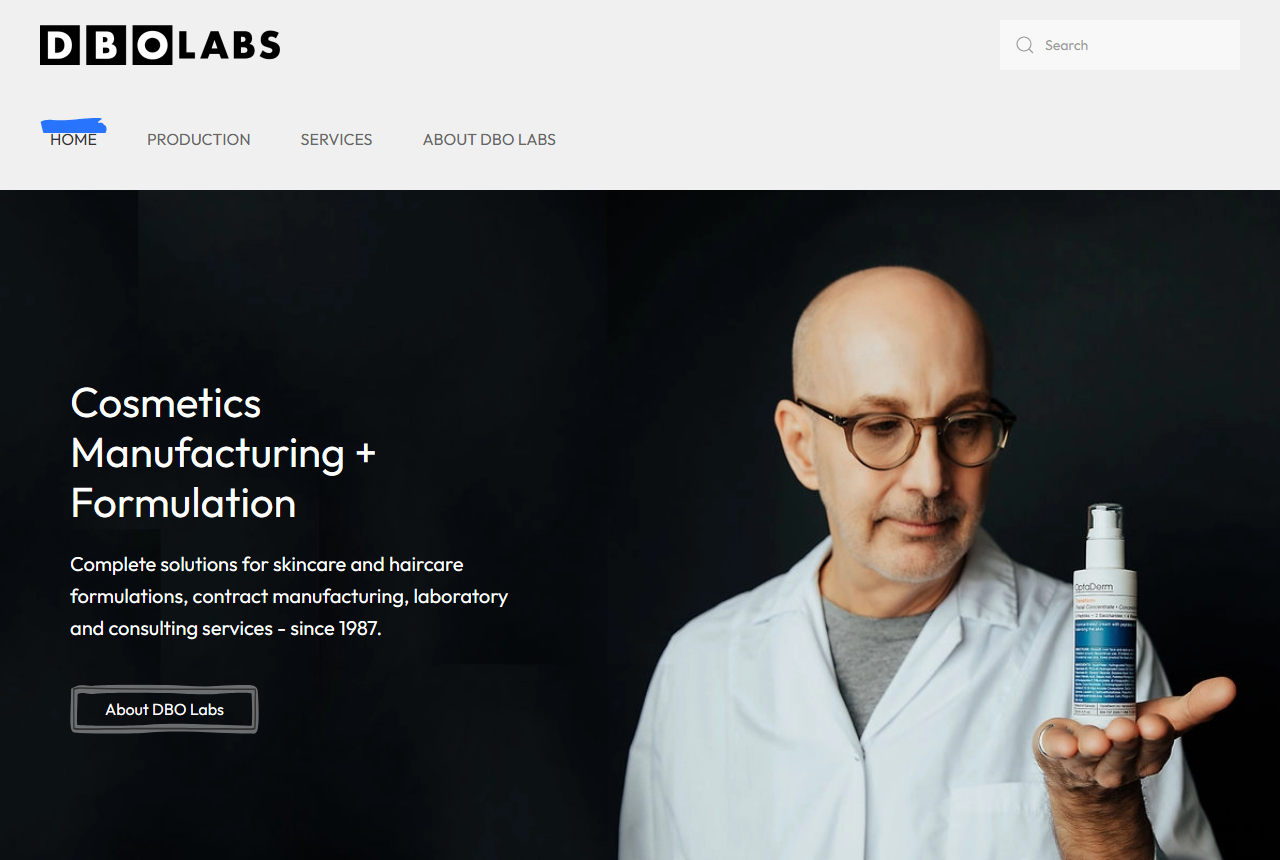
HQ: 6741 Cariboo Road, Burnaby, British Columbia · Type: Formulation laboratory with contract manufacturing and white label · Best known for: Custom skincare and hair-care formulation since 1987
DBO Labs leads with formulation rather than filling capacity, and the homepage states complete solutions for skincare and hair-care formulations, contract manufacturing, laboratory and consulting services since 1987 — the longest continuous track record on this list. Client testimonials on the site reference twenty-year relationships and describe the operation as boutique, which is a fair characterisation of the scale on offer. That makes it a good fit for a brand whose product is the formula, and a poor fit for a brand whose problem is volume. No certifications, capacities or minimums are published, so a GMP and stability-testing conversation should come early.
7. Nature’s Own Cosmetics (Jordane)
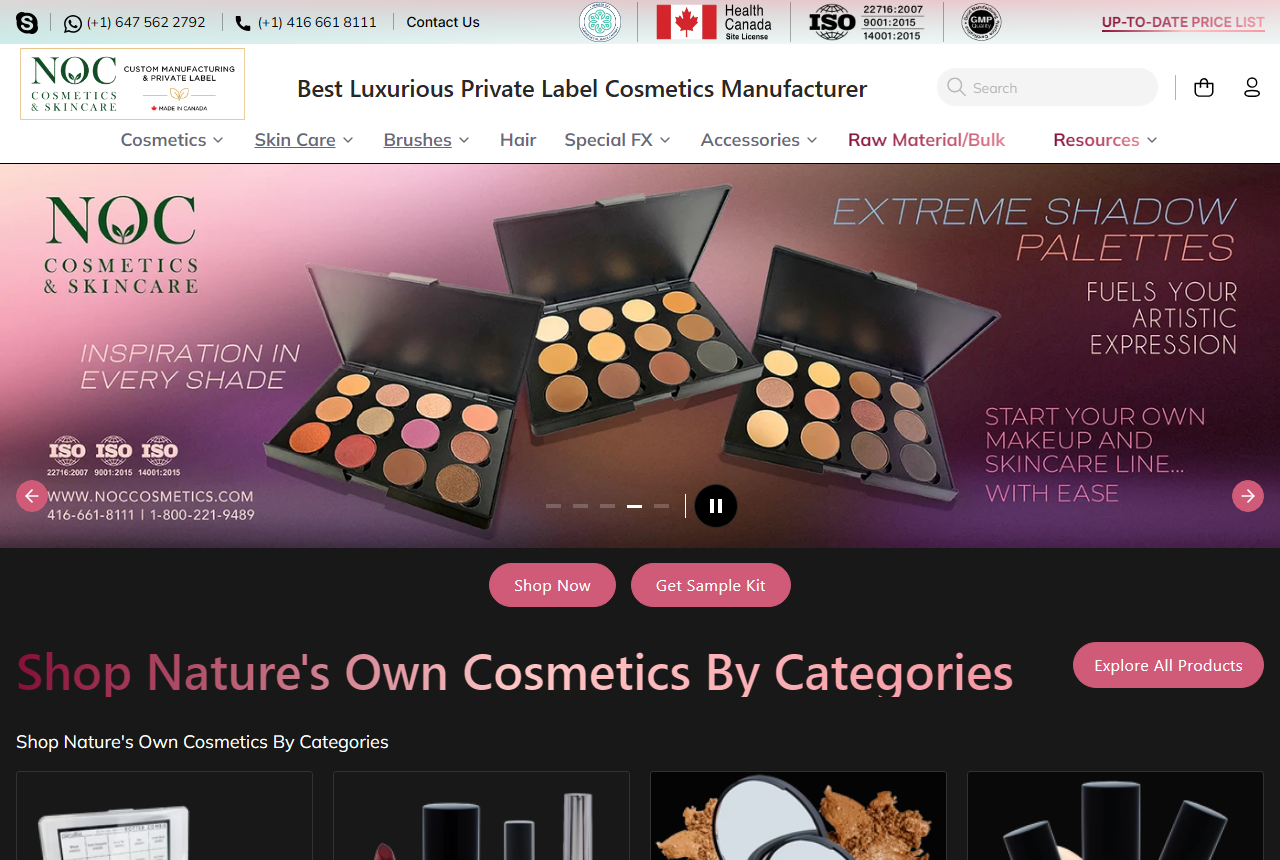
HQ: 80 Penn Drive, North York, Ontario · Type: Private label and custom manufacturer · Best known for: Colour cosmetics, brushes and special-effects makeup
Trading for decades as Jordane Cosmetics before rebranding, this is a colour house with an unusual second specialism: alongside foundations, eyeshadows, lipsticks and a skincare range, it manufactures theatrical and special-effects makeup, which almost no other North American private-label supplier carries. The site publishes ISO 22716, ISO 9001 and ISO 14001 marks, a Health Canada site licence and membership of Cosmetics Alliance Canada, and advertises no minimum on private-label orders alongside brushes, accessories and bulk raw material. The model is closer to catalogue-plus-your-label than ground-up development, so if you need a proprietary formula rather than a branded version of an existing one, ask early whether custom development is in scope.
Visit Nature’s Own Cosmetics →
8. Pinnacle Cosmetics
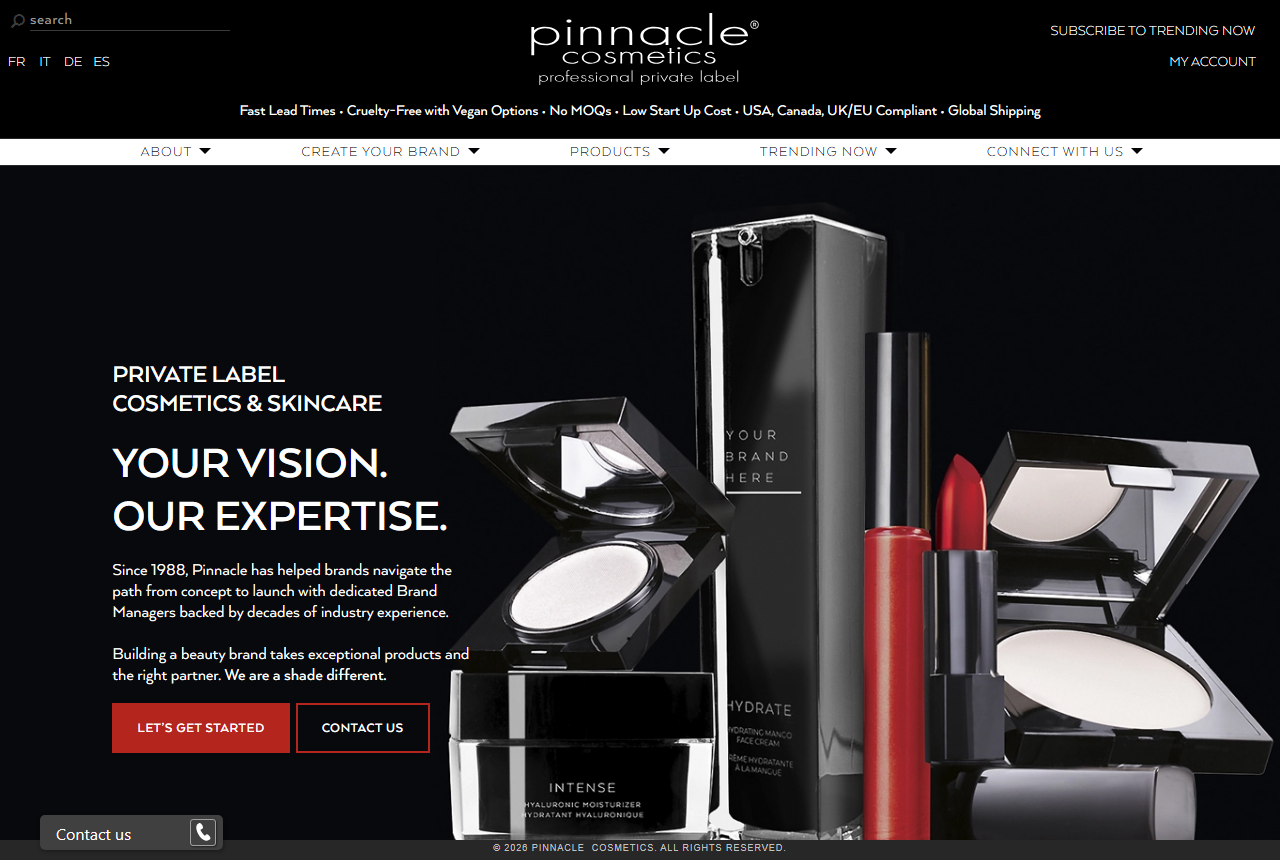
HQ: 9C Taymall Avenue, Etobicoke, Toronto, Ontario · Type: Professional private label with select custom development · Best known for: No-MOQ colour cosmetics and skincare for new brands
Founded in 1988, Pinnacle is one of Canada’s oldest private-label houses and built its position on removing the barrier that stops most launches: it states it was first to offer no minimum order quantities, and pairs that with a named brand manager from first call onward. The published proposition is cruelty-free and paraben-free with vegan and halal-certified options, GMP-compliant Canadian facilities, compliance for the United States, Canada and the UK/EU, and lead times of two to three weeks on a first branded order after approval and payment. Almost everything is made in Canada, with pencil formats the stated exception. The trade-off is inherent to the model: a no-MOQ stock-formula programme gives speed and low risk, not a formula nobody else can buy.
9. Swift Innovations
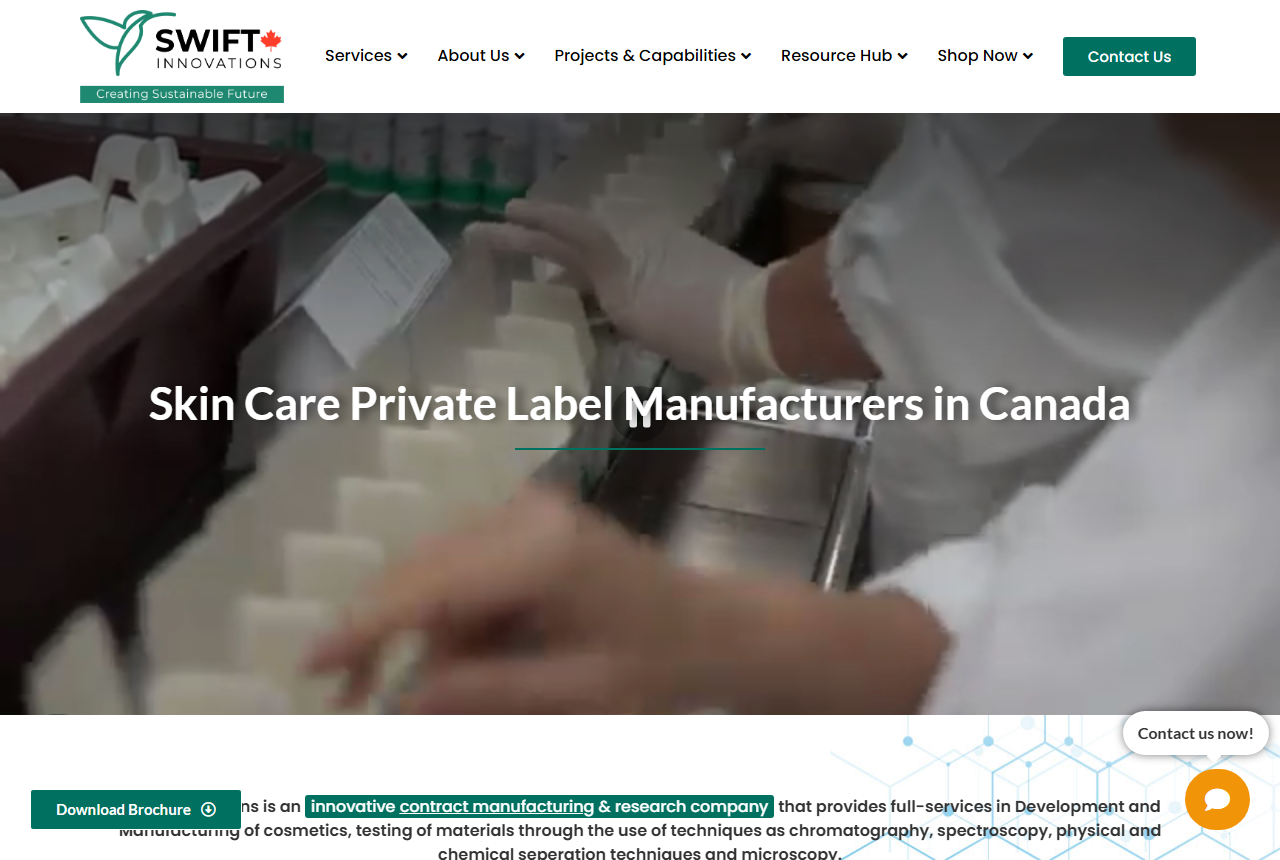
HQ: Ponoka, Alberta · Type: Contract research and manufacturing organisation · Best known for: Bioactive extraction and natural-ingredient formulation
Swift Innovations is the outlier on this list and the only Alberta entry: it presents itself as a contract manufacturing and research company whose work runs from ingredient sourcing and extraction through formulation, testing and analysis to private labelling. The published capability list — proprietary blends, extracts, peptides, essential oils, encapsulated bioactives, surfactants — reads more like an ingredient house than a filler, and the stated focus is on green processing and substituting organic actives for synthetics. It states it does not insist on minimum order quantities. Scale is the constraint: this is the partner for a formulation problem or a natural-claims product, not for a national retail rollout.
10. Vicora Cosmeceuticals
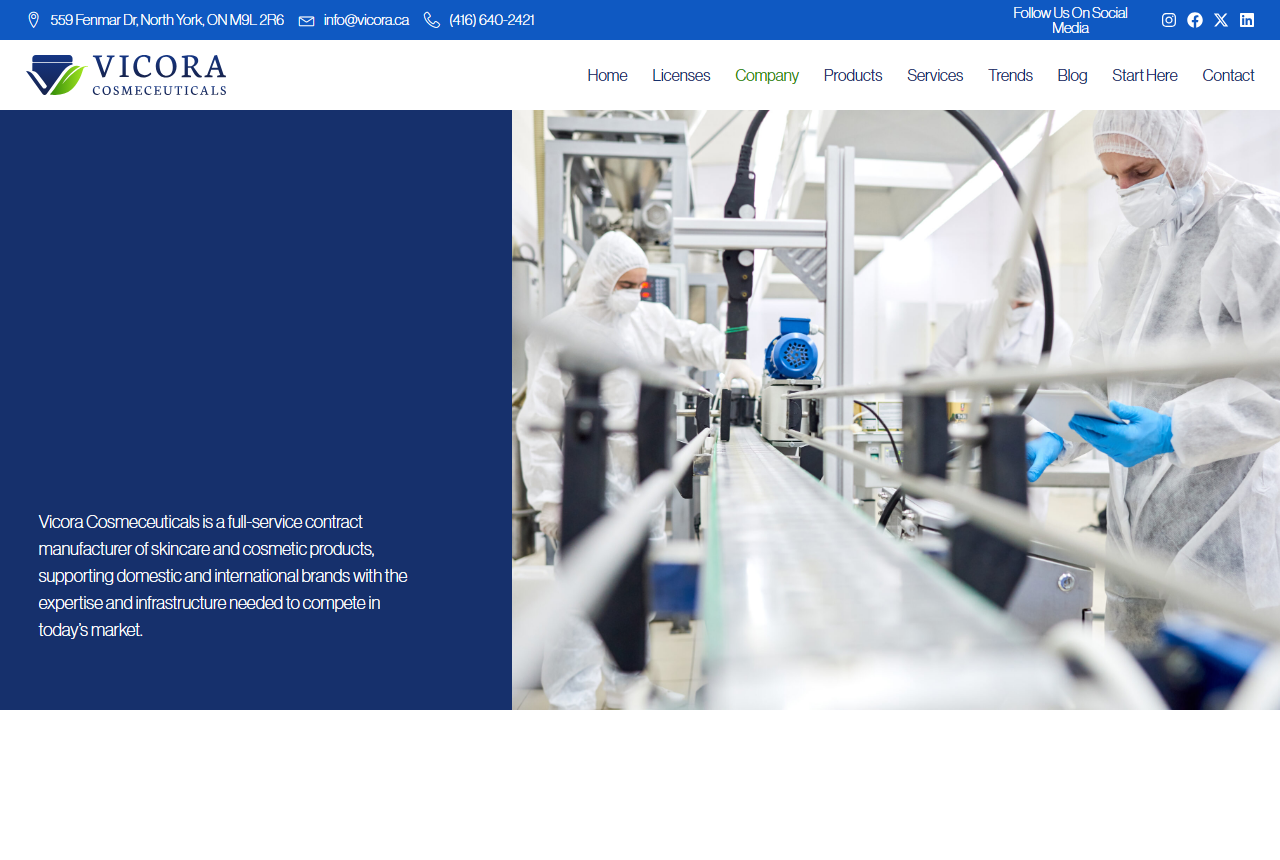
HQ: 559 Fenmar Drive, North York, Ontario · Type: Full-service contract manufacturer and private-label house · Best known for: Organic-certified processing and US-export-ready documentation
Vicora publishes the most specific credential set of any company on this list, and that is the reason to look at it: a Health Canada site licence covering manufacture, labelling and packaging of applicable natural health products; USDA Organic certified processor status; GMP certification through Food, Health and Consumer Products of Canada; and registration with the US FDA under MoCRA. For a brand planning to sell into the United States, that last item removes a step that catches out a lot of first-time importers. Services span product and custom development, private label, contract manufacturing, turnkey programmes and contract filling and packaging. Neither minimums nor capacity are published — establish both in writing before you build a costing.
What Health Canada actually requires
Canada does not operate a pre-market approval regime for cosmetics. Under the Food and Drugs Act and the Cosmetic Regulations, anyone who manufactures or imports a cosmetic for sale in Canada must submit a Cosmetic Notification Form to Health Canada within ten days of first sale, listing the product, its ingredients and the responsible party. There is no licence number to wait for and no approval to receive — which is why a Canadian launch can move faster than one into a market with pre-market registration.
The binding constraint is the Cosmetic Ingredient Hotlist: an administrative list of substances Health Canada has determined may not comply with the general prohibition on selling a cosmetic that could injure health, split into prohibited and restricted entries. A formula your factory has run for years for another market can still fail the Hotlist. Labelling is governed separately, requiring bilingual English and French declarations and an INCI ingredient list in descending order of concentration.
Two boundaries matter more than they look. First, classification: if a product makes a therapeutic claim or contains a scheduled active, it stops being a cosmetic and becomes a drug or a natural health product with its own licensing pathway — the reason several manufacturers above advertise a Drug Establishment Licence or NPN capability. Second, export: Canadian compliance carries no weight elsewhere. Goods bound for the United States fall under the FDA and MoCRA; for the European Union you need a CPNP notification and an EU-established Responsible Person; for Malaysia, an NPRA notification. Our comparison of OEM, ODM and private label sets out how much of that documentation burden each contracting model actually shifts onto the manufacturer.
Notable exclusions
A screen only means something if you can see what it removed. These companies were researched and left out:
- KDC/One (Knowlton Development Corporation). Headquartered in Longueuil, Quebec, and by revenue the largest beauty and personal-care contract manufacturer in the country. It is excluded on capture grounds only: a cookie-consent panel sat over the page hero across every attempt, so we could not produce a verified screenshot of the page we would be sending readers to. If your programme is large enough for a global CDMO, it belongs on your list regardless.
- Cosmetica Laboratories. A major Toronto colour and skincare manufacturer trading since 1992, excluded for the same reason — a persistent cookie panel over the homepage hero in repeated captures.
- Kolmar Canada. A genuine Barrie, Ontario manufacturer with more than fifty years of history. Its homepage and interior pages rendered as empty gradient panels across three capture attempts at up to thirty seconds of load budget, leaving nothing verifiable to publish.
- Vitelle Labs. Widely cited in other Canadian manufacturer round-ups as a Burnaby, British Columbia professional-skincare private-label house. Its domain has expired and now resolves to a registrar parking page, which is a reminder that recycled listicles keep dead companies alive for years.
- Groupe Marcelle and Lise Watier. Substantial Quebec cosmetics producers, but they operate as own-brand houses without a published contract-manufacturing offer for external brands.
- Several offshore laboratories running Canada-targeted landing pages. A recurring pattern in this market: pages titled for Canadian private label whose registered address, phone code and shipping terms are elsewhere entirely. An SEO landing page aimed at a country is not a factory in it.
Methodology, limitations and conflicts
Research window: 7 August 2026. Candidates were identified through open web research, then screened against the four criteria above. Each surviving company’s official website was loaded in a real browser at 1280 px and captured; every screenshot in this article is that capture, dated to the research window. Sites returning a parked page, an error, a bot-verification challenge or a modal over the hero were rejected rather than worked around. Where a homepage would not render but an interior corporate page did, we captured and linked that page instead and say so — the Vicora Cosmeceuticals image is its company page.
What we did not do: we did not visit any factory, inspect any certificate, request a quotation, test a product or contact any company. Certifications, capacities and minimums are reported as published by each manufacturer and should be independently verified before you commit. Published minimum order quantities in particular describe the factory’s filling floor, not your packaging supplier’s — a custom bottle or pump routinely carries its own minimum in the thousands, which is what usually decides the true size of a first order. Payment structure changes the cash position again, as our guide to payment terms and deposits explains, and the unit price a factory quotes is only one input into the number you should actually price against, as our note on pricing private label beauty products sets out.
If you find an error, tell us and we will correct it and log the change below. We applied the same screen and the same capture method to OEM/ODM cosmetic manufacturers in Brazil, if a Latin American supply base is also on your shortlist.
Frequently asked questions
Do I need Health Canada approval before I can sell a cosmetic made in Canada?
No. Canada has no pre-market approval for cosmetics. You must submit a Cosmetic Notification Form to Health Canada within ten days of the product’s first sale in Canada, listing the product, its full ingredient composition and the responsible person. Health Canada may follow up, but you do not wait for a licence. Your formula must comply with the Cosmetic Ingredient Hotlist, and your label must carry bilingual English and French text plus an INCI ingredient list. If the product makes a therapeutic claim it is no longer a cosmetic and a different licensing route applies.
What is the smallest order a Canadian cosmetics manufacturer will accept in 2026?
Genuinely small, by international standards. Pinnacle Cosmetics, Nature’s Own Cosmetics and Swift Innovations all publish a no-minimum position on private-label lines, and Cosmetic Labs Canada advertises low minimums with roughly twenty-one business days from label approval. At the other end, ATS Health & Beauty Care publishes 5,000 pieces per SKU. Treat any no-MOQ claim as applying to the bulk and filling stage only: custom packaging components usually carry their own minimums of several thousand pieces, and that is what normally sets the real size of a first order.
Is manufacturing in Canada cheaper than the United States for a brand selling into the US market?
Often, but not automatically, and the reason is currency rather than labour. Canadian wage and compliance costs are broadly comparable to the northern United States, so the saving comes from quoting in Canadian dollars against US-dollar revenue. Against that, goods crossing the border need to satisfy CUSMA rules of origin to enter duty-free, and any product sold in the United States must meet FDA requirements including MoCRA facility registration — which is why several manufacturers above advertise that registration directly. Compare landed cost per filled unit on your own specification rather than country-level averages, the same way you would when weighing a US manufacturer against an Asian one.
Update history
- 7 August 2026 — First publication. Fourteen candidates researched and captured; ten verified and listed; four companies plus two own-brand groups documented in Notable exclusions.
Sources: each company’s official website as captured on 7 August 2026; the Food and Drugs Act and Cosmetic Regulations, the Cosmetic Notification Form guidance and the Cosmetic Ingredient Hotlist as published by Health Canada; the Canada–United States–Mexico Agreement rules of origin; the US FDA’s Modernization of Cosmetics Regulation Act facility registration requirements. Screenshots are page captures from the research window and may not reflect later site changes. This article is editorial research, not a certification check — verify certifications, capacity and contractual terms directly with any manufacturer before entering an agreement.
Building a shortlist across more than one market? Compare this list with our guides to OEM/ODM cosmetic manufacturers in the USA, the United Kingdom and Australia — or, if you are sourcing for Southeast Asia, our list of cosmetics manufacturers in Malaysia.
Looking at the third USMCA market? Our companion list of OEM/ODM cosmetic manufacturers in Mexico covers ten Mexican maquiladoras, what COFEPRIS and NOM-259 require of them, and how their published minimums compare with the no-MOQ Canadian laboratories above.