South Africa has the most developed third-party cosmetics manufacturing base on the African continent, and most of it is hidden in plain sight. Behind the familiar pharmacy and supermarket own-brands sits a cluster of contract laboratories in Gauteng’s industrial east (Edenvale and Sebenza), in Midrand, Roodepoort and Pretoria, plus outliers in Durban, the Western Cape winelands and the North West. They formulate, fill and pack under other people’s names, from 5 kg pilot batches to retailer-scale runs. This guide profiles ten of them, each checked against its own live website on 11 September 2026.
The market has a particular character that matters to a buyer. Regulation is light-touch and largely industry-led, retail buyers expect specific local standards and trade-metrology marks, and there is real depth in categories that other bases treat as niche: textured and ethnic hair care, depilatories, sun care built for high-UV conditions, and halal-certified personal care. That combination makes South Africa a serious option for brands selling into Southern Africa and the Middle East, and a less obvious one for brands whose main market is Europe or ASEAN.
Quick answer
South Africa’s strongest cosmetics contract manufacturers include Serendipity Toiletries and Prime Product Manufacturing at retail scale, Proficos, SDK Laboratories and Lee-Chem Laboratories for full-service development, and Alchem Labs, Brunational, Customised Cosmetics, DC Laboratories and Emulcfy for smaller or more specialised runs. Stated minimums on the companies’ own sites start at around 5 kg of bulk. Cosmetics are regulated under the Foodstuffs, Cosmetics and Disinfectants Act 54 of 1972, with no pre-market registration, so ISO 22716 certification and the CTFA’s compendium carry most of the compliance weight. Ask for documents before you ask for prices.
Key takeaways
- There is no pre-market registration for cosmetics in South Africa. Products fall under the Foodstuffs, Cosmetics and Disinfectants Act 54 of 1972, overseen by the National Department of Health, and the detailed cosmetics regulations first published in draft in 2016 have still not been finalised as far as we could establish, so compliance relies heavily on industry standards.
- Batch floors are genuinely low at the small end. Two of the ten publish minimums of roughly 5 kg of bulk. At the other end, Customised Cosmetics states capacity of up to 50 tonnes a month per product.
- ISO 22716 is common but not universal. Six of the ten name cosmetics GMP certification or state that they work to it. Two lead with ISO 9001 quality management instead, which is not the same thing.
- Retail credentials are a real differentiator here. Serendipity Toiletries names six national retail chains as approved-supplier relationships. It and Prime Product Manufacturing both hold the SANS 1841 e-mark for prepackaged quantity, which retailers routinely ask for.
- South Africa has JAKIM-recognised halal certifiers. SANHA, the MJC Halaal Trust and NIHT are all recognised by Malaysia’s halal authority. That matters if you are selling into Muslim-majority export markets, though only one manufacturer below publicly claims a halal-certified facility.
Who this list is for, and how we chose
This guide is for brand owners, retailers and sourcing managers deciding whether a South African contract manufacturer belongs on their shortlist. That usually means a brand selling into Southern Africa and the SADC region, a founder based in South Africa who wants to manufacture locally rather than import, or an international brand looking for textured hair care, sun care or halal-certified capacity outside Asia. If you are still weighing local production against importing finished goods, start with our comparison of local versus overseas cosmetics manufacturing.
Every company below had to clear four screens:
- It must physically manufacture in South Africa. Packaging resellers, distributors, and brand developers producing through third-party factories were excluded.
- It must openly offer third-party work. The company’s own website has to present contract manufacturing, private label, white label or custom formulation to outside brands. Own-brand-only producers were excluded.
- Its core catalogue must be cosmetics or personal care. Businesses where cosmetics sit beside cleaning chemicals, fabric care, food or supplements as one division among several were excluded.
- Its live website had to be captured cleanly on 11 September 2026 in a standard desktop browser window. Dead domains, and screenshots where a consent banner or promotional pop-up covered the hero, were rejected rather than published.
We researched eighteen South African candidates, drawing on search results and the contract-manufacturer directory published by the Society of Cosmetic Chemists of South Africa. Sixteen resolved to a live website and thirteen qualified with a clean capture. Ten are profiled here. The numbering is alphabetical by company name, not a ranking. OEMHallmark does not score these companies against each other. Company facts (locations, certifications, capacities and founding years) come from each manufacturer’s own published material and are labelled company-stated where they could not be verified independently. No factory was audited and no sample was produced for this article.
The list at a glance
| Company | Base | Best suited to | Main limitation |
|---|---|---|---|
| Alchem Labs | Tulbagh, Western Cape | Natural skincare at small batch sizes; halal-certified facility | 250 kg stated ceiling per run limits scale-up |
| Brunational | Edenvale, Gauteng | Broad skin, hair and bath ranges with packing services | Leads with ISO 9001, not cosmetics-specific GMP |
| Customised Cosmetics | Edenvale, Gauteng | Depilatories, waxes and ethnic hair care at volume | No MOQ published |
| DC Laboratories | Wallmansthal, Pretoria | Boutique, relationship-led development for start-ups | States it follows ISO 22716 guidelines, not that it is certified |
| Emulcfy | Roodepoort, Gauteng | Skincare with a clear private-label vs white-label choice | Founded 2015, the shortest track record here |
| Lee-Chem Laboratories | Durban, KwaZulu-Natal | Hair removal, grooming and skincare with six decades of history | Runs its own brands alongside contract work |
| Prime Product Manufacturing | Pelindaba, North West | Unusual formats: hot-fill, powders, lip balms, fragrance | Geared to established brands rather than micro-launches |
| Proficos | Sebenza, Edenvale | Colour cosmetics, cosmeceuticals and fragrance with colour matching | Certification detail beyond vegan status not published |
| SDK Laboratories | Midrand, Gauteng | Widest category range, including intimate care and kids | Founding year and MOQ not published |
| Serendipity Toiletries | Silverton, Pretoria | National retail supply: bath, body, sun and anti-ageing | Retail-scale focus may not suit very small first orders |
Company details as published on each manufacturer’s own website, reviewed 11 September 2026. Alphabetical order.
How cosmetics are regulated in South Africa
The legal foundation is the Foodstuffs, Cosmetics and Disinfectants Act 54 of 1972, which gives the Minister of Health power to make cosmetics regulations and places oversight with the National Department of Health. What the Act does not create is a pre-market gate. There is no notification portal equivalent to the EU’s CPNP and no product registration, so a cosmetic can go on sale without a prior submission. The detailed Regulations Relating to the Labelling, Advertising and Composition of Cosmetics were published for comment in August 2016 and revised in 2017. Industry guidance still describes them as unfinalised, and we could find nothing showing otherwise by September 2026.
In that gap, the industry regulates itself to a high degree. The Cosmetic, Toiletry & Fragrance Association of South Africa (CTFA) publishes a Cosmetic Compendium for members that tracks the draft regulations and is modelled largely on the EU’s Regulation (EC) No 1223/2009, including its prohibited and restricted ingredient annexes. Advertising claims are governed by the Cosmetic Advertising Code of Practice administered by the Advertising Regulatory Board. Sunscreens have their own performance and labelling standard, SANS 1557, which also limits the UV filters that may be used. Prepackaged quantities fall under legal metrology, which the National Regulator for Compulsory Specifications enforces. That is why the SANS 1841 “e-mark” appears on several manufacturers’ sites below.
Two practical consequences follow. First, “no registration” does not mean “no file”. A competent South African manufacturer should still build a product information file, a safety assessment and stability data, because retailers ask for them and because export markets require them. Our explainer on the cosmetic product safety report sets out what such a file should contain. Second, claims are where products cross boundaries. A product making medicinal claims can fall under the medicines framework administered by SAHPRA rather than the cosmetics regime, so settle the claim wording with your manufacturer before artwork, not after.
1. Alchem Labs
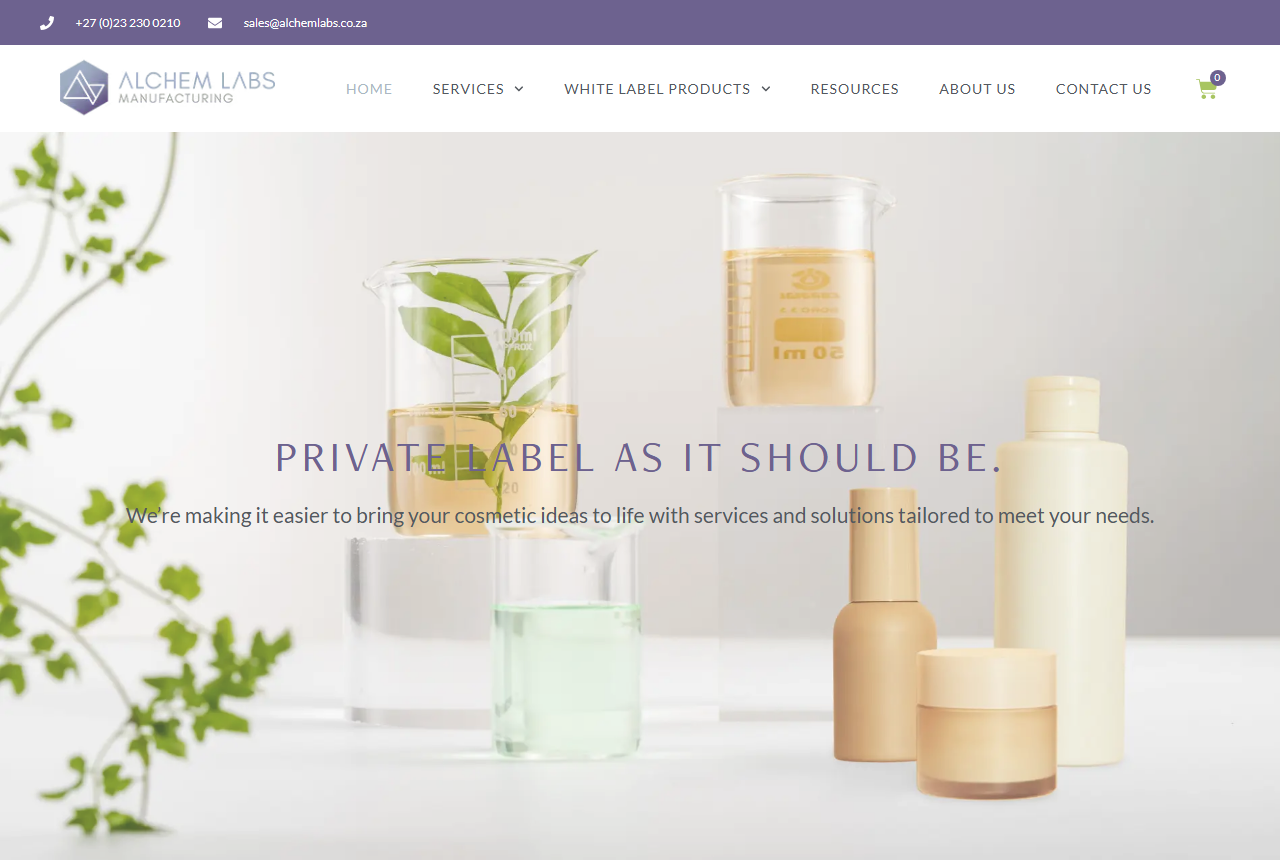
HQ: Tulbagh, Western Cape · Type: Contract manufacturer & white label · Best known for: Natural-leaning skincare at very small batch sizes
Alchem Labs is a winelands manufacturer that publishes some of the most specific terms on this list: production runs from 5 kg to 250 kg, and minimum order quantities “as low as 5kg”. Its offer covers product development and formulation, contract manufacturing, a white-label range, and filling and labelling. The catalogue spans retail skincare, salon and spa products, dermacosmetics and body care. It describes its facility as halal-certified and its formulations as cruelty-free, and it is listed by the Society of Cosmetic Chemists of South Africa as an award-winning, female-owned business.
For a founder who wants to test a natural skincare range without committing to thousands of units, the 5 kg floor is the draw. The halal status is unusual among South African contract labs and worth confirming by certifier name before you rely on it. The limitation is the other end of the range: at a stated 250 kg per run, a brand that takes off will eventually need a second, larger partner. Plan that transition before you sign rather than after.
2. Brunational
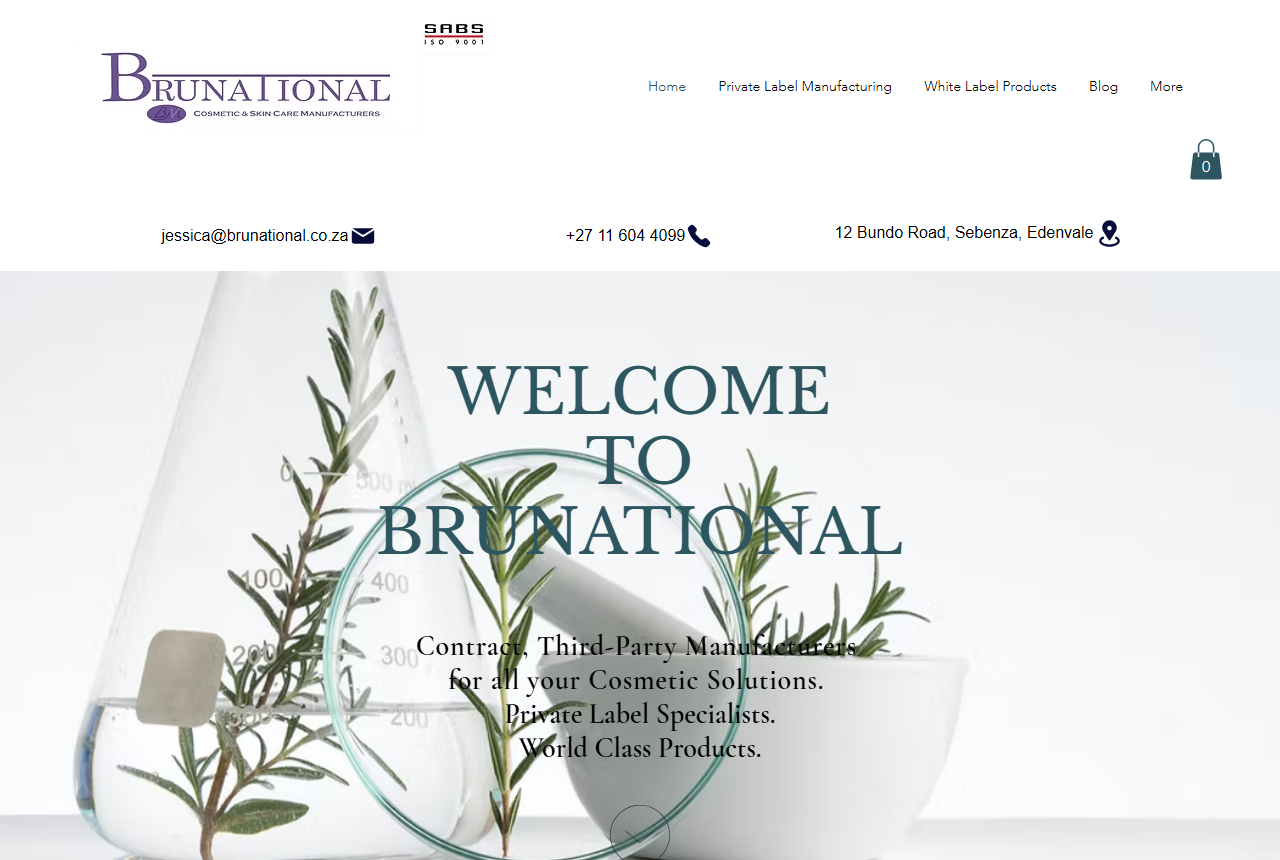
HQ: Sebenza, Edenvale, Gauteng · Type: Contract, third-party & private label manufacturer · Best known for: Broad skin, hair and bath ranges with full packing services
Brunational describes itself as a contract and third-party manufacturer and private-label specialist with more than 20 years in cosmetic manufacture. It displays SABS and ISO 9001 approval. The range covers serums, moisturisers, masks and cleansers, shampoos and conditioners, bath products, perfumed products and salon-quality treatments. Packing services include filling, shrink-wrapping, labelling, cartoning, sealing, barcoding and batching, and it states it can produce from small quantities up to bulks of 1,000 kg and more, with smaller MOQs available on request.
The packing depth is the practical advantage. A brand can hand over bulk, primary pack and secondary pack to one site and receive shelf-ready goods. Weigh that against the certification profile: ISO 9001 proves a quality-management system, not cosmetics GMP, so ask directly how its processes map to ISO 22716 and request the audit report. The company also sells its own white-label products, which is useful if you want a fast first launch on an existing formula.
3. Customised Cosmetics
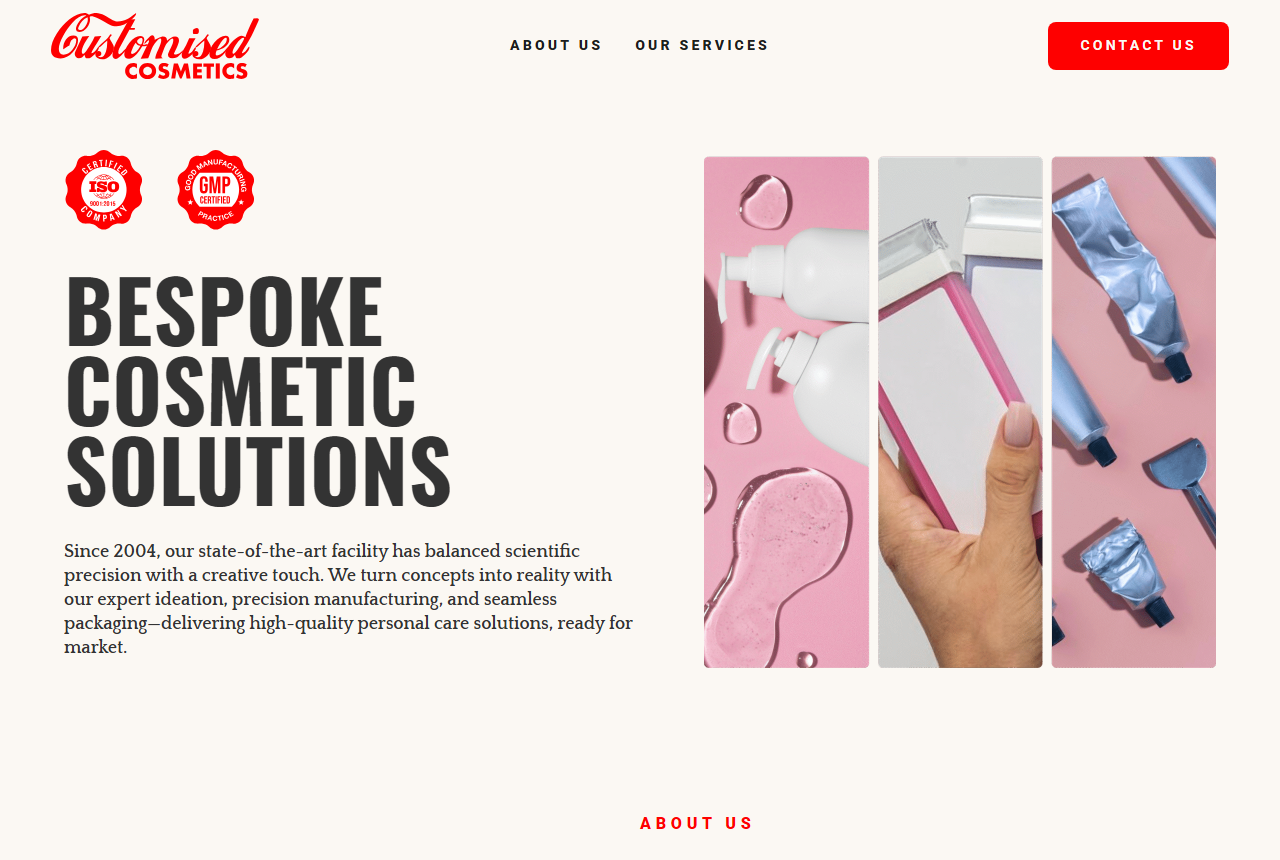
HQ: Eastleigh, Edenvale, Gauteng · Type: Contract manufacturer & private label · Best known for: Waxes, depilatories and ethnic hair care at volume
Operating since 2004 from a stated 2,000 m² facility, Customised Cosmetics offers R&D and formulation, contract manufacturing, private label, packaging and labelling. It describes its range as running “from waxes and depilatories to anti-ageing creams, ethnic hair care, and waterless hand sanitisers”. Its homepage displays ISO 9001:2015 and GMP-certified marks, and it quotes capacity of up to 50 tonnes a month per product.
That category mix is the reason to call. Depilatories and textured-hair products are technically demanding, with pH-sensitive chemistry and higher safety stakes, and relatively few contract labs worldwide specialise in them. The stated tonnage also means a successful product can scale in the same building. It does not publish a minimum order, so get a per-component MOQ early. Our explainer on MOQ, lead time and turnkey explains why the bulk minimum is rarely the binding one.
4. DC Laboratories
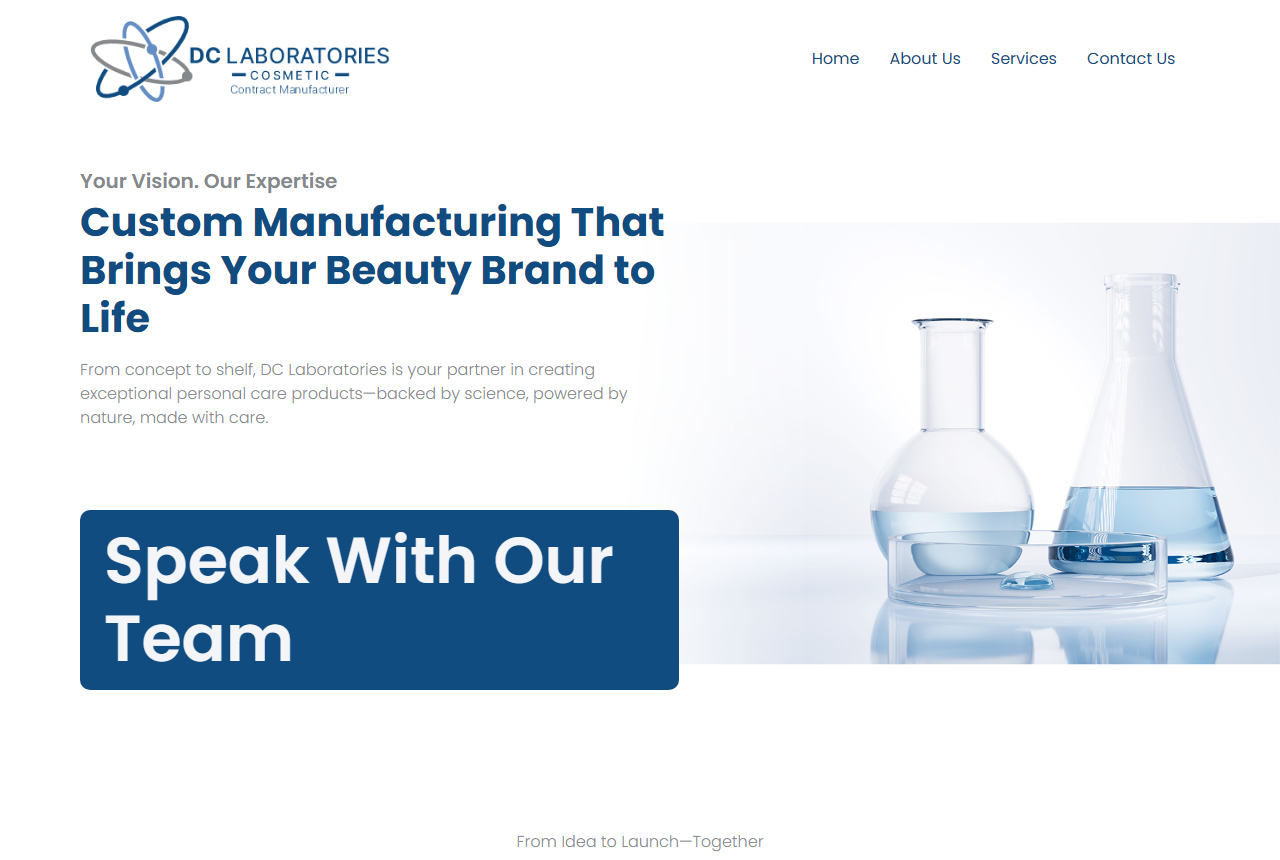
HQ: Wallmansthal, Pretoria, Gauteng · Type: Boutique contract manufacturer & private label · Best known for: Hands-on development for start-up and growing brands
DC Laboratories presents itself as a family-owned, boutique contract manufacturer offering custom manufacturing, private-label formulation, R&D and packaging across skin care, body care, hair care and perfumery. It states that it follows ISO 22716 GMP guidelines, cites output of more than 72,000 units a month, and lists endorsements from the Cosmetic Export Council of South Africa, the Small Enterprise Development Agency and the Department of Trade, Industry and Competition. It says it offers low minimum order quantities without publishing a figure.
A small, owner-run lab is often the right partner for a first product. You tend to get direct access to the person formulating your product, and a willingness to iterate that larger plants cannot offer. Note the wording on GMP, though. “Follows ISO 22716 guidelines” is not the same as holding a third-party certificate, and a retailer or export market may ask for the latter. Clarify which you are getting before the first batch.
5. Emulcfy
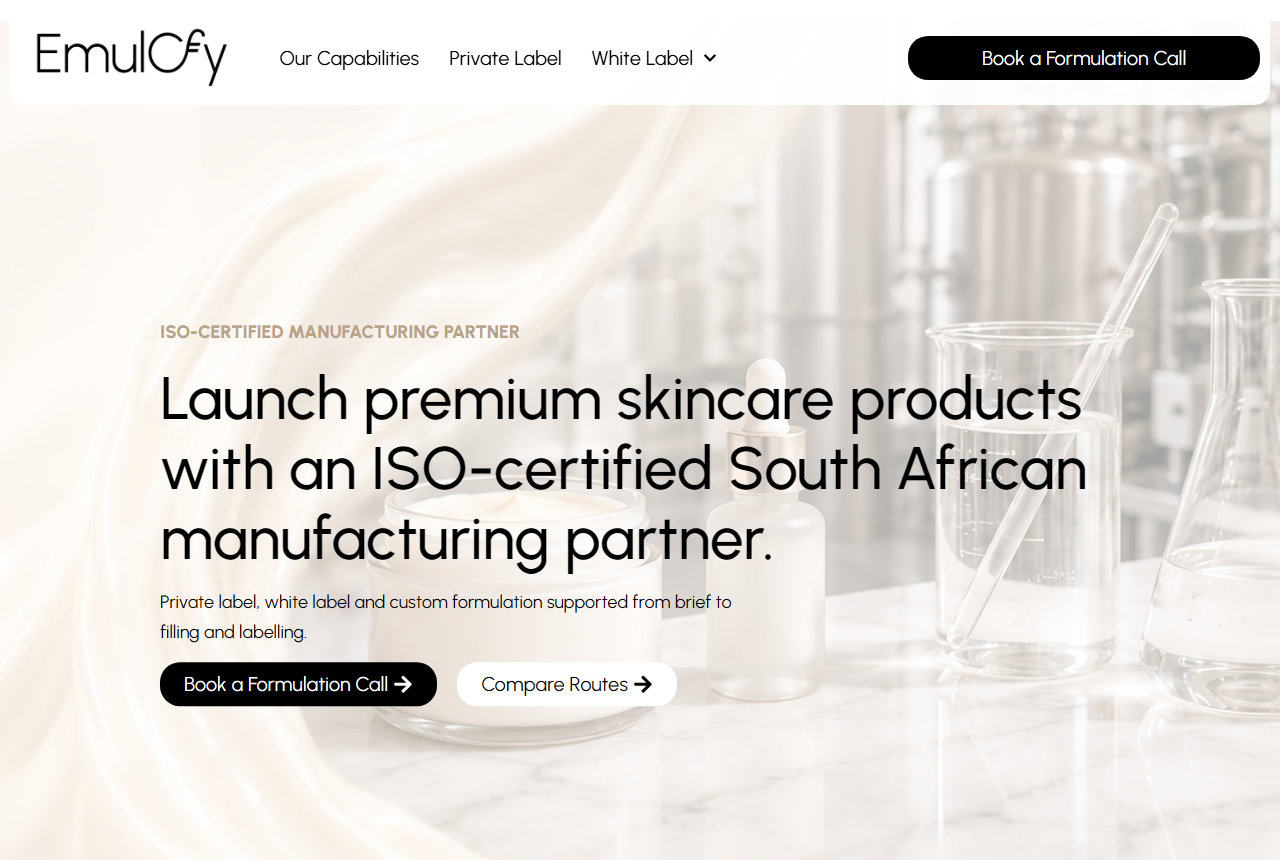
HQ: Roodepoort, Gauteng · Type: Private label, white label & custom formulation · Best known for: ISO-certified skincare with clearly separated launch routes
Emulcfy positions itself as an ISO-certified South African manufacturing partner for skincare, body care and hair care. It covers everything from brief to filling and labelling, plus scale-up support. It states ISO 9001:2015 and ISO 22716 certification. The Society of Cosmetic Chemists’ directory dates the business from 2015, which makes it the youngest company on this list. Its site explicitly separates private label, white label and custom formulation as distinct routes and invites buyers to compare them.
That framing is more useful than it sounds. Many first-time founders do not know whether they need a stock formula with their label on it or a formula developed for them, and a manufacturer that lays out the trade-off saves weeks of confused quoting. Pairing both ISO certificates with a young business is a reasonable combination, but ask for references in your category and a copy of the certificate scope. If the distinction between the routes is new to you, our guide to the cost of manufacturing a private label skincare product shows how each changes the numbers.
6. Lee-Chem Laboratories
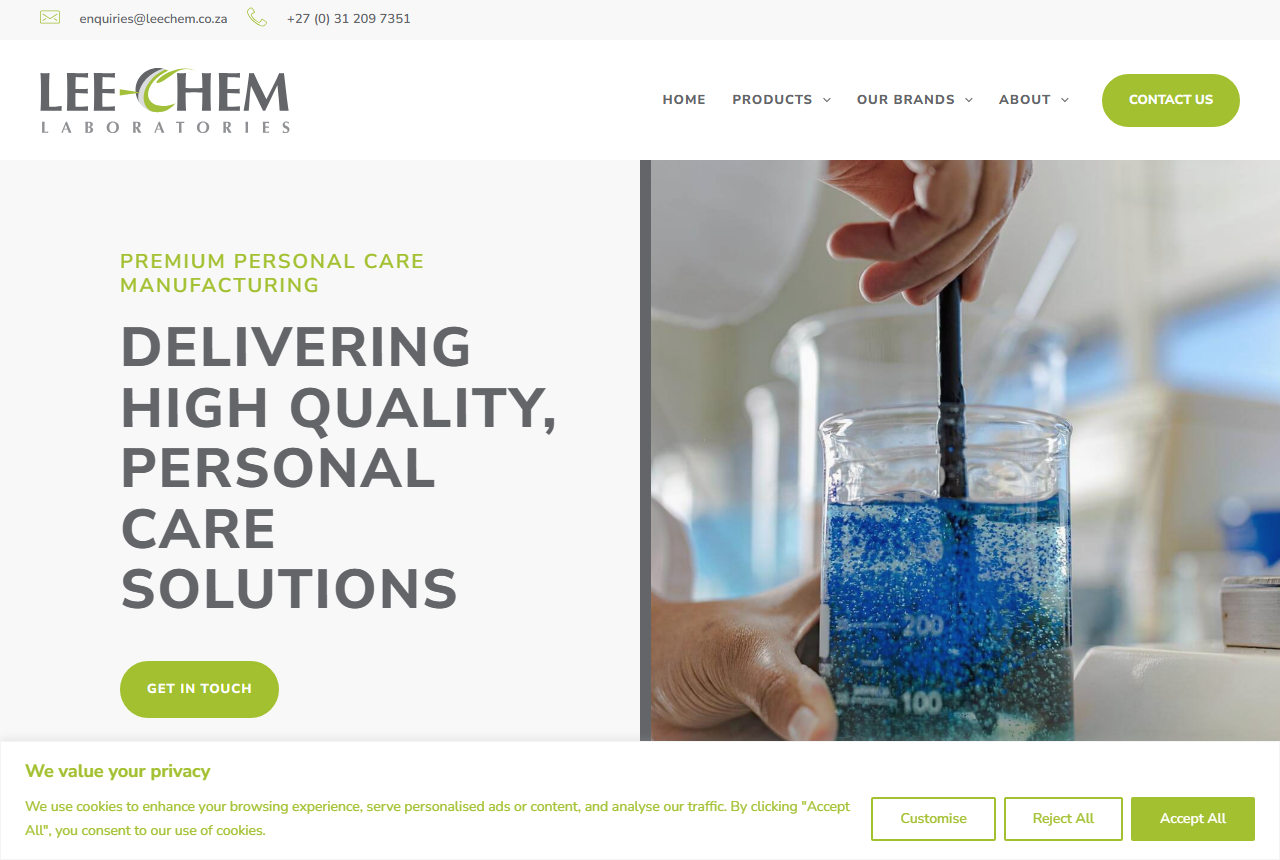
HQ: Bonela, Durban, KwaZulu-Natal · Type: Contract manufacturer, private & white label · Best known for: Hair removal, grooming and skincare since 1962
Lee-Chem describes itself as a personal-care specialist since 1962, making it the longest-established company on this list. It offers contract manufacturing and formulation development, private- and white-label solutions, end-to-end packaging from design to filling and labelling, and R&D and regulatory support. It states ISO 22716 cosmetics GMP compliance, alignment with EU cosmetics regulations, CTFA membership and cruelty-free certification. Its product focus is skin care, hair removal and grooming.
Six decades of operation and a named cosmetics-GMP position make Lee-Chem one of the better-evidenced entries here. A Durban base also suits brands exporting through the country’s busiest container port. The trade-off is that Lee-Chem also runs its own brands. That is common and not a red flag, but it does mean you should agree in writing how formula ownership, confidentiality and capacity allocation are handled. Capture note: a cookie banner sat along the bottom edge of the homepage but did not cover the hero.
7. Prime Product Manufacturing
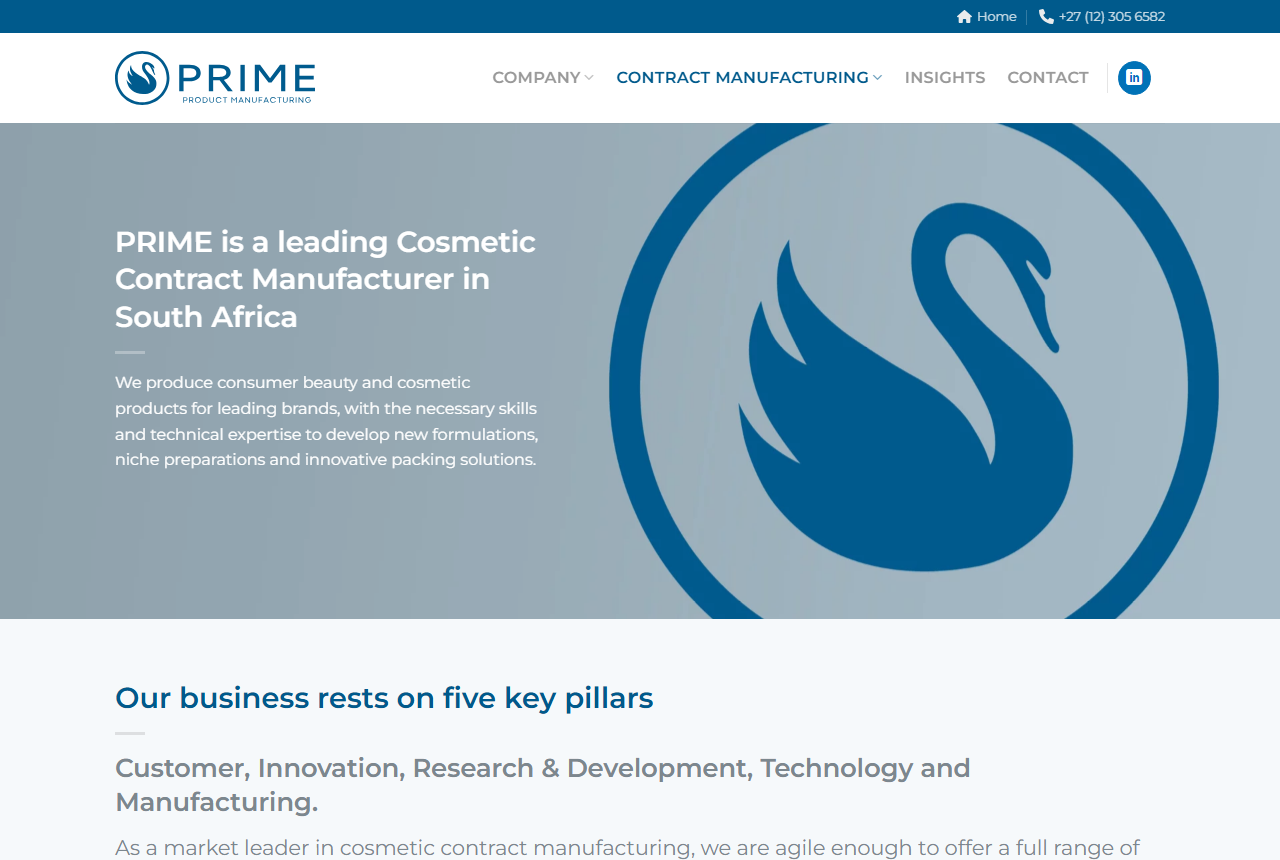
HQ: NECSA Eco-Industrial Estate, Pelindaba, North West · Type: Cosmetic contract manufacturer & packer · Best known for: Niche formats and hard-to-make products
Prime describes itself as an independent, medium-sized cosmetics and beauty contract manufacturer and packing company that specialises in “the products that no-one else can make”. It produces liquids, gels, creams, lotions and powders in tubes, bottles and jars, plus lip-balm kits, talcum powder, perfume and hot-fill products. It states ISO 22716 cosmetics GMP, SANS 1841 trade-metrology compliance, SANS 490 for alcohol-based hand rubs and B-BBEE Level 4 status. The Society of Cosmetic Chemists’ directory lists it as established in 1993, operating from a 13,000 m² facility and the first South African company to hold ISO 22716. Capture note: we photographed its contract-manufacturing page rather than the homepage, because it states the offer more directly.
If your product involves a hot-fill stick, a pressed or loose powder, or a fragrance, Prime is the most obviously equipped entry on the list. Its B-BBEE rating matters for anyone supplying South African retailers, whose procurement scorecards weight it. It is geared to established brands, so a very small first order may be a harder conversation here than at Alchem or DC Laboratories.
Visit Prime Product Manufacturing →
8. Proficos
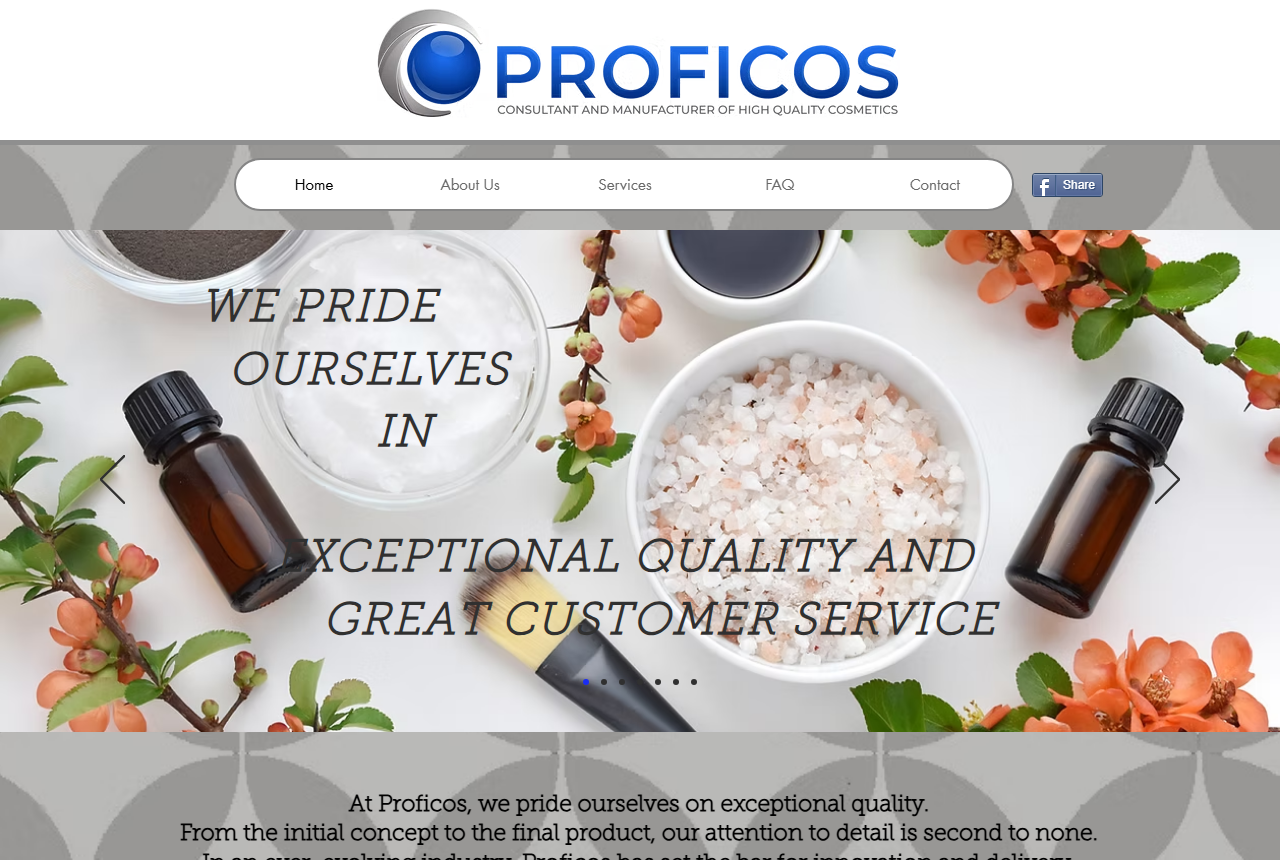
HQ: Sebenza, Edenvale, Gauteng · Type: Consultant & full-service contract manufacturer · Best known for: Colour cosmetics, cosmeceuticals and fragrance
Founded in 1991, Proficos describes a team of pharmacists, chemists, scientists and compounders offering R&D, formulation, packaging, filling and a full turnkey service, including support with EU certification and registration for export clients. It states that its site grew from 3,400 m² to 4,124 m² in 2021, adding clean-room technology and 300 m² of compounding space. It also reports a full colour-matching facility and a vegan-certified plant, plus satellite offices in the UK and China. Its categories include colour cosmetics, cosmeceuticals, skin and sun care, anti-ageing, bath and body, and fine fragrance.
Proficos is the clearest colour-cosmetics option in this set. In-house colour matching is what separates a lab that can build a shade range from one that can only fill someone else’s. The EU-registration support is also relevant if South Africa is your manufacturing base but Europe is your market. Beyond the vegan certification, the site does not name a GMP standard, so put that question first.
9. SDK Laboratories
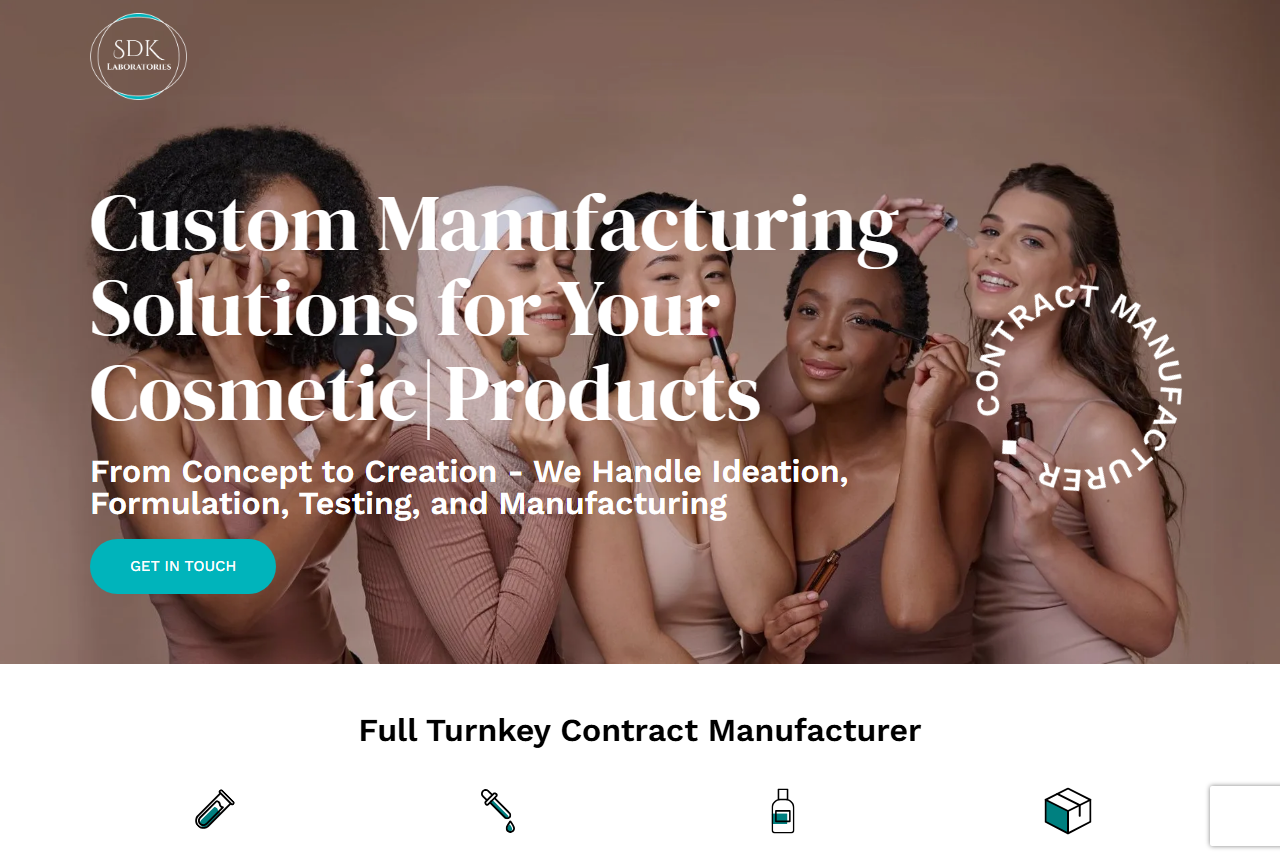
HQ: Randjespark, Midrand, Gauteng · Type: Full-turnkey contract manufacturer & private label · Best known for: The widest category spread on this list
SDK Laboratories describes itself as an independent, GMP-certified cosmetic and personal-care contract manufacturer running a 30,000 sq ft facility with in-house R&D and quality assurance. It covers ideation, formulation, testing, manufacturing, filling, packaging and branding support. Its categories take in health and intimate care, hair care, fragrances and mists, skin care and dermo-cosmetics, colour cosmetics, children’s products and therapeutic treatments. It states ISO 22716 accreditation alongside a SAHPRA certification for medical devices.
That SAHPRA medical-device credential sets SDK apart. If your roadmap includes an intimate-care product, a barrier cream or anything that edges towards a device claim, working with a site already inside that framework removes a later supplier change. The breadth is an advantage for a brand planning a multi-category range from one partner. The site publishes no founding year and no minimum order, so request both, along with client references in your category.
10. Serendipity Toiletries
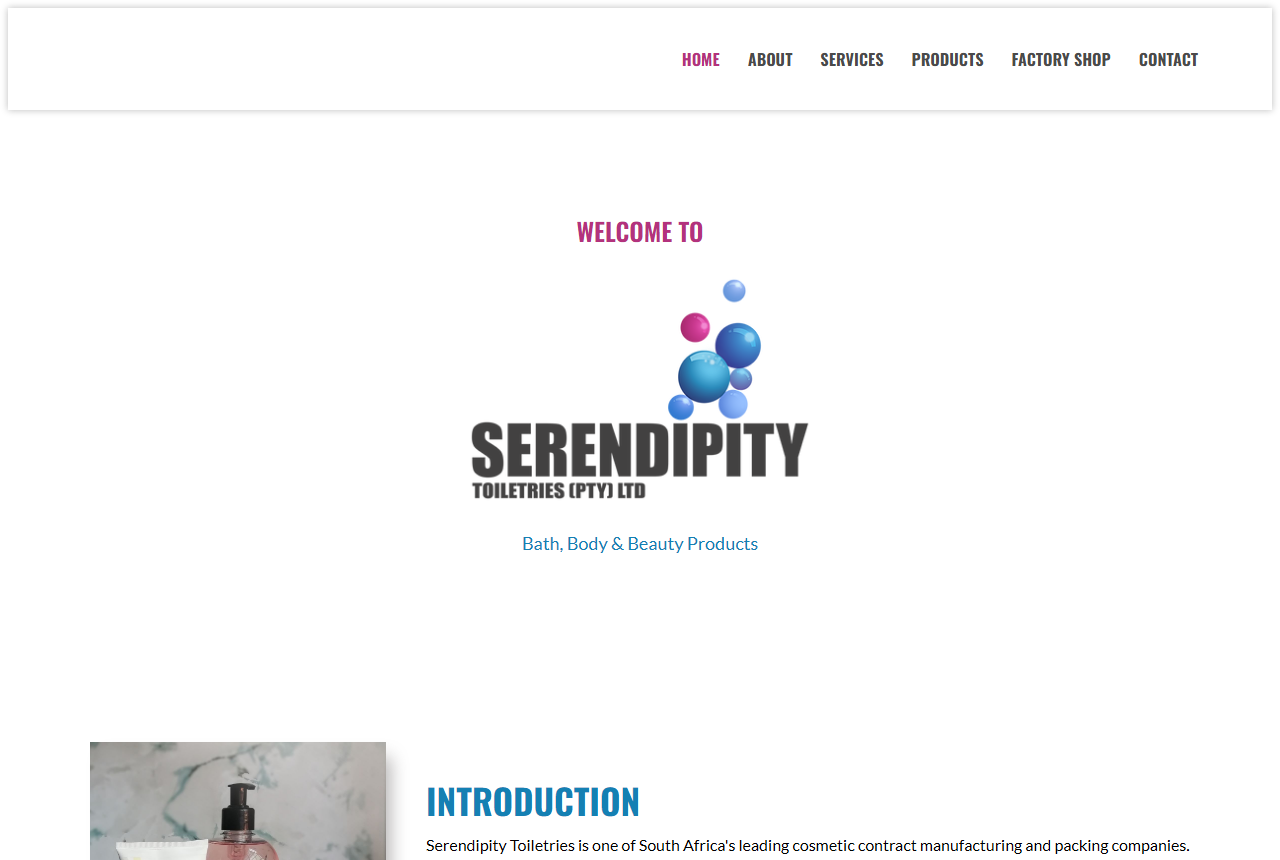
HQ: Silverton, Pretoria, Gauteng · Type: Contract manufacturer & packer · Best known for: Approved supplier to major South African retail chains
Serendipity calls itself one of South Africa’s leading cosmetic contract manufacturing and packing companies, making bath, body, beauty, sunscreen and anti-ageing products on a turnkey, concept-to-launch basis. It sources packaging locally and internationally. It names Ackermans, Clicks, Mr Price, PEP, Pick n Pay and Woolworths as retailers for which it is an approved manufacturer. It lists ISO 22716:2007, a SMETA 2-Pillar ethical-trade audit, Global Security Verification and the SANS 1841 e-mark.
No other company here matches that retail evidence, and it is the most relevant credential if your goal is a South African chain listing. A factory already approved by a retailer’s technical team shortens your own approval process, and the SMETA audit answers the ethical-sourcing questionnaire most chains now send. The flip side is a retail-scale operation, so check early whether your first order is large enough to be worth its planning slot. Sunscreen capability also means asking how it handles SANS 1557 SPF testing.
Visit Serendipity Toiletries →
Notable exclusions: who we looked at and left out
The companies that did not make the list are as informative as those that did, because several appear in other South African round-ups:
- White Label Cosmetics / Soulever Wellness (Montague Gardens, Cape Town): a genuine private-label manufacturer with filling, sachet and tube-sealing services. It was excluded only because a pop-up overlay covered the hero on two separate captures, so no clean verified screenshot was possible.
- Antiseptol International Company, AIC (Kempton Park): a family-owned contract manufacturer with more than 60 years in hair care, including relaxers, bleach powder and cream peroxide. It was excluded because a consent notice covered part of the page on capture, and because home-care products such as sanitisers and dishwashing liquid form a large part of its catalogue.
- Sastel Pharmaceuticals & Packing (Pretoria): a substantial independent contract manufacturer, but personal care sits beside health supplements, complementary medicines and food. It was excluded under the core-catalogue rule.
- Jasmar (Muldersdrift): a private-label manufacturer since 1986, but its catalogue is led by protectors and cleaning products for fabrics, leather and floors, with personal care secondary.
- Sunskin (Johannesburg): a well-known South African sunscreen formulator and manufacturer, but its website presents only its own consumer range, with no contract or private-label offer.
- CosQ Manufacturing (Epping, Cape Town): still cited as an independent contract manufacturer of cosmetics and toiletries, but its domain did not load on any attempt during this research window. We do not link readers to sites we cannot verify.
- Remancos (Strijdom Park, Randburg), DramaticaLabs (Kempton Park) and Zinplex Cosmeceuticals (Waltloo, Pretoria): all three captured cleanly and qualify on every screen. Remancos states ISO 22716 certification, DramaticaLabs publishes batches from 4 kg to 500 kg, and Zinplex runs a GMP-certified facility. They were held over only to cap the list at ten, and each is a strong candidate for the next update.
What to compare before you commit
A South African shortlist narrows quickly once you look beyond the homepage. Four questions separate the ten above in practice.
Which GMP claim, exactly? The ten companies above use three different formulations: a named ISO 22716 certificate, “follows ISO 22716 guidelines”, and ISO 9001 quality management. Only the first is evidence you can hand to a retailer or an export regulator. Ask for the certificate, the issuing body, the scope and the expiry date. Our guide to cosmetic GMP and ISO 22716 explains what each proves.
What does the retailer need? If a South African chain listing is the goal, the questions go beyond formulation. Is the factory already approved by that retailer? Does it hold the SANS 1841 e-mark for your pack sizes? Does its B-BBEE level help your supplier scorecard? A manufacturer that already supplies the chain has answered most of these once already.
Who owns the formula and the file? Several companies here sell their own brands or white-label ranges alongside contract work. That is normal, but it makes ownership terms essential. Settle in writing whether the formula is yours, who holds the product information file, and what transfers if you move supplier. The documents to request from a cosmetics manufacturer is the list we would send first.
Which market is the product really for? A South African compliance position is a good starting point, not a finished export file. Europe needs a CPNP notification and an EU responsible person. ASEAN markets need a local notification holder. A halal claim needs a certificate from a body your target market recognises. If you are sourcing from outside the region, apply the same method as in our guide to vetting an overseas cosmetics manufacturer.
For comparison with other English-speaking manufacturing bases, see our profiles of Australian and UK contract manufacturers. If halal certification is central to your brand, our list of halal cosmetics manufacturers in Malaysia covers the most established halal base in the industry. The full set of profiled companies is in the OEMHallmark manufacturer directory.
Frequently asked questions
Do cosmetics need to be registered before they can be sold in South Africa?
No. South Africa has no pre-market registration or notification system for cosmetics. Products are governed by the Foodstuffs, Cosmetics and Disinfectants Act 54 of 1972 under the National Department of Health. The detailed cosmetics regulations published in draft in 2016 had still not been finalised, as far as we could establish in September 2026. In practice, manufacturers and retailers rely on the CTFA’s Cosmetic Compendium, modelled on EU ingredient rules, together with SANS standards and the Cosmetic Advertising Code of Practice. A product making medicinal claims may fall under SAHPRA instead. Confirm the current position before launch.
Can a South African contract manufacturer make halal-certified cosmetics?
Yes, but it depends on the individual factory. South Africa has three halal certifiers recognised by Malaysia’s JAKIM: the South African National Halaal Authority (SANHA), the Muslim Judicial Council Halaal Trust and the National Independent Halaal Trust. Among the ten manufacturers profiled here, only Alchem Labs publicly describes its facility as halal-certified. Halal certification is issued per facility and per product, so ask any manufacturer for the certificate, the certifying body’s name and the product scope. Then check that body against the recognition list for your target market.
What is the minimum order for private label cosmetics in South Africa?
It varies more than in most manufacturing bases. At the small end, Alchem Labs publishes minimums from about 5 kg of bulk and DramaticaLabs from 4 kg. A 5 kg batch fills roughly 100 jars of 50 ml. Larger plants such as Serendipity Toiletries and Prime Product Manufacturing are built for retail volumes and rarely publish a figure. The bulk minimum is seldom the real constraint anyway: printed cartons, decorated bottles and custom closures usually carry their own minimums in the thousands. Ask each manufacturer for a minimum on every component, not just the formula.
How are sunscreens regulated in South Africa?
Sunscreens are cosmetics under the Foodstuffs, Cosmetics and Disinfectants Act, but their performance and labelling follow a dedicated national standard, SANS 1557, maintained with the CTFA. The standard sets how SPF and UVA protection must be tested and labelled, and restricts which UV filters may be used and at what concentration. Retailers commonly expect evidence of compliance before listing a sun product. If you are developing a sunscreen, ask the manufacturer which laboratory performs its SPF testing and whether the results are reported against SANS 1557. Budget for that testing separately from the formulation.
Limitations of this research
This article is desk research, not an audit. No factory was visited, no quality system inspected, no sample produced and no reference customer interviewed. Certifications, capacities, founding dates, retailer relationships and service scopes are as published by each company and are company-stated unless noted. Certificates expire and scopes change, so request current documents directly. The capture rule that filtered this list, a clean screenshot on a single day, is a proxy for a live, maintained web presence, not for manufacturing quality. At least one genuine manufacturer was excluded by it. The list also skews towards Gauteng because that is where most of the country’s contract capacity sits, not because of any regional preference. Prices, minimum orders and lead times are not compared because they depend on formulation, packaging and volume.
Sources and update history
Primary sources: the ten manufacturers’ own websites (reviewed 11 September 2026); the Foodstuffs, Cosmetics and Disinfectants Act 54 of 1972; the CTFA and its SANS 1557 sunscreen guidance; the ARB/CTFA Cosmetic Advertising Code of Practice (2023); the NRCS for legal metrology; SANHA and the MJC Halaal Trust for halal recognition; the Society of Cosmetic Chemists of South Africa contract-manufacturer directory; and ChemLinked for the status of the draft cosmetics regulations.
Update history: 11 September 2026: first published. Eighteen candidates researched, sixteen resolved, thirteen captured cleanly and qualified, ten profiled.
Written and researched by Evelyn Chong. Fact-checked by Marcus Tan. Company screenshots were captured from each manufacturer’s live website on 11 September 2026 and are reproduced for identification. Regulatory summaries are general information, not legal or regulatory advice. Verify current requirements with the National Department of Health, the CTFA or a qualified regulatory consultant before you commit to a market.